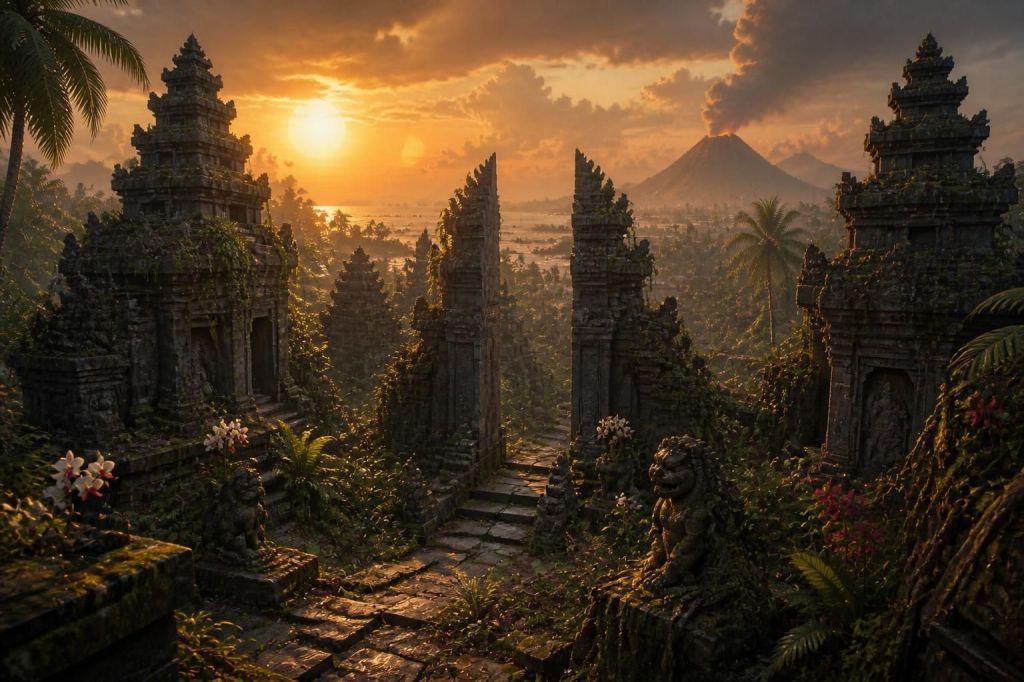
The Two Suns in the Approach to 2029, Kompas
By Mudhofir Abdullah, Kompas.com, October 4, 2026
On Thursday (October 1, 2026)—coinciding with Indonesia’s national Pancasila Sanctity Day—President Prabowo Subianto swore into office 18 officials in his seventh cabinet reshuffle, coming just two weeks after the sixth reshuffle. The national police chief changed, the foreign minister shifted roles, and a new coordinating ministry was created.
Some observers interpret this move as an attempt by President Prabowo to step out of the shadow of former president Joko Widodo. I view it differently. A Javanese proverb reminds us: ora ana ratu loro ing sakjagad (there cannot be two kings in one world). Yet, our politics today reveal two suns shining simultaneously; they need each other, yet are quietly preparing their own respective orbits in the lead-up to Indonesia’s 2029 presidential election.
In political science terms, this stance is known as “hedging”—maintaining mutual dependence while simultaneously preparing an independent exit strategy. The three events of this past week should be viewed as a single picture, not as unrelated events.
These three events are the cabinet reshuffle, Joko Widodo’s political campaign tour with the Indonesian Solidarity Party (PSI), and the Constitutional Court hearing on the eligibility requirements for the 2024 candidacy of Widodo’s son, and President Prabowo’s current vice-president, Gibran Rakabuming Raka. The frequency of the reshuffles itself conveys a message. Seven reshuffles in two years signify more than just a routine refresh; they indicate a coalition that is constantly being renegotiated.
Dudung Abdurachman, for instance, had headed the office of the president’s staff for only five months before being boosted into the key role of Coordinating Minister for Political and Security Affairs.
Stronger Rotation
There are at least three reasons why the network often dubbed the “Solo Gang” is strengthening rather than weakening. First, departing national police chief Listyo Sigit Prabowo has not exited the sphere of power; he has moved deeper into it. After leading the Indonesian National Police for five years and eight months, he now heads the office of the president’s staff—a pivotal hub that oversees priority programs directly for the President.
He first rose to prominence while serving as the chief of police in the hometown of former present Joko Widodo during his term as mayor. He has been shifted from commanding the security apparatus to orchestrating the agenda.
Second, former energy and minerals minister Bahlil Lahadalia was not sidelined but promoted. He now serves as the Coordinating Minister for Downstreaming and Energy Transition while retaining the Ministry of Energy and Mineral Resources (ESDM) portfolio. Energy, mining, and downstreaming constitute a core of the national economy and a source of political resources.
Bahlil also leads the Golkar Party; a party acolyte of his, Nusron Wahid, retained his position even though four individuals identified by the anti-corruption commission (KPK) as Bahlil’s close associates had been named as suspects in a bribery case involving the administration of land-use rights (HGB).
Third, other key nodes remain intact. Raja Juli Antoni, the secretary-general of PSI, kept his portfolio as Minister of Forestry despite his ministry facing scrutiny. Outside the palace, Joko Widodo actively works to boost PSI. This network now has a foothold both inside and outside the palace.
The only figure truly ousted was Pratikno—a technocrat lacking a political base—though he was subsequently appointed chair of the Presidential Advisory Council the following day. While Pratikno had been a close associate of Joko Widodo for a decade, he commands neither a mass following, a political party, nor any of the security apparatus. What was lost was symbolic; what was gained was substantive.
National Police Chief and the Orbit of the First Sun
So why did Prabowo proceed to replace the national police chief? This is where the “first sun” asserted its orbit. Suyudi Ario Seto—born in West Java’s Pandeglang region in 1973 and a 1994 Police Academy graduate—is a detective-track officer whose career peaked under Prabowo, who appointed him head of the national anti-narcotics agency (BNN) in August 2025.
Given his age, he is a potential head of the Indonesian National Police (Polri) well beyond the 2029 elections. Before the House of Representatives’ oversight Commission III, he described the role of national police chief as the pinnacle of responsibility rather than the pinnacle of a career.
At the same time, Dudung—a former chief of staff of the army—now coordinates the political and security sectors. The government’s two pillars of coercion are now in the hands of individuals personally selected by President Prabowo.
The position of national police chief has always been more coveted than any ministerial post. The Indonesian National Police (Polri) maintains a presence down to the village level, controls security intelligence, and wields legal leverage over local elites. During the 2024 regional elections, the label “Brown Party”—a reference to the brown police uniform—emerged following allegations by various politicians that the national police force was being mobilized to secure victories for specific candidates.
While these allegations were never proven in court, they provided insight into public perception of the police’s strategic role in the electoral process. Installing a hand-picked national police chief effectively secures a crucial pillar for the road to the 2029 presidential election.
The police force has also recently flexed its muscles; investigators from the police corruption crime corps (Kortas Tipidkor) searched the Sentul residence of the deputy assistant attorney general for special crimes, Febrie Adriansyah—an action that preceded Febrie’s resignation and his designation as a suspect. The Attorney General’s Office subsequently announced the discovery of 74 kilograms of gold and Rp 543 billion in cash.
Curiously, the leadership of the Attorney General’s Office remained untouched in the reshuffle. It is only natural for the public to question whether the deciding factor was accountability or merely a balancing of power between institutions.
As the 2029 presidential election looms over the horizon, the risk of law enforcement acting in alignment with the power landscape is one that cannot be underestimated.
Meanwhile, the “second sun” is not sitting idle. Joko Widodo already holds a PSI membership card and is scheduled to be inaugurated as chair of the party’s board of trustees in November. Although PSI’s electability currently stands at just 2.3 percent (Poltracking August 2026 poll), the message is clear: Joko Widodo does not want his influence to rely solely on the president’s largesse.
Prabowo keeps Joko Widodo’s network inside his cabinet under control, while Joko Widodo builds an external vehicle to maintain leverage. They keep each other close, yet remain wary of one another.
The picture is made complete by the Constitutional Court hearing examining the authenticity of the educational qualifications of vice president Gibran Rakabuming Raka. Whatever the eventual ruling, Gibran serves as the bridge between these two “suns.” If that bridge falters, this hedging strategy could devolve into open rivalry long before 2029.
Among all these maneuvers, one party is rarely factored in: the public. Purbaya Yudhi Sadewa was removed as Finance Minister, while a minister whose inner circle is under investigation by the anti-corruption commission (KPK) remained in office.
The criteria for the reshuffle has been unclear: was it performance, integrity, or political loyalty? When positions are retained due to party calculations and elite networks, the public is right to ask whether the cabinet serves the people or the ruling coalition.
Public trust in the national police—which hit a low point in September 2025 before recovering (Kompas R&D June 2026 poll)—demonstrates that trust is built through consistency, not the rotation of personnel. A presidential cabinet is fundamentally a tool to serve the people, not a chessboard for arranging orbits of power.
The cabinet belongs neither to political parties nor to elites calculating their prospects for the next two years. If ministerial seats are determined by 2029 electoral calculations and the national police chief’s position by the need to secure the election, who is this government actually working for?
Mudhofir Abdullah is a Professor and Senior Researcher at Raden Mas Said National Islamic University (UIN) in Surakarta.
This post is based on https://nasional.kompas.com/read/2026/10/04/07030071/dua-matahari-menjelang-2029.
Related:
- https://www.tempo.co/politik/reshuffle-kabinet-prabowo-subianto-menggusur-orang-jokowi-2298740
- https://www.tempo.co/politik/reshuffle-kabinet-prabowo-menggeser-orang-jokowi-2298736
- https://www.tempo.co/politik/prabowo-reshuffle-listyo-sigit-prabowo-2298739
- https://open.spotify.com/episode/6DeWiiyNMz8X84SN3pET0J
- https://www.tempo.co/politik/reshuffle-kabinet-prabowo-orang-jokowi-2299767
- https://open.spotify.com/episode/66jyfVScrwAV0ZnItVUxhq


Leave a Reply