
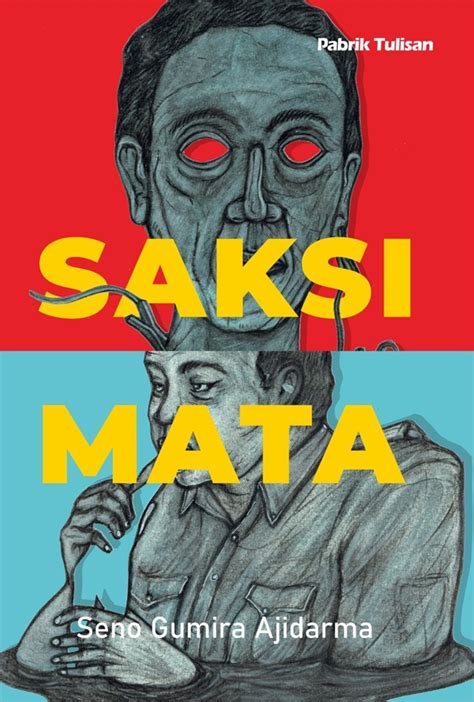
The Eyewitness
A Short Story by Seno Gumira Ajidarma (1992)
The eyewitness arrives with no eyes.
He stumbles into the center of the courtroom, hands groping at the air.
From the hollows where his eyes once were, blood gushes—a red so intense that no other red can compare to the color of the blood flowing slowly and continuously from those sockets.
The blood soaks his cheeks, his shirt, his trousers and his shoes, trickling onto the courtroom floor—a floor that was actually scrubbed clean with disinfectant, the scent of which still lingers for the spectators. The crowd now breaks into an uproar, shouting with surging emotion, while journalists—ever eager to capture sensational events—snap photos of the eyewitness from every conceivable angle, even bending low and crouching, their camera flashes making the atmosphere feel more and more heated.
“Outrageous!”
“Madness!”
“Savage!”
Quickly regaining his composure, His Honor the Judge raps his gavel. With the last vestiges of his authority he tries to calm the situation.
“Order, everyone! Order! Anyone disrupting the proceedings will be removed from the courtroom!”
Fortunately, the audience can be calmed. They are also eager to learn what has actually happened.
“Eyewitness.”
“Yes, Your Honor.”
“Where are your eyes?”
“Someone took them, sir.”
“Took them?”
“Yes, Your Honor.”
“You mean removed in an operation?”
“No, sir—removed with a spoon.”
“Huh? With a spoon? Why?”
“I don’t know why, Sir, but they said they wanted to make tengklèng with them.”(1)
“Make tengklèng? That’s outrageous! Who said that?”
“The one who took my eyes, Sir.”
“Obviously idiot! I mean, who took your eyes with a spoon?”
“They didn’t say their name, Sir.”
“You did not ask moron?”
“No, Sir.”
“Listen carefully stupid—I mean, what did they look like?
Before your eye was scooped out with a spoon—supposedly to be made into tengklèng or maybe added to a goat soup—your eye was still in their sockets, weren’t they?”
“Yes, Your Honor.”
“So you saw what they looked like, didn’t you?”
“Yes, Your Honor.”
“Please describe what your eyes saw—the ones that have by now probably been eaten by those tengklèng enthusiasts.”
The eyewitness falls silent for a moment. Everyone in the courtroom holds their breath.
“There were several people, Sir.”
“How many?”
“Five, Sir.”
“What did they look like?”
“I didn’t have time to examine them, Sir; my eyes got taken too quickly.”
“Do you remember what they were wearing, perhaps?”
“One thing for sure was they were in uniform, Sir.”
The courtroom erupts into noise again. A sound like the swarming of a thousand bees.
***
The judge taps his gavel. The roaring subsides.
“Army uniforms, you mean?”
“No, Sir.”
“Police?”
“Not them either, Sir.”
“Civil Defense, perhaps?”
“That’s it, Sir—the one that’s all black like in the movies.”
“Were their faces covered?”
“Yes, Sir; only their eyes were visible.”
“Aha, I know! Ninjas, right?”(2)
“That’s the one, Sir—ninjas! They were the ones who took my eye with a spoon!”
Again the audience breaks into an uproar, whispering and gossiping like shoppers at a coffee shop. Again and again His Honor the Judge has to bang his gavel to quieten the crowd.
Blood continues to drip—slowly but continuously—from the black hollows where the eyewitness’s eyes were; he stands motionless as a statue in the courtroom. Blood pools on the floor—scrubbed clean with disinfectant—filling the room until it overflows out through the doorway, cascading down the stairs and on into the courtyard.
Yet, no one sees it.
“Eyewitness.”
“Yes, Your Honor.”
“By the way, why did you stay quiet when your eye was being gouged out with a spoon?”
“There were five of them, sir.”
“Surely you could have screamed, or thrown something within reach—done something—so the neighbors would hear and come to help you. You live in a cramped alleyway where even a whisper next door can be heard; why didn’t you make a noise?”
“Well, it happened in a dream, sir.”
The crowd laughs. The Judge pounds his gavel angrily again.
“Settle down, please! This is a courtroom, not a comedy show!”
***
The courtroom feels stifling. People are sweating, yet they refuse to leave. The blood from the courtyard flows all the way into the parking area. The Judge resumes his questioning.
“You said before it happened in a dream. Do you mean the event unfolded with the rapid, surreal quality of a dream?”
“No, sir—not like a dream; it actually happened in a dream. That’s why I didn’t say a word when they were about to scoop my eyes out.”
“Are you serious? Do not play games with me; you will need to testify under oath.”
“I am absolutely serious, Sir; I just stayed quiet because I thought it was all happening in a dream anyway. I even laughed, Sir, when they said they were going to turn them into tengklèng.”
“So, in the view of the eyewitness the entire removal of the eyes happened only in a dream.”
“It’s not just my view, Sir; it really did happen in a dream.”
“You could just be mad, you know.”
“But this can be proved, Your Honor; there are many witnesses who know I was asleep all night long and that while I was asleep nobody disturbed me.”
“So, it must have happened in a dream, is that right?”
“Yes, Your Honor.”
“But when you woke up, your eyes were gone?”
“That’s right, Your Honor. That’s what confuses me. It happened in a dream but when I wake up it turns out to be true, see?”
The Judge shakes his head unable to comprehend.
“Absurd,” he mutters.
The flowing blood has reached the main road.
***
Can an eyewitness who no longer has their eyes still testify? Of course they still can, thinks His Honor the Judge; surely their memory doesn’t vanish along with their eyes?
“Eyewitness.”
“Yes, Your Honor.”
“Are you still able to testify?”
“I am ready, Your Honor. That is why I came to the court first rather than going to an eye doctor, Sir.”
“Eyewitness, do you still remember everything that happened, even though you don’t have any eyes any more?”
“Yes, Your Honor.”
“Do you still remember how the massacre happened?”
“Yes, Your Honor.”
“Do you still remember how they fired wildly and people toppled over like banana trees cut down?”
“Yes, Your Honor.”
“Do you still remember how the blood flowed, how people groaned, how those left half-dead were stabbed to death with knives?”
“Yes, Your Honor.”
“Hold those memories close because even though there were many eyewitnesses, not a single one is willing to testify in court—except for you.”
“Yes, Your Honor.”
“Once again, eyewitness, are you still willing to testify?”
“Yes, Your Honor.”
“Why?”
“For the sake of justice and truth, Sir.”
The courtroom breaks into uproar. Everyone applauds, including the prosecutor and the defense attorney. There are many who cheer. A few start to call out campaign slogans.
His Honor quickly pounds his gavel.
“Hush! There is to be no campaigning here!” he says sternly.
“Today’s hearing is adjourned; it will resume tomorrow to hear the testimony of the Eyewitness—who no longer has any eyes!”
With a final burst of energy, he strikes the gavel again but it snaps in two. The people laugh. Reporters—forced to write minor stories because they lack the power to write major ones—quickly snap photos. Click-click-click-click! His Honor is immortalized holding a broken gavel.
***
On the way home, His Honor the Judge talks to his driver.
“Just imagine—a person having to lose both their eyes for the sake of justice and truth. As a servant of the law, shouldn’t I be the one who has to make a greater sacrifice?”
The driver wants to reply with something that will dispel his guilt—a phrase like, “Justice is not blind.”(3) But His Honor the Judge has already fallen asleep in the middle of the maddening traffic jam.
The blood continues to flow—slowly, yet ceaselessly—along the main road until it floods the city. The blood soaks every corner of the city, even creeping up the high-rises until no place remains unstained by its crimson color. Yet, miraculously, not one person sees it.
As night falls, the Eyewitness—who no longer has any eyes—prays before going to sleep. He prays that life in this mortal world will be just fine, that everything will run smoothly and that everyone will be happy.
In his sleep he dreams over and over: five figures in ninja uniforms tear out his tongue—this time using a pair of pliers.
Jakarta, March 4, 1992
Footnotes:
(1) Tengklèng – A dish traditionally from Surakarta; a type of goat-bone soup with scraps of meat (tètèlan) still clinging here and there. It was a favorite of the writer Danarto, who introduced it to the author of this short story. Sometimes, the “bones” in question included the goat’s skull complete with its eyes.
(2) Ninja – Derived from ninjutsu, the term for the art of espionage in the Japanese tradition. It was first taught by Otomo no Hosoto, a prominent warrior from Omi Province (now Shiga Prefecture), to serve Prince Shotoku. The art of espionage involved covert operations into enemy territory to steal documents, poison targets or carry out sophisticated assassinations. Another theory suggests the practice was introduced by Xu Fu, who arrived from Qin, China, in 221 to 206 BC. Ninjutsu flourished in Japan during the Sengoku period (1467–1586) when warlords employed groups of ninjutsu practitioners—known as ninja—in their operations. Wandering samurai from Iga Province (present-day Mie Prefecture) near Kyoto and the Koga region of Omi Province refined the techniques of the Iga and Koga schools. At one time, there were 49 ninjutsu schools in Japan. These fearless ninja possessed knowledge of astronomy, topography, and history and were also skilled at mimicking animal sounds. Naturally, they were adept at bypassing night guards and escaping entrapment. As spies, ninja lived lives shrouded in secrecy. Knowledge about ninjutsu, originally passed down orally, was first compiled by Fujibayashi Samuji in 1676 into four handwritten volumes titled Mansen Shukai. Spoons and pliers are not recorded there as specialized ninja weapons—likely because the ninja in this short story is actually a fake. Ninjas come to be popular because of their frequent portrayal on the silver screen, from Japan to America. (Source: “ninja-ninjutsu” entry in the Encyclopaedia of Japan—accessed in 1992 at the Kompas Library.)
(3) – This driver must have often watched the television series Dark Justice which used to air on television channel RCTI every Saturday night. The show featured a judge character who would go undercover to hunt down crooked defendants who managed to evade justice in court. This character would also frequently say, “Justice is not blind.”
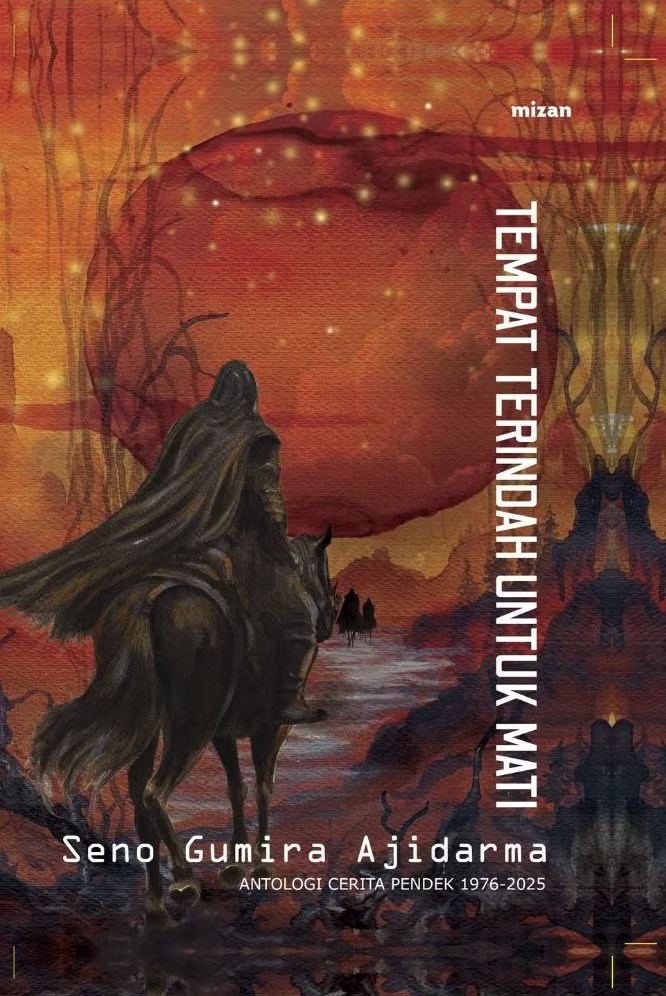
The short story “The Eyewitness” (Saksi Mata) is published in: Seno Gumira Ajidarma, Tempat Terindah Untuk Mati: Antologi Cerita Pendek 1976-2025 [The Most Beautiful Place to Die: Short Story Anthology 1976-2025], PT Mizan Pustaka, Bandung, 2026. Photo credit: Getty Images, Andrew Merry, Colourful traditional textiles, Tais market Timor Leste.
Related:
- Chega! The final report of the Timor-Leste Commission for Reception, Truth and Reconciliation, Jakarta 2013 (Atau di sini.)
- https://www.tempo.co/politik/-aliansi-keterbukaan-sejarah-desak-pemerintah-cabut-penulisan-ulang-sejarah-2059178
- https://en.wikipedia.org/wiki/Santa_Cruz_massacre
- https://www.gramedia.com/products/tempat-terindah-untuk-mati




Leave a Reply