Jogja Art+Books Festival Becomes Platform for Opposition to Militarism
By Shinta Maharani for Tempo.co, October 5, 2026
A group of children stand atop a mound of human skulls. Flanked by coconut fronds they appear to be listening to an adult recounting a story. The black-and-white image of children is part of the “Eyewitness” (Saksi Mata) series—a collection of woodcuts by artist Redi Murti—displayed at the Jogja Art+Books Festival (JABFest) 2026 at The Ratan Gallery, held from September 30 to October 12, 2026, in Jogjakarta, Indonesia.
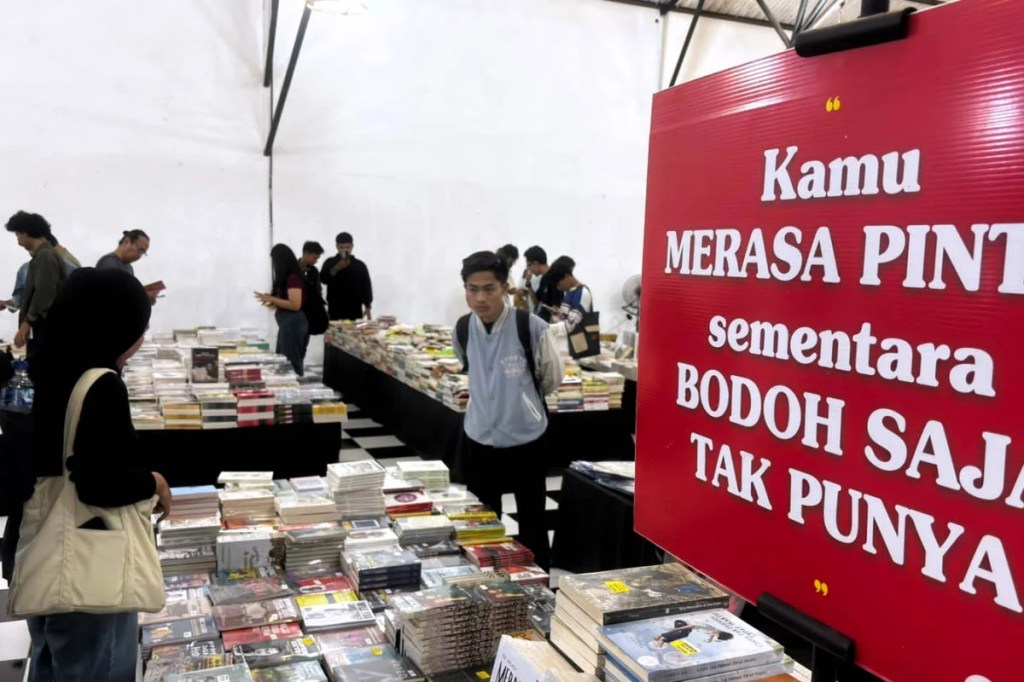
The Jogja Art+Books Festival brings together hundreds of independent publishers, visual artists, musicians, and social justice activists. This year’s book festival is marked by strong criticism of the rise of militarism under the government of Indonesia’s current president Prabowo Subianto and vice president Gibran Rakabuming Raka. Involving at least 100 independent publishers, this year’s festival theme is “Eyewitness (Saksi Mata): When Shallowness Reigns, Depth Has to Go to Work.”
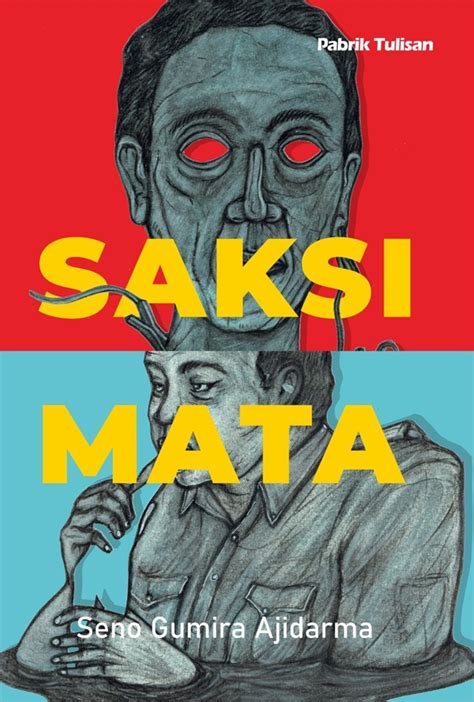
The theme is closely linked to the short story “Eyewitness” (Saksi Mata) by writer and critic Seno Gumira Ajidarma. Saksi Mata recounts the events of the Santa Cruz tragedy in what was at the time Indonesia’s province of East Timor (now independent Timor-Leste) on November 12, 1991—an incident involving the shooting and mass killing of hundreds of pro-independence East Timorese demonstrators by Indonesian military forces at Dili’s Santa Cruz cemetery.
Redi visually reconstructs Seno’s short story collection using allegorical and satirical approaches, aligning with the writer’s magical realism style to depict the violence, cruelty, and human suffering amid the military conflict in Timor-Leste. The short story “Eyewitness” (Saksi Mata) was first published in 1994 as an act of resistance against the silencing of the press—using literature as the medium—following the Santa Cruz massacre. In 1991 after reporting on the Santa Cruz incident, Seno was removed from his position as managing editor of current affairs magazine Jakarta Jakarta. From then on, he voiced the truth through literature. He became known for the saying: “When journalism is silenced, literature must speak.”
According to the head of program for JABFest 2026, Dodo Hartoko, the images of military brutality featured in the work represent a political stance—a form of resistance against state violence. In the context of the Santa Cruz tragedy, history has been written based on the official narrative of the New Order government. “History is written by the victors—the rulers. Art works to counter that silencing,” says Dodo, when interviewed by Tempo magazine at the Ratan Gallery on Wednesday, September 30, 2026.
The book festival has been held four times since 2023. This year’s is heavily marked by social and political criticism of the Prabowo-Gibran government which has been described as authoritarian and militaristic. The organizers’ political position is evident the moment visitors enter the festival grounds.
Consider the entrance of the Ratan Gallery which displays a red-colored art installation bearing the words: “Art is long-lasting, regimes are only temporary.” Beyond Redi Murti’s woodcut prints, the theme of resistance against militarism appears in two paintings by artist Agung Kurniawan. The first work is titled “Mysterious Shooter with Purple Color on an Open Coffin” (Penembak Misterius dengan Warna Ungu pada Keranda Terbuka). The second work is titled “His Excellency Prabowo as a Source of Inspiration for Contemporary Indonesian Painting”.
The first painting depicts the “mysterious shootings”—referred to as Petrus—that occurred during the New Order government of President Suharto. A burly man in uniform is depicted opening a coffin that contains a corpse wrapped in a purple shroud.
Through this piece Agung conveys a message about the New Order’s fascist culture, suggesting it persists under the current regime. According to Dodo, the work is closely linked to Agung’s previous art on the topic of Petrus—which was exhibited in Poland, a country with its own dark history of human rights violations. In the second work, Agung depicts human figures bearing Prabowo’s face; one figure wears a white fez cap (peci) and a white shirt featuring Prabowo’s image while another wears glasses and a shirt also displaying Prabowo’s face.
All the figures Agung create possess imperfect bodies; one, for instance, has arms that reach all the way to the floor resembling snakes. The painting illustrates the fascism of the Prabowo regime that ends in state centralism backed by the military and the corporate bosses. Agung believes the painting reflects an Indonesian situation not very different from that of the New Order era.
Some view Prabowo as a noble figure, much like Suharto—who has been feted as the “Father of Development” at the height of New Order power. “We are heading into the same dark place. The history of the New Order—steeped in militarism—is repeating itself,” says Agung.
The painting, continues Agung, represents an attempt to revive the style of pre-Renaissance artists who depicted saints and the Divine as the primary source of inspiration and creativity. Agung presents a work steeped in sarcasm, employing metaphor and humor through the glorification of the figure of Prabowo.
JABFest 2026 curator, Ayos Purwoaji, explains that the curatorial team has been developing the festival since October 2025. For each event the team highlights a literary work as the central theme. Last year, for instance, the committee featured a work by author Kunto Wijoyo titled “The Train That Departed in the Morning” (Kereta yang Berangkat Pagi Hari).
This year, the team selected the work by Seno Gumira titled “Eyewitness” (Saksi Mata) which is set to be republished. From this starting point the team refined the festival’s theme as “State violence, including the rampant repression of the citizenry,” Ayos says.
According to Ayos, a key strength of the festival is that it goes beyond literature to include visual arts exhibits. Participating artists respond to the theme of state violence in a variety of ways. Military brutality is also depicted in artworks addressing the 1965 massacres illustrating soldiers’ violence against individuals affiliated with or suspected of sympathy for the Indonesian Communist Party (PKI). One example is a painting by Balinese artist Dewa Ngakan Made titled HANA TAN HANA which explores the violence that raged during the 1965 tragedy.
The theme of intensifying militarism also features in a number of seminars involving researchers such as well-known academic Made Supriatma. The festival will also discuss a book about Trubus Sudarsono, an artist associated with the pre-1965 era People’s Cultural Institute (Lekra)—an organization which had links to the PKI. Titled “Trubus, Where Are You? 1926-1966” (Trubus, di Mana Engkau? 1926–1966), the book recounts Trubus’s story as told by his two children, with activist and researcher Ita Fatia Nadia presenting a discussion of the book.
The organizing committee has also involved human rights activist Maria Catarina Sumarsih, known as a key figure behind the “Thursday Action” (Aksi Kamisan) demonstrations. The “Thurday Action” is a long-running weekly peaceful protest each Thursday, with participants wearing black and carrying black umbrellas, which takes place opposite the official presidential office, Merdeka Palace, in central Jakarta and has consistently called for the resolution of unresolved past gross human rights violations. “Involving so many activists demonstrates our political stance,” says Dodo Hartoko, founder of JABFest 2026.
Shinta Maharani is a graduate of the International Relations Department at National Development University (UPN) Yogyakarta. She has served as a Tempo correspondent for the Yogyakarta region since 2014 and focuses on issues of gender, diversity, minority groups and human rights.
This post is based on https://www.tempo.co/teroka/jogja-art-festival-buku-kritik-militerisme-prabowo-gibran-2298752.


Leave a Reply