Not the Representatives of the Corrupt
By the Kompas Editorial Board, July 5, 2017
JAKARTA, July 5, 2017. Members of the Indonesian House of Representatives are not the representatives of the corrupt. The supposedly honorable representatives of the people are paid with the people’s money.
The House Committee of Inquiry into Indonesia’s Corruption Eradication Commission plans to go on safari to meet convicted corruption offenders in a number of prisons throughout Indonesia and this has deeply unsettled the citizens’ sense of justice, as taxpayers.
According to the committee’s deputy chair Representative Risa Mariska from the Indonesian Democratic Party of Struggle, “the committee wants to find information on how they felt about their treatment as witnesses, suspects and convicts of corruption offenses.” Mariska represents the 6th West Java electoral district covering the regencies of Bogor and Bekasi. She received 25,578 votes.
It is easy to find corruption convicts in prison. They will be overjoyed to tell the inquiry about how the commission behaved when they were questioned, their experience in custody, their belief they were the victims of a conspiracy, their feelings of being entrapped and any amount of other mistreatment.
Armed with this information—and driven by a coalition that supports the government, the inquiry will collect ammunition for dismantling the anti-corruption body. The aim of the House inquiry at the very least can be seen from the statement of House deputy speaker Fahri Hamzah from the Prosperous Justice Party who represents West Nusa Tenggara: to review government commissions such as the Corruption Eradication Commission. By ‘review,’ he clearly means disbanding the commission, limiting its authority, or transforming it into an ad hoc agency.
The inquiry’s real aim is obvious: to undermine the Corruption Eradication Commission. The declaration of some politicians that the inquiry is aimed at strengthening the commission does not have a shred of empirical evidence. From the beginning, some House of Representatives politicians have been uncomfortable with steps taken by the commission to eradicate corruption from the country. There are Representatives on trial as well as party chairs and businesspeople who have been arrested. The commission is certainly not without fault. But the way to fix these mistakes is not to exercise the House’s right to establish inquiries of dubious legitimacy.
Members of the inquiry should realize they are representatives of the people, not representatives of the corrupt. Corrupt behavior by members of the government violates the civil and economic rights of the people. The behavior of constitutional judges who trade in Constitutional Court decisions to enrich themselves is a betrayal of the law. It is the victims of this corrupt behavior that the inquiry should be listening to and not the perpetrators of the corruption.
Unfortunately, President Joko Widodo’s pronouncements have been too weak in defending the commission. President Widodo has said only that he wants to strengthen the commission. However, President Widodo is apparently not able to intervene in the inquiry because it is a constitutional right of the House of Representatives. The fact is the direction taken by the House inquiry can only be seen as intended to delegitimize the Corruption Eradication Commission.
This post is based on “Bukan Perwakilan Koruptor” [Not the Representatives of the Corrupt], Kompas Editorial, July 5, 2017 https://kompas.id/baca/opini/2017/07/05/bukan-perwakilan-koruptor/.
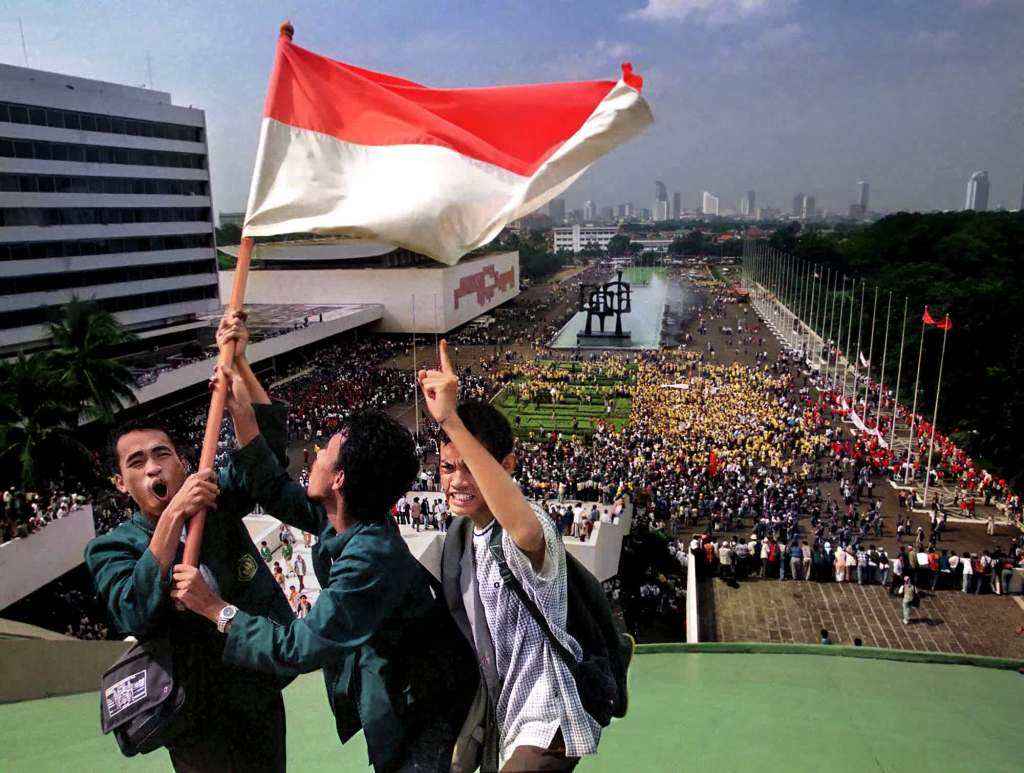
Featured image credit: Paula Bronstein www.paulaphoto.com/. University students protest on top of Indonesia’s capitol building in Jakarta after President Suharto resigned May 21, 1998, “This photographer has spent decades covering war. But she doesn’t focus on the front lines”, Photographs by Paula Bronstein, Story by Tristen Rouse, CNN, September 7, 2024 https://edition.cnn.com/interactive/2024/09/world/paula-bronstein-retrospective-cnnphotos/.



Leave a Reply