Board of Peace, Mining Concessions, and Hegemony Over Islamic Community Organizations
By Firdaus Cahyadi for Islami.co, March 2, 2026
It is understandable that Islamic community organizations (or ormas) were angry with the government’s decision to join the Board of Peace (BoP) for Gaza, initiated by Israel’s ally, the United States. Even the Indonesian Ulema Council (MUI) has strongly criticized the government’s decision. However, everything changed after 16 prominent leaders from these Islamic organizations visited the presidential palace when summoned by Indonesia’s President Prabowo Subianto.
President Prabowo’s meeting with the 16 leaders to “align perceptions” regarding Indonesia’s involvement in the BoP was not just going to be about foreign diplomacy. Viewed through the lens of Italian political thinker Antonio Gramsci, “aligning perceptions” is the implementation of the concept of hegemony. According to Gramsci, power does not operate solely through the barrel of a gun; it operates through hegemony.
Hegemony is a form of moral and intellectual leadership that makes people agree to be ruled, even if what they agree to conflicts with their own interests. In the Indonesian context, hegemony is no longer an abstract concept. It is now manifest in the phrase “aligning perceptions” regarding Indonesia’s involvement in the BoP.
The Long Road of Hegemony over Islamic Organizations
Indonesia’s two largest Islamic community organizations Nahdlatul Ulama (NU) and Muhammadiyah were among the 16 Islamic organizations that summoned to meet with President Prabowo Subianto at the palace. As the largest Islamic organizations, their role in approving government policies without public consultation regarding signing up to the BoP cannot be underestimated.
Before these organizations were ultimately “hegemonized” by Indonesia’s involvement in the BoP, NU and Muhammadiyah had already received coal mining concessions. This occurred despite their previous criticisms of mining activities that damaged the environment. In some areas, the two organizations had even offered political resistance alongside the communities affected by mining. The question now is: Are the mining concessions related to the approval of the two largest Islamic community organizations in Indonesia for the government’s BoP policy?
The Granting of Mining Concessions and Hegemony over Islamic Organizations
Perhaps not directly, as the relationship may not be purely causal. However, it is undeniable that the granting of mining concessions served as a stepping stone for the long-term hegemony of the country’s economic-political elite over Islamic organizations. From Gramsci’s perspective, this is referred to as the material basis of hegemony. This means that the ruling elite do not simply have to deliver speeches to persuade Islamic organizations to support government policies; the government also has to provide economic benefits to strategic groups to secure their support.
When NU and Muhammadiyah accepted the mining concessions, it was difficult to imagine them maintaining a critical stance toward the government, including policies related to Indonesia’s involvement in the BoP. The situation might have been different if, from the outset, Indonesia’s two largest Islamic community organizations had refused to accept the mining concessions, which serve as the basic material for the hegemonic trap.
This is what Gramsci described as an attempt by the state, controlled by the bourgeois elite, to draw the two organizations into its orbit of power. The goal was to transform them from serving to oversight the state, into rubber stamps of government policy. By becoming part of that government policy, it was hoped they would be able to quell popular protests. Now, it is hard to deny that this is what is happening with NU and Muhammadiyah.
The meeting at the presidential palace as a stage for hegemonic activity was starkly on display. President Prabowo Subianto’s explanation of realistic considerations for joining the U.S.-formed BoP was accepted at face value as political rationalization (ijtihad). Why was this so easy?
In the past, NU and Muhammadiyah were part of the organic intellectual community that reflected the community’s concerns. However, through a Gramscian lens, we see that role fading. Their acceptance of Indonesia’s policy of joining the BoP is one indication of the diminishing organic intellectual role of these two community organizations.
The narrative of helping Palestine through strategic channels serves as effective marketing language to package the government’s political pragmatism which was adopted without any public consultation. NU and Muhammadiyah should have been at the forefront of dismantling this political pragmatism.
But instead of dismantling it, the two Islamic organizations have become part of the 16 organizations legitimizing it. So with the legitimacy of these religious organizations the wider public is forced to normalize Indonesia’s alignment with the initiative of Israel’s ally in the occupation of Palestinian land. NU and Muhammadiyah should be questioning whether Indonesia has simply become an accessory to Washington’s grand agenda that undermines the very concept of peace?
When Islamic organizations which should be bastions of civil society protection enter the country’s political-economic structure, Indonesia is now on the path to becoming an “integral state,” to use Gramsci’s expression. Gramsci’s definition of an “integral state” is a state where hegemony is shrouded in coercive power.
We long for an NU and Muhammadiyah with the courage to stand bravely outside the presidential palace, as they once did, instead of sitting quietly within it and merely justifying government policies that undermine justice and common sense. Our longing is for the organic intellectual role of NU and Muhammadiyah which cannot be pinned on the good intentions of the political elite currently in power. These political elites are the very ones benefiting from the waning of NU’s and Muhammadiyah’s organic intellectual role.
Now is the time for the public to rescue NU and Muhammadiyah from the grip of state hegemony. The public must continue to speak out to remind Indonesia’s two largest Islamic community organizations of their role as members of civil society, not as public relations staff for the government. Saving NU and Muhammadiyah from the grip of state hegemony is part of the effort to preserve civil society in the face of the ever diminishing space for democracy today.
This post is based on https://islami.co/board-of-peace-konsesi-tambang-dan-hegemoni-atas-ormas-islam/.
In related news:
- Unpad Professors Criticize Policies on BoP and US-Indonesia Trade Deal, Tempo.co, 6 March 2026 (Indonesian)
- Students Urge Prabowo to Reevaluate Indonesia’s Membership of the BoP, Tempo.co, 7 March 2026 (Indonesian)
- MFA: BoP Discussions Suspended, Tempo.co, 7 March 2026 (Indonesian)
- President’s US ties questioned amid public anger over Iran war, Al Jazeera, 7 March 2026
- Indonesia’s BoP Conundrum after War on Iran, Kompas.com, 8 March 2026 (Indonesian)
- President Spokesperson says BoP cannot be linked to US War on Iran, Tempo.co, 10 March 2026 (Indonesian)
- https://storiesfromindonesia.com/2026/01/09/transition-mass-movements-nu-and-muhammadiyah-to-get-cabinet-posts-in-new-government-after-accepting-mining-permits-tempo/
- https://storiesfromindonesia.com/2024/08/01/religion-scrumptious-mines-to-feed-religious-organizations/
- https://www.tempo.co/politik/indeks-demokrasi-indonesia-era-prabowo-2123012
- https://www.hrw.org/id/news/2026/01/27/trumps-board-of-peace-puts-rights-abusers-in-charge-of-global-order
- https://islami.co/astagfirullahaladzim-mongabay-ingatkan-pbnu-supaya-tidak-jadi-perusak-lingkungan-konsesi-tambang-masuk-konservasi/
- https://www.theguardian.com/commentisfree/2026/mar/30/world-without-rules-un-security-council-global-order
- https://www.tempo.co/internasional/mengapa-hamas-bubarkan-pemerintahan-gaza-2276200
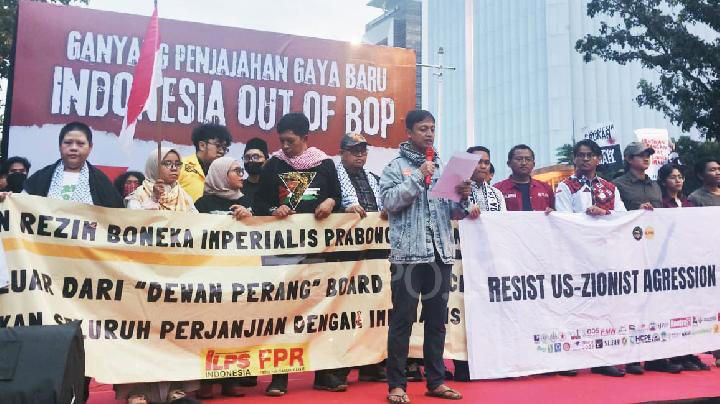
Civil society groups and students hold a public meeting critical of Indonesia’s involvement in the US Board of Peace for Gaza, the sending of Indonesian Armed Forces (TNI) troops to Gaza as part of a US-controlled ISF, and Indonesia’s trade relations with the United States, at Jakarta’s National Monument (Monas) on March 7, 2026. Photo credit: Tempo/Dani Aswara.

 Stories From Indonesia
Leave a Reply