Why Have Forest and Land Fires Spread to 22 Provinces?
By Avit Hidayat for Tempo.co, April 19, 2026
As he hung up dozens of water hoses in the warehouse last year, Elly Prianto could already guess that a major fire would break out soon. Sure enough, fires started to emerge in the peatlands around his village in the Sidomulyo neighborhood of Limbung Village (Sungai Raya district, Kubu Raya regency) in Indonesia’s West Kalimantan province in early February 2026.
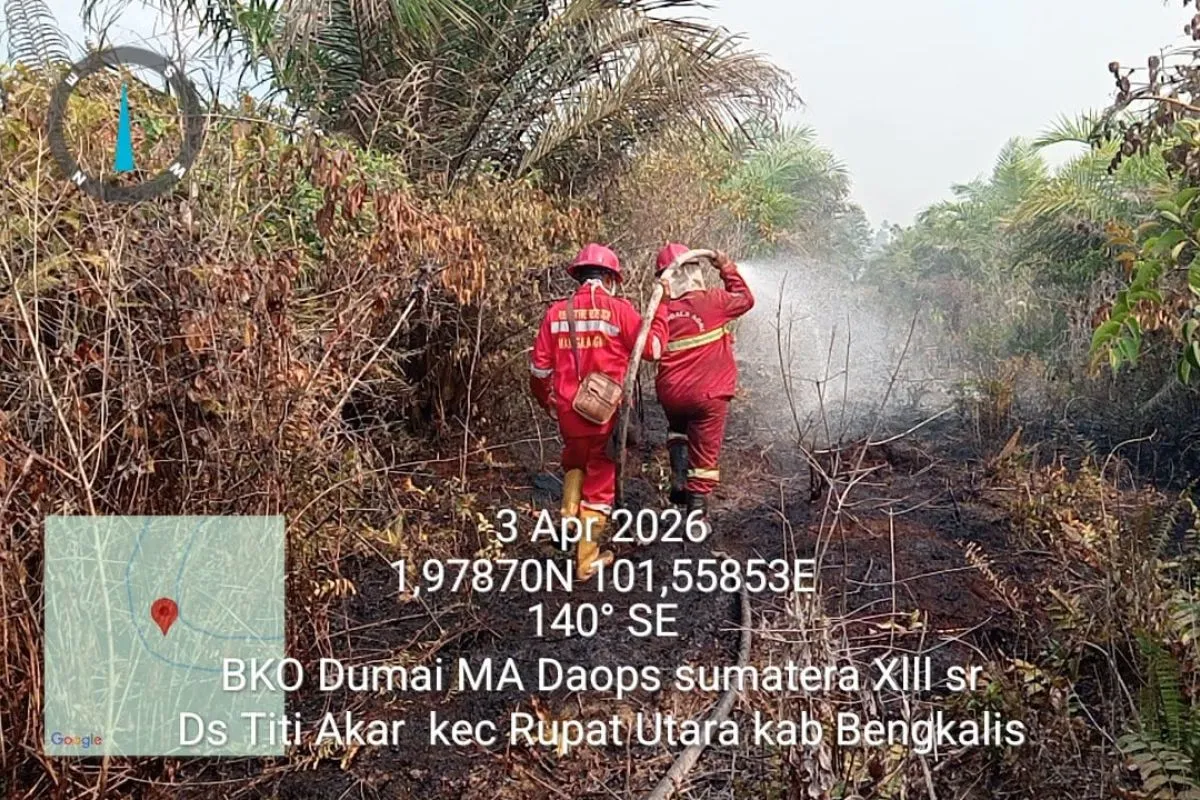
“By April this year, around 200 hectares of land in our village was completely burned,” said Elly, head of the Limbung Village local Fire Awareness Community (MPA), on Thursday, April 16, 2026.
Seeing the fires that spread over recent months around Limbung Village, the 39-year-old is worried that forest and land fires this year will be even worse than during the 2014-2015 disaster. In those years, according to the MapBiomas Indonesia Fire platform, a total of 394 hectares in Limbung Village was destroyed by fires.
The fires that have spread over the last three months didn’t spread because Elly wasn’t proactive in preventing fires in the surrounding peatlands. Fires occur almost every year, he said. The peatland wetting conducted by the Limbung Village MPA only reduces the risk. But a new problem has emerged recently as peat wetting works were halted because of a lack of funds.
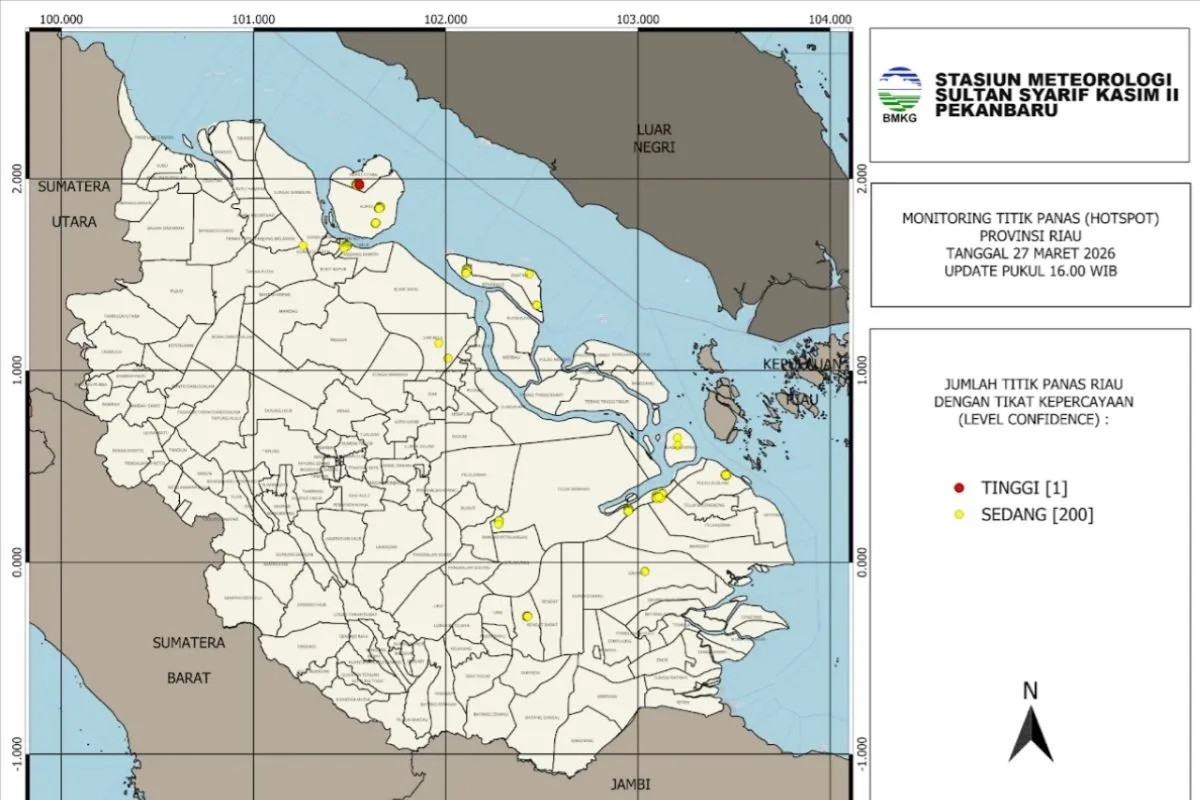
The 20 hoses and five pumps owned by the Limbung Village MPA have lain idle for the last year, Elly explained. The equipment hasn’t been used because the budget for purchasing logistics and fuel was slashed. This year alone, the village authority could allocate just Rp 5 million ($300), about one-tenth of the amount allocated in previous years.
Villagers were hoping for an injection of operational assistance from the central government to help combat fires. Unfortunately, since the Peatland and Mangrove Restoration Agency (BRGM) was abolished by the Prabowo government at the end of December 2024, funding for peatland restoration or fire prevention in Limbung Village has all but evaporated.
Located directly behind Supadio International Airport in West Kalimantan’s provincial capital city Pontianak, Limbung Village represents an island within the 101,269-hectare Punggur Besar-Kapuas River Peatland Hydrological Area (KHG). Approximately 70 percent of the village’s 5,251 hectares is peatland, with peat depth varying from 2 to 40 meters. The history of fires over the past decade has made the Punggur Besar-Kapuas River KHG a priority area for peatland restoration, including through re-wetting and canal blocking.
By the end of 2023, the BRGM had constructed 25 canal blocks in Limbung Village—the most in West Kalimantan, out of a total of 85. These blocks are now abandoned and overgrown, Elly says. Equipment to monitor the level of water is now also out of action. This situation means that the peatlands around Limbung Village are now unprotected.
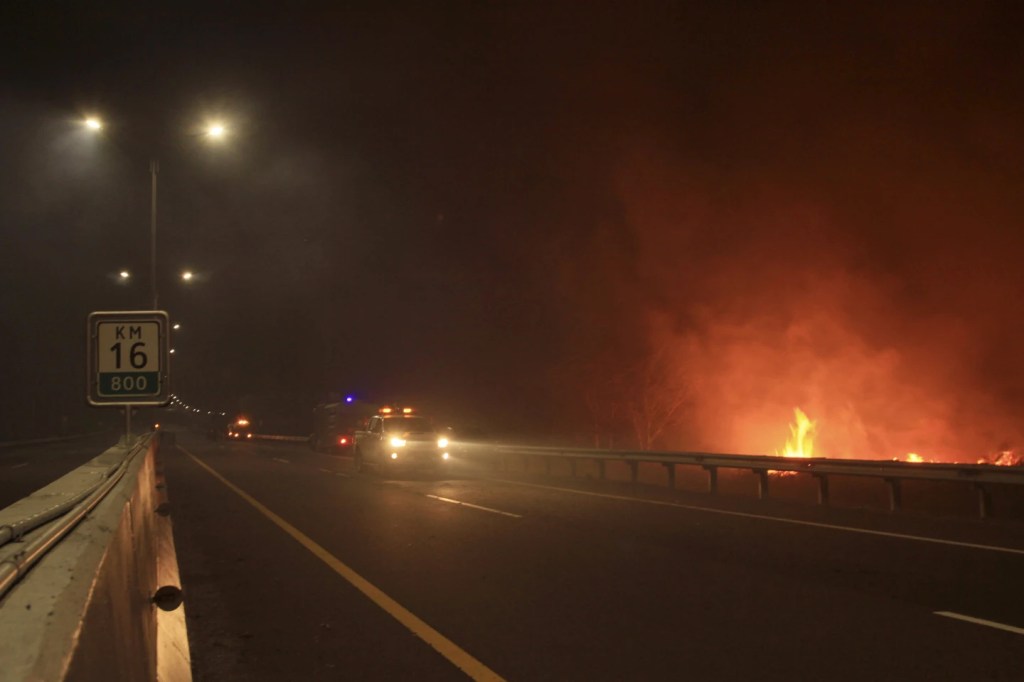
As the fires spread in February 2026, ash blanketed the entire hamlet. Several elderly residents of the village had to be evacuated because they had difficulty breathing. The impact of the fires also led to an incident with a Wings Air flight from Ketapang to Pontianak reportedly could not land on Sunday, February 1, 2026.
On Sunday, April 12, 2026, Elly was visited by Yunus Sudaryanti, head of the Kalimantan Peat and Mangrove Ecosystem Management Center (BPEGM). The BPEGM, which replaced the BRGM, was established by the Prabowo government’s Ministry of Environment in August 2025. Sudaryanti visited Elly’s garden which was scorched by the fires. “When we asked why there was no budget for fire prevention, they just said they would see what they can do,” Elly said.
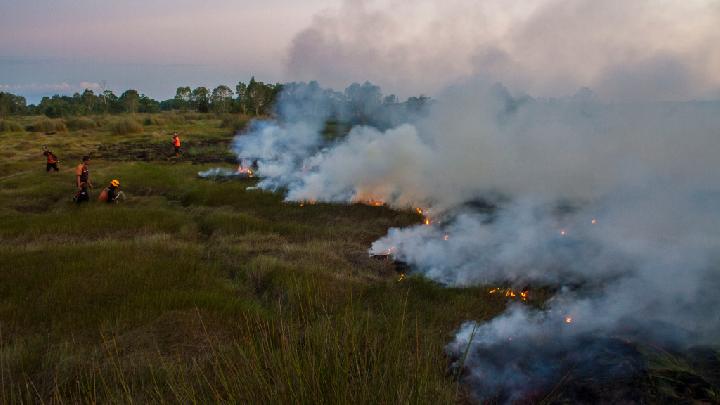
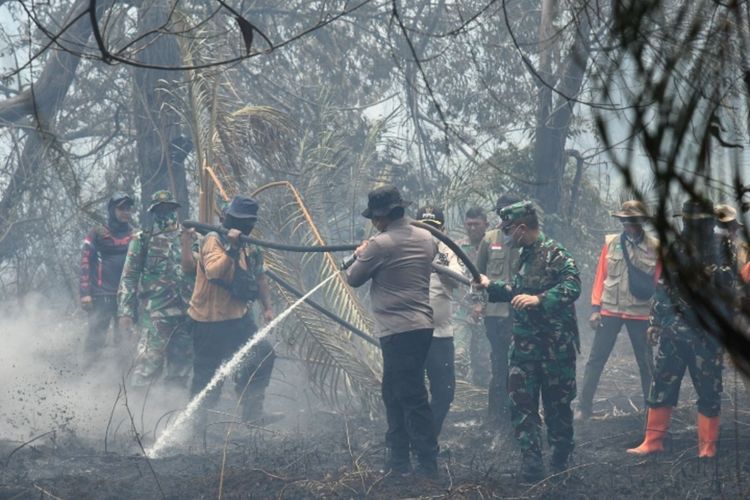
The Limbung Village MPA, along with local military and police, work hard to extinguish fires engulfing peatland around Limbung Village, Sungai Raya district, Kubu Raya regency, West Kalimantan province, on March 25, 2026.
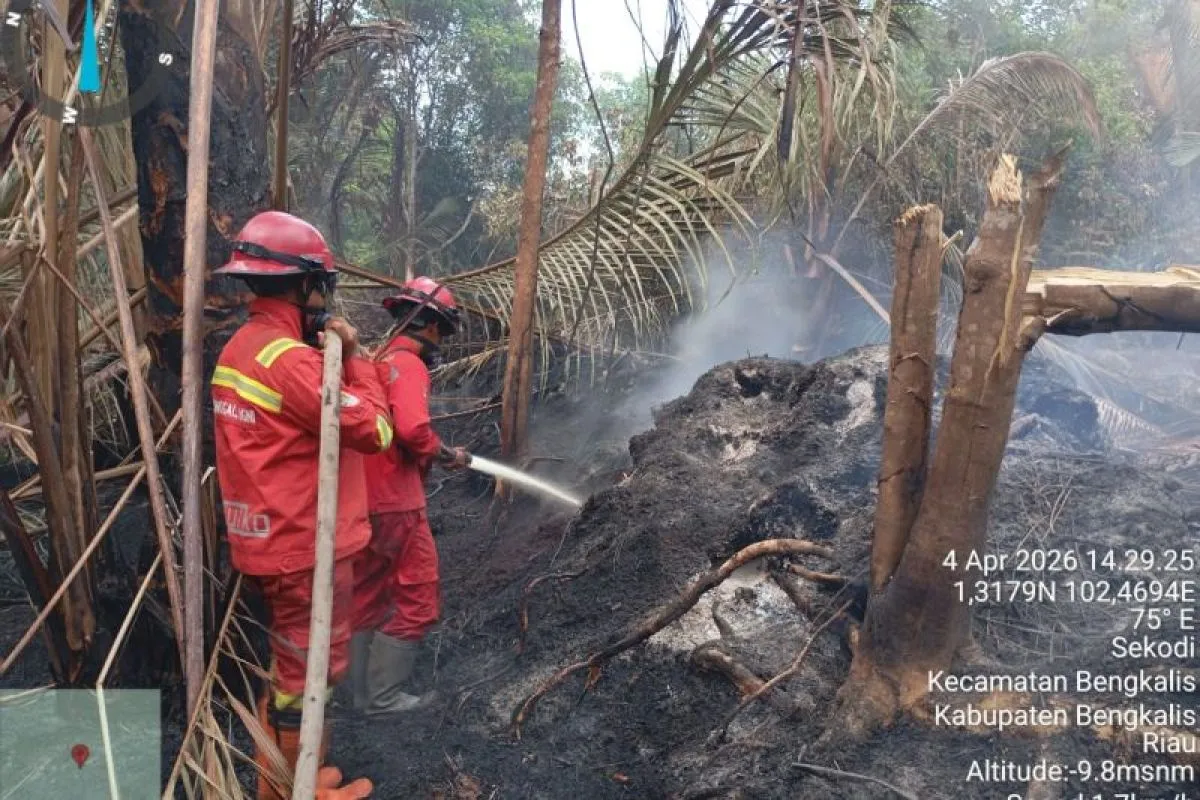
The Limbung Village MPA is not the only MPA struggling to prevent peatland fires. Since last year, hundreds of MPAs across Kalimantan (Indonesia’s portion of Borneo Island shared with Malaysia and Brunei) have expressed concern about the lack of funds needed to keep peatlands wet.
Jakarta is not unaware of the problem. An official from the Ministry of Forestry said they have been worried fires would break out, especially in peat areas, for the last year. “The existing facilities and infrastructure are not operational because they don’t have the necessary logistics,” the official told Tempo.co on Friday, April 17, 2026.
By logistics, the official was referring to operational supplies needed to maintain water levels in canal blocks, and to replant or re-vegetate burned land, maintain bores and restore the ecological function of peatlands. These works were started by the government of the previous President Joko Widodo in 2016.
Yunus Sudaryanti confirmed she has visited Limbung Village to inspect peatland management infrastructure. She denied reports the government was not helping the MPAs in Kalimantan. She said only that the Ministry of Environment has formed 10 new MPA groups that would receive training in fire prevention.
“Assistance to MPAs remains an important part of efforts to prevent fire in Kalimantan, notwithstanding the change in approach in line with the organizational changes,” Sudaryanti said on Friday, April 17, 2026.
Previously, Sudaryanti told Fachri Hamzah from Tempo.co that the BPEGM is very new and is currently still at the stage of data consolidation, coordination, and strengthening its role on the ground. She did not deny there was an issue with the limited budget. “But we don’t see it as a major obstacle; it’s a condition that has to be addressed,” said Sudaryanti in an interview on Tuesday, April 14, 2026.
The head of public relations and foreign cooperation at the Forestry Ministry, Ristianto Pribadi, echoed this sentiment. In a written response provided to Tempo.co on Saturday, April 18, 2026, Ristianto confirmed that the Ministry of Forestry would continue to strengthen the role of the MPAs. The government has generally reduced the budget by around 20 percent to support its policy of austerity, Ristianto said.
“However, this does not reduce the priority of controlling forest and land fires, rather it encourages the optimization of the use of funds to ensure they are better targeted and have a direct impact on the ground,” Ristianto said.
***
West Kalimantan is not the only province being ravaged by fires. Between January and March 2026, according to SiPongi data downloaded on April 16, 2026, fires have affected 22 provinces, impacting over 55,000 hectares—an area almost the size of Jakarta. However, West Kalimantan is in the spotlight because it accounts for nearly half the total fire-affected area.
After the fires worsened in West Kalimantan, a group of government officials led by Coordinating Minister for Political and Security Affairs Djamari Chaniago flew from Jakarta and held a meeting in Pontianak on Thursday, April 16, 2026. Djamari held a fire preparedness parade. In his speech, the Gerindra Party politician emphasized that President Prabowo Subianto places great emphasis on the control of forest and land fires.
“The government cannot be complacent. Every part of the nation has to strengthen preparedness, increase mitigation measures, and build strong cooperation to minimize forest and land fires, even aiming at moving towards zero fires,” said Djamari.
According to Coordinating Minister Djamari, prevention measures include a variety of methods such as continuing to manage water levels, optimizing reservoirs and canals, and maintaining operational readiness in the field. “The government is committed to acting before the fires grow, controlling them before they spread, and protecting the people before impacts become more harmful,” he said.
However, the experience of the residents of Limbung Village over the past three months are not the only indication that Djamari’s speech does not represent the reality on the ground. In Jakarta, according to one official, fire prevention measures are all over the shop because of the reorganization of agency responsibilities. Peatland protection and restoration works following the abolition of the Peat and Mangrove Restoration Agency are more uncertain along with the separation of the Ministry of Forestry and the Ministry of Environment.
As an example, the official cited uncertainty over management of the Peatland and Mangrove Ecosystem Restoration Information System (PRIMS). “The system previously developed by BRGM has now been turned off,” he said.
The PRIMS is an information system developed by BRGM to monitor the actual conditions of peatlands and mangroves. The PRIMS included the Peatland Water Monitoring System (Sipalaga) which recorded actual water levels in peat areas, serving as a reference point for undertaking re-wetting, planting, and revitalization (3Rs) works. Basically, the platform served as an early warning system for fire vulnerability in peatland restoration areas.
When the BRGM was disbanded, the PRIMS and Sipalaga assets were handed over to the Environment Ministry. However, the personnel who had previously operated the systems were returned to the Forestry Ministry. According to one Tempo.co source, the two information systems are not operational.
Over the last week, Tempo.co has attempted to obtain clarification from Environment Minister Hanif Faisol Nurofiq and Forestry Minister Raja Juli Antoni. However, as of the publication of this report, neither had responded.
Head of the Kalimantan Peat and Mangrove Ecosystem Management Center Yunus Sudaryanti confirmed the reports that the two legacy BRGM systems were not currently operational. However, she assured that PRIMS and Sipalaga remained important references. “Their management is now integrated and aligned with the existing systems at the Ministry of Environment,” Sudaryanti said.
The Ministry of Environment, according to Sudaryanti, has developed a Groundwater Level (TMAT) monitoring application that is continuously updated, named Simatag, or the 0.4 Meter Peatland Water Level Monitoring System. This mechanism adopted the scheme from the era of the Ministry of Environment and Forestry which required corporations to submit regular reports. The Ministry of Environment’s BPEGM role is to coordinate, act as facilitator, and strengthen policy.
Pantau Gambut Advocacy Manager Wahyu Perdana noted that the Ministry of Environment’s creation of a new system is tantamount to starting peatland restoration work from scratch. In fact, the government should simply continue the work left by the BRGM, Wahyu said. “The Ministry of Environment’s BPEGM seems to be merely doing only post-fire recovery,” Wahyu said on Friday, April 17, 2026.
According to Wahyu, fire prevention work should be based on peatland restoration. This includes maintaining the peatland ecosystem, cross sectoral supervision, and law enforcement. He reminded that these aims were behind the establishment of the Peatland Restoration Agency by President Joko Widodo in 2015—which later became the BRGM. “Now, with the BRGM abolished, everything is just about fire management or going backwards from previous years,” Wahyu said.
Ristianto Pribadi, head of public relations and foreign cooperation at the Ministry of Forestry, admitted that fire prevention efforts currently rely on the forestry ministry’s “Manggala Agni” fire patrol teams. In 2026, the government also established a Forest Fire Control Supervision Task Force within the Ministry of Forestry. “This team is led by senior officials for coordinating and communicating with stakeholders,” Ristianto said.
Echoing Yunus Sudaryanti, Ristianto said that peat monitoring systems, such as TMAT measurement and previous platforms, have not been discontinued.
“Rather, they are in the process of being incorporated into a more integrated national system,” he said.
***
Institutional governance is not the only suspected cause of the widespread fires in early 2026. Professor of forestry at Bogor Agricultural University (IPB University) Bambang Hero Saharjo highlighted the direction of government policy—including budgeting—which has historically tended to prioritize extinguishing, rather than preventing fires.
“Indonesia spends enormous amounts of money on fire management,” said Bambang.
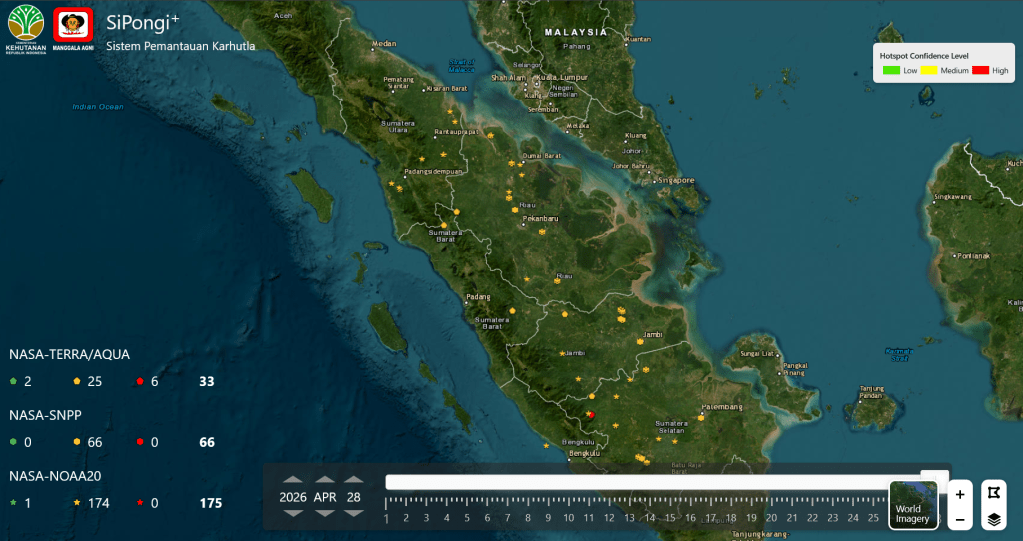
Forest and Land Fire Monitoring System (Sistem Pemantauan Karhutla (SiPongi+) https://sipongi.gakkum.kehutanan.go.id/peta) Ministry of Forestry
The measures Bambang is referring to include the government’s work to operate water-carrying helicopters, deploy the “Manggala Agni” fire control teams, and conduct weather modification operations. Hundreds of billions of rupiah are spent annually on these three activities alone. “The problem arises precisely because these large expenditures are not addressed structurally,” he added.
Meanwhile, according to Bambang, the government should concentrate on structural prevention policies. These efforts could start with resolving overlapping authority over forests and peatlands, regulating the permits of rogue companies, and altering the economic patterns of farmers.
In the case of overlapping authority, he cited the common example of one agency being tasked with protecting forests, while another agency has a barn sale on permits to generate foreign exchange.
Budget issues were highlighted in a short study conducted by the Indonesian Forum for Budget Transparency (Fitra) in Riau province. Tarmizi, Fitra Riau Coordinator, reported that the Riau provincial government’s budget for forest and land fire control in 2026 was only Rp 3.6 billion ($0.22 million). The majority of which, Rp 2.8 billion, was allocated for disaster management. Only Rp 785 million was dedicated to forest and land fire prevention.
Tarmizi believes the budget policy is very ironic. Riau province is prone to forest and land fires and consistently ranks among the top five provinces with the largest areas burned. From January to March 2026, the area of suspected fires in Riau reached 8,555 hectares, the second largest after West Kalimantan. “This surge in fires should coincide with appropriate budget commitments, especially to anticipate recurring disasters,” Tarmizi urged.
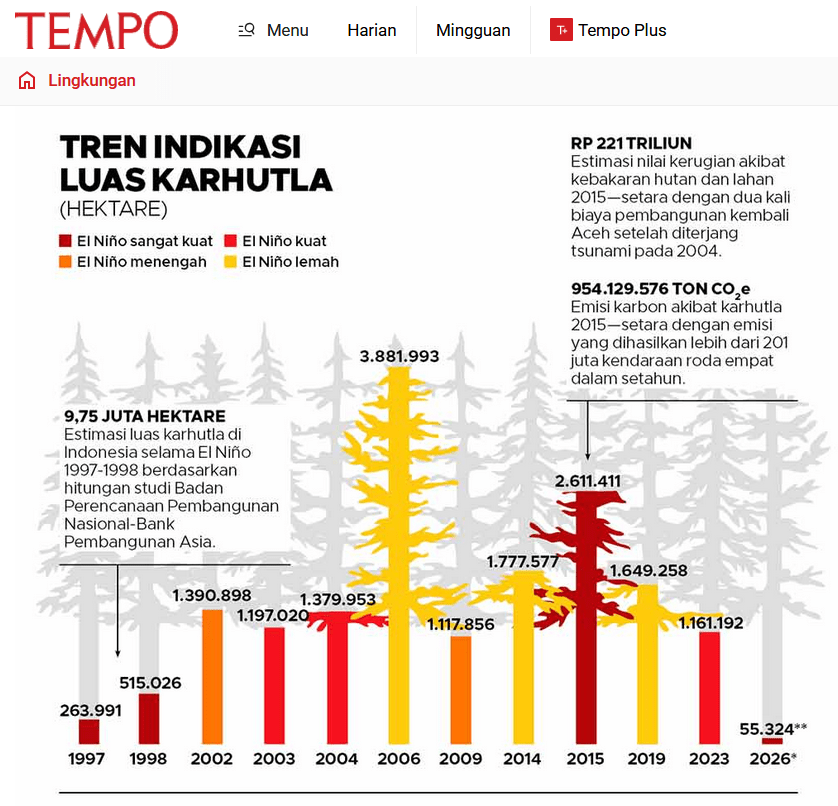
Abdul Madian, head of the Economic and Natural Resources Division of Riau province’s Regional Development Planning Agency, explained that the regional government has prepared Rp 50 billion ($3 million) in contingency funds for the year. This reserve fund has the flexibility to be utilized at any time, including for handling forest and land fires. “The funds have almost doubled from last year,” said Madian, when asked for confirmation on Thursday, April 16, 2026.
This difference of opinion has not dampened the alarm about the disaster that is now escalating. A very strong El Niño phenomenon is expected to establish over the coming months. The Meteorology, Climatology, and Geophysics Agency (BMKG) has predicted that this year’s dry season will potentially above average in length. Like Elly Prianto, Bambang Hero Saharjo is concerned that fires will be more widespread and severe than in previous Super El Niño years.
***

This post is based on https://www.tempo.co/lingkungan/penyebab-kebakaran-hutan-dan-lahan-2026-2130041. Featured image credit: Smoke haze victims stage peaceful protest at Palembang District Court, South Sumatra, Indonesia, July 2025. © Abriansyah Liberto/Greenpeace https://www.greenpeace.org/indonesia/siaran-pers/63918/gugatan-kabut-asap-palembang-greenpeace-sinarmas-kebakaran-hutan/.
Related:
- https://www.suaramerdeka.com/opini/0417148371/giant-sea-wall-dan-politik-adaptasi-perubahan-iklim-di-pantura
- https://regional.kompas.com/read/2026/06/02/143133578/11-daerah-di-riau-siaga-karhutla-luas-lahan-terbakar-tembus-15000-hektare
- https://www.detik.com/sumbagsel/berita/d-8514472/hotspot-sumsel-mei-2026-tembus-708-titik-tertinggi-sejak-2015/amp




Leave a Reply