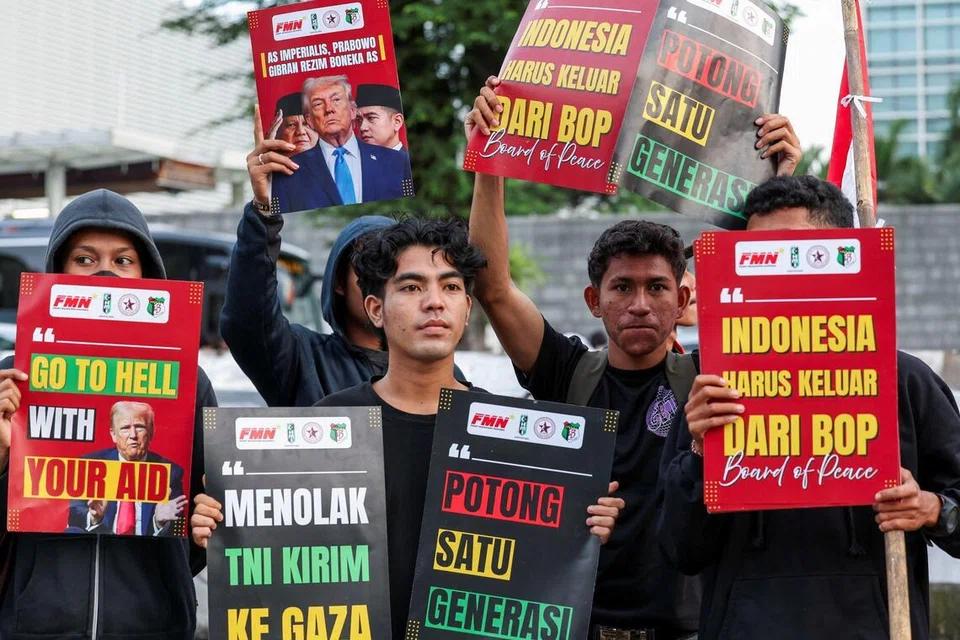
US-Israel Attack on Iran: MUI Urges Indonesian Government to Withdraw from Board of Peace for Gaza
Indonesian Ulema Council, March 1, 2026
The Indonesian Ulema Council (MUI) officially urged the Indonesian government to withdraw from the US Board of Peace (BoP) for Gaza, in a statement released March 1, 2026. The statement was issued by the MUI in response to the US-Israeli attacks on Iran on February 28, 2026.
The MUI said the US, which is playing a central role in the management of the Palestinian conflict through the BoP, faces a major question. Is this strategy really aimed at a just peace, or just strengthening an unequal security architecture, and burying Palestinian independence?
“For this reason, the MUI urges the Indonesian government to revoke its membership of the BoP, and believes it has been ineffective in realizing true independence in Palestine,” the MUI said in a statement issued on Sunday March 1, 2026.
MUI statement No. Kep-28/DP-MUI/III/2026 was signed by MUI Chair KH Anwar Iskandar and Secretary General Buya Amirsyah Tambunan.
The MUI believes in fact the opposite is occurring. US President Donald Trump is carrying out a joint attack against Iran with Israel, triggering a regional war involving a number of countries, both directly and through proxies.
The MUI calls on Muslims around the world to continue to pray for Almighty God’s assistance and protection for Muslims experiencing hardship, oppression, and disaster in different parts of the world.
“The MUI calls on the UN and the Organization of Islamic Cooperation (OIC) to take maximum steps to stop the war and respect international law. The MUI believes that war will bring global harm,” said the statement.
The US-Israeli attacks on Iran have resulted in the death of Iran’s Supreme Leader. The Indonesian Ulema Council (MUI) expresses its deep condolences for the death of Iran’s Supreme Leader and prays for his eternal rest.
The MUI condemned the US-backed Israeli attacks because they conflict with humanitarian values and the Preamble to Indonesia’s 1945 Constitution which countries “to participate in establishing a world order based on freedom, eternal peace, and social justice.”
The MUI understands that Iran’s attacks against Gulf states are retaliation for the US and Israeli attacks targeting military bases. According to the MUI, Iran’s retaliatory attacks are justified, and protected by international law.
“Therefore, to avoid a wider escalation, the US and Israel must halt attacks on Iran as they violate Article 2 (4) of the UN Declaration.”
The Indonesian Ulema Council (MUI) considers the Israeli and US military attacks on Iran, which Iran has subsequently responded to, constitute a serious escalation with the potential to drag the Middle East into a wider conflict.
Not an isolated incident
“This situation should not be viewed as an isolated incident, but rather it should be seen as part of a larger geopolitical configuration. It is the duty and responsibility of all countries to achieve peace in order to provide maximum protection for civilians,” it stated.
Strategic motive
The MUI believes the strategic motive behind the attacks is a systematic attempt to weaken Iran’s strategic position in the region, and limit Iranian support for the struggle for Palestinian independence.
In the context of the Israeli-Palestinian conflict, the MUI encourages countries to act as peacemakers in order to prevent military attacks with the potential to serve as instruments of political pressure aimed at securing Israel’s regional dominance over Palestine.
This post is based on https://mui.or.id/baca/berita/as-dan-israel-serang-iran-mui-desak-pemerintah-ri-mundur-dari-board-of-peace and https://mui.or.id/baca/berita/as-israel-serang-iran-majelis-ulama-indonesia-sampaikan-10-tausiyah. Featured image credit: Protesters outside the US Embassy urge the Indonesian government to revoke its membership of the Board of Peace on March 3, 2026. Photo: REUTERS via The Straits Times.
In related news:
- https://nasional.kompas.com/read/2026/03/04/12051261/surya-paloh-sebut-indonesia-tetap-di-board-of-peace-kecuali-dievaluasi-ulang
- https://nasional.kompas.com/read/2026/03/04/10164811/gelombang-desakan-agar-indonesia-hengkang-dari-board-of-peace-usai-serangan
- https://www.bloomberg.com/news/articles/2026-03-04/indonesia-says-board-of-peace-talks-paused-as-iran-crisis-rises
- https://islami.co/board-of-peace-konsesi-tambang-dan-hegemoni-atas-ormas-islam/
- https://nasional.kompas.com/read/2026/03/05/23531921/kumpulkan-ulama-prabowo-tekankan-persatuan-di-tengah-konflik-timur-tengah
- https://nasional.kompas.com/read/2026/03/05/23152941/kata-jimly-dan-gus-yahya-soal-prabowo-berbelasungkawa-untuk-khamenei
- https://nasional.kompas.com/read/2026/03/06/11280041/bukan-bop-waketum-mui-dorong-peran-pbb-dan-oki-damaikan-as-dengan-iran
- https://nasional.kompas.com/read/2026/03/06/10515321/ri-gabung-board-of-peace-muhadjir-kita-sekarang-mencoba-berjuang-dari-dalam
- https://nasional.kompas.com/read/2026/03/06/10445261/prabowo-ajak-ulama-dan-tokoh-ormas-islam-rapatkan-barisan-dukung-perdamaian
- https://mui.or.id/baca/berita/momen-keakraban-prabowo-dengan-ketum-mui-rais-aam-nu-dan-ketum-muhammadiyah
- https://www.bloomberg.com/news/articles/2026-03-06/indonesia-says-pakistan-uae-back-prabowo-bid-for-iran-mediation
- https://open.spotify.com/episode/0tCWPoPhars03hdd3lJ12L?si=_CrDi40mSlmLB35WX25y7g
- https://www.thenation.com/article/politics/trump-iran-religious-war-crusades/
- https://www.hrw.org/id/news/2026/01/27/trumps-board-of-peace-puts-rights-abusers-in-charge-of-global-order
- https://nasional.kompas.com/read/2026/03/22/16501021/prabowo-tegaskan-tak-pernah-janji-sumbang-1-miliar-dollar-untuk-board-of
- https://www.kompas.com/tag/iuran-1-miliar-dollar?type=artikel
- https://www.theguardian.com/commentisfree/2026/mar/30/world-without-rules-un-security-council-global-order
- https://nasional.kompas.com/read/2026/06/25/14442581/mantan-dubes-ri-ungkap-kekecewaan-iran-terhadap-sikap-indonesia
- https://islami.co/kenapa-nahdlyin-akar-rumput-tolak-board-of-peace-beda-dengan-ketum-pbnu-yang-justru-merangkul/
- https://www.theguardian.com/law/2026/jun/27/board-of-peace-legal-immunity-un
- https://www.kompas.com/tren/read/2023/11/11/160000765/kata-media-asing-soal-fatwa-mui-haram-mendukung-agresi-israel
- https://www.tempo.co/internasional/mengapa-hamas-bubarkan-pemerintahan-gaza-2276200
In earlier news…
Indonesia’s Gaza Gamble
By Ronny P Sasmita for Al-Jazeera, February 16, 2025
(Excerpt) President Prabowo Subianto’s government said on February 10 that Indonesia is preparing to deploy up to 8,000 troops to a proposed multinational Gaza stabilization force under Donald Trump’s so-called Board of Peace (BoP). The troop proposal forms part of Jakarta’s broader decision to participate in the BoP framework, an initiative conceived and driven by Trump. Together, these steps signal a significant shift in Indonesia’s longstanding foreign policy posture. At a time of intensifying geopolitical volatility, Jakarta appears to be committing itself to a project shaped around a single, deeply polarizing political figure. The decision raises a fundamental question: is Indonesia advancing its national interests and diplomatic credibility, or allowing its foreign policy direction to be shaped by an external agenda?
Geopolitics is not a theater for symbolic proximity to power but a disciplined calculation of national interest and sovereign credibility. Indonesia’s decision to engage with the BoP appears less like a carefully calibrated strategic choice and more like a reactive impulse that risks weakening the philosophical foundations of its diplomacy, built over decades. Indonesia’s international influence has historically rested on strategic equidistance rather than personal alignment with controversial leaders.
There is a growing sense that Jakarta risks acting out of geopolitical urgency. Yet the initiative Indonesia has chosen to support is led by a figure known for transactional diplomacy and disregard for international consensus. The implications extend well beyond Middle East peace initiatives. What is at stake is Indonesia’s reputation as an independent stabilizing actor in global diplomacy.
If Indonesia proceeds with troop deployment under the BoP framework, the risks become even more acute. Gaza is not a conventional peacekeeping theater. It is one of the most volatile and politically contested conflict environments in the world, where humanitarian imperatives and hard security objectives frequently collide. Deploying thousands of troops into such an arena without an inclusive multilateral mandate risks drawing Indonesia into a conflict environment where neutrality would be difficult to sustain.
Erosion of the ‘Free and Active’ doctrine
The most serious concern is the gradual erosion of Indonesia’s “Free and Active” foreign policy doctrine, the intellectual backbone of its diplomacy since the Djuanda Declaration and the Bandung Conference. Indonesia has historically positioned itself as a mediator, rather than a follower of personalized diplomatic agendas.
By participating in an institution closely identified with Donald Trump, Jakarta risks legitimizing unilateral approaches that often conflict with established international norms. “Free” diplomacy implies independence, and “active” diplomacy implies engagement driven by national priorities rather than external pressure.
Indonesia also risks being reduced to a symbolic endorsement of a United States-centered foreign policy outlook. If Jakarta drifts too far into this orbit, its leverage with other major actors, including China, Russia and ASEAN partners, could weaken. Indonesia’s leadership in Southeast Asia has depended on its credibility as a neutral stabilizing force. That credibility may erode if it is seen as participating in great-power security agendas.
Indonesia’s respected record in United Nations peacekeeping has historically rested on internationally recognized neutrality under UN command structures. Participation in a BoP framework, which sits outside established multilateral systems, risks shifting Indonesia from neutral arbiter to participant in a political security architecture shaped beyond globally recognized peacekeeping norms.
More troubling is the precedent this sets. If foreign policy principles become negotiable in exchange for economic or strategic promises, Indonesia risks undermining the coherence of its diplomatic identity. Its constitutional commitment to promoting global peace and social justice depends on preserving policy independence.
The Palestine paradox
Indonesia’s participation in the BoP also creates a visible moral and constitutional tension. The Indonesian constitution explicitly rejects all forms of colonialism and emphasizes international justice. Participation in an initiative led by the architect of policies historically skewed in Israel’s favor creates a contradiction that is difficult to reconcile.
Trump’s record in the region remains controversial. His decision to relocate the US embassy to Jerusalem altered decades of diplomatic consensus and drew widespread criticism across the Muslim world. For Indonesia, the world’s largest Muslim-majority nation and a consistent supporter of Palestinian statehood, association with this framework carries significant political sensitivity….
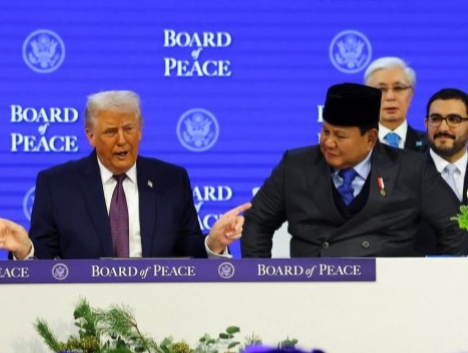
Read the whole piece at https://www.aljazeera.com/opinions/2026/2/16/indonesias-gaza-gamble. Featured image credit: Protesters outside the US Embassy urge the Indonesian government to revoke its membership from the Board of Peace on March 3, 2026. Photo: REUTERS via The Straits Times. Image Credit: Excerpt – US President Donald Trump gestures towards Hungary’s Prime Minister Viktor Orban and Indonesia’s President Prabowo Subianto, during a charter announcement for his Board of Peace in Davos, Switzerland, January 22, 2026. [Denis Balibouse/Reuters via Al-Jazeera] Per Al-Jazeera Ronny P Sasmita is a senior international affairs analyst at the Indonesia Strategic and Economics Action Institution, a Jakarta-based think tank focused on geopolitics and geoeconomics. His commentary has appeared in leading Indonesian outlets and a number of international English-language publications. He regularly contributes analysis on international political economy, China’s economy, and global geoeconomic trends.
In related news:
- https://www.theguardian.com/us-news/2026/feb/19/trump-gaza-military-plan
- https://nasional.kompas.com/read/2026/02/10/13031811/indonesia-jangan-kirim-pasukan-perdamaian-ke-gaza
- Indonesia to Fill ISF Gaza Deputy Commander, Ready to Send 8,000 Personnel, Kompas.com, February 19, 2026, Fika Nurul Ulya, Ardito Ramadhan (Indonesian)
- House Speaker Puan Defends Prabowo Attending Gaza Peace Summit Despite Israel’s Presence, Kompas.com, February 19, 2026, Adhyasta Dirgantara, Dani Prabowo (Indonesian)
- Pakistan Refuses to Rush to Send Troops to Gaza, Avoids Missions Other Than Peacekeeping, Kompas.com, February 19, 2026, Irawan Sapto Adhi (Indonesian)
- Prabowo Attends Gaza Peace Board Summit in the US Today, Signs Trump Tariffs Deal, Kompas.com, February 19, 2026, Adhyasta Dirgantara, Robertus Belarminus (Indonesian)
- Civil Society Coalition Criticizes Indonesia’s US Foreign Policy for Lack of Public Involvement, NU Online, 2 March 2026, Mufidah Adzkia (Indonesian)
- https://www.tempo.co/politik/indonesia-keanggotaan-dewan-perdamaian-perang-iran-israel-2119105
- https://www.bloomberg.com/news/articles/2026-03-04/indonesia-says-board-of-peace-talks-paused-as-iran-crisis-rises
***
The Illusion of Trump’s Board of Peace
By A.D. Agung Sulistyo, for Tempo.co January 30, 2026
Indonesia’s decision to join President Donald Trump’s Board of Peace for Gaza is anything but neutral. It bristles with ethical problems.
This choice, made by Indonesia to participate in the Board of Peace for Gaza established by President Trump, is framed in familiar clichés: active involvement, a commitment to global stability, and a dedication to peace.
However, Indonesia’s membership in this U.S.-controlled peace forum actually presents a dilemma: stand firm in upholding the rules-based international order or participate and risk gradually diminishing the significance of the United Nations Charter.
Since World War II, peace has never stood alone as a goal in international law. It has always been accompanied by procedures, mandates, and limitations on power. Pursuing peace without a legal framework is akin to establishing a new, subtler form of domination. Consequently, the responsibility for maintaining peace is entrusted to the Security Council. This is not because the institution is perfect, but because its authority is anchored in collective representation and legitimacy.
When the White House describes the Trump Board of Peace for Gaza as an initiative aligned with UN Security Council Resolution 2803, a more fundamental question arises: Is world peace still governed by law, or is it beginning to be determined by those in power who are merely using legal language as a diplomatic facade?
A policy may appear to align with the UN’s objectives, but that does not automatically confer legal validity. A UN Security Council resolution is not a blank check. If a resolution does not explicitly establish a body—including its structure, mandate, and accountability—then legally that body does not exist.
Herein lies the tenuous nature of the White House’s claim. UN Security Council resolutions—under Chapter VII of the UN Charter—has never created new bodies through vague interpretations or ulterior motives. International organizational law recognizes the principle of express mandate which asserts that authority must be explicitly stated and cannot be assumed. Without this clarity an action is ultra vires—an action beyond the limits of legal authority.
Article 24 of the UN Charter clearly asserts that the primary responsibility for maintaining international peace and security rests with the UN Security Council. This is not merely a division of administrative duties; it is a constitutional rule in the post-1945 world order. If this function were carried out by another mechanism outside the authority, oversight, and accountability of the UN Security Council, it would amount to a tacit takeover.
What we are witnessing now is a hollowing out of the UN’s functions. The Charter is still cited, and resolutions are still referenced, but crucial decisions about peace are being transferred to a forum serving the interests of the powerful. This represents a new form of defiance against international law.
Indonesia’s decision to join is clearly not a neutral step. By participating, Indonesia indirectly acknowledges that peace can be discussed outside a mutually agreed legal framework. This involvement also indirectly reinforces the notion that the UN Charter is merely one option, no longer the primary foundation for international relations.
The Indonesian government’s policy is fundamentally problematic. For years, Indonesian diplomacy has consistently emphasized multilateralism and international law—not just as rhetoric, but as a core identity maintained since the dawn of independence.
By engaging in a peace mechanism outside the UN Charter, that position becomes tenuous. How can Indonesia assert its support for a rules-based order while simultaneously normalizing peace negotiated outside the law?
International legal theorists have long warned of the dangers of hegemonic multilateralism. It may appear benign—multilateral on the surface—but it is controlled by one party. The Trump Gaza Board of Peace exemplifies this pattern clearly. The initiative originates from the United States, leadership resides with Trump, the agenda is set in Washington, membership is selectively chosen, financial contributions are the price of entry, and there is no accountability to the UN General Assembly, which is meant to be representing the international community.
If peace is determined by the party who leads, funds, and wields informal veto power, it is fair to ask: Is this a global Board of Peace or merely the Board of America dressed up to appear legitimate?
In international legal theory, the UN is often regarded as a constitutional instrument of the international community. Its Charter is no ordinary treaty; it is the lex superior, the primary framework governing the exercise of power on a global scale. When mechanisms like the Board of Peace operate outside this framework, we witness what Martti Koskenniemi describes as the fragmentation of international law.
This fragmentation is not merely an academic concern; it reflects a tangible reality. Today, one major country forms a Board of Peace. Tomorrow, another could establish a Board of Stability or a Coalition for Order and claim alignment with UN resolutions. In such a scenario, the UN Charter gradually transforms from binding law into mere symbolism—referenced but no longer respected.
Supporters of the Board of Peace will undoubtedly argue that the world needs a quick solution, claiming that the UN is too slow, complicated, and often paralyzed. This argument has some merit. However, international law does not promise speed; it offers legitimacy and accountability.
Peace without a legal framework, even if at first blush it appears stable, is always tenuous from a normative perspective. History has shown that stability without legitimacy rarely endures.
The world is indeed changing, and international law must adapt. The question is whether Indonesia is prepared to build a world where peace is maintained not by law, but by the balance of power alone.
A.D. Agung Sulistyo is a researcher specializing in transnational law and public policy. He has previously worked as a researcher at both the PARA Syndicateand the Soegeng Sarjadi Syndicate. This post is based on https://www.tempo.co/kolom/ilusi-dewan-perdamaian-donald-trump-2111160.
- Virdika Rizky Utama. “Indonesia Should Reconsider Decision to Join Trump’s Board of Peace.” Nikkei Asia, 27 Jan. 2026, asia.nikkei.com/opinion/indonesia-should-reconsider-decision-to-join-trump-s-board-of-peace.
- Hendrik Yaputra and Wibowo, E.A. (2026). Soal Dewan Perdamaian, PDIP: Indonesia Harus Bebas Aktif. [online] Tempo. Available at: https://www.tempo.co/politik/soal-dewan-perdamaian-pdip-indonesia-harus-bebas-aktif-2111541
- Tangkilisan, Yuda B. “Sovereignty on Seas: The Making of the Declaration of Djuanda 1957.” Www.atlantis-Press.com, Atlantis Press, 29 May 2023, www.atlantis-press.com/proceedings/ahs-aprish-19/125987317.
- Nidžara Ahmetašević. “Gaza Is on Its Way to Becoming a Semi-Protectorate, Just like Bosnia.” Al Jazeera, Feb. 2026, www.aljazeera.com/opinions/2026/2/1/gaza-is-on-its-way-to-becoming-a-semi-protectorate-just-like-bosnia
- “Op-Ed: Prabowo Government’s Directionless Diplomacy, Tempo.” Stories from Indonesia, 13 July 2025, storiesfromindonesia.com/2025/07/13/op-ed-prabowo-governments-directionless-diplomacy-tempo/


 Stories From Indonesia
Leave a Reply