
Young Jamal And His Books
A Short Story by Mochtar Lubis (1950)
“Did you know,” Jamal said to me, “you can learn anything on your own?”
“Really?” I replied. “Can you become a doctor by just studying books?”
“You can,” he said. “Of course, you wouldn’t get a diploma, but your knowledge wouldn’t be any worse than a doctor who has a diploma.”
“Come on,” I said, skeptical. “What’s the use of being a ‘book doctor’ then?”
“That’s my point,” he said. “Theoretical knowledge can be learned without formal schooling. You don’t have to climb too high in the academic world, and not everyone with a title like Ir., Dr., Mr., or Prof. is as smart as their title would make them seem.”
“That, I won’t argue with,” I said. “My own brother graduated from law school, but all he’s done is sell off my family’s rice fields. And he hasn’t won a single case.”
“Well, there’s your proof right there,” he said.
“Proof of what?” I asked.
“Proof of what I just said,” he argued.
“Oh,” I said.
“Do you understand what I mean now?” he asked.
“I get it,” I said. “But I’m not convinced.”
“Wait and see. I’ll prove it myself,” he said.
“How?” I asked.
But before I go on, so you really understand the story, first I had better tell you a little about young Jamal.
Jamal was born in Padang Pandjang in West Sumatra. His father was a livestock inspector. Jamal was his only son, though he had one younger sister. I won’t say if it was good fortune or bad luck, but Jamal was born at a time that, as he grew up, he found himself caught in the waves of religious revival that swept through West Sumatra every few years. When Jamal finished elementary school, the revival was at its peak. Madrassas were sprouting up everywhere like mushrooms, and countless Islamic colleges were opening up—even small villages of barely 2,000 people had their very own “Al-Islam University.”
Had Jamal been born two or three years earlier or later his father might not have thought to send him to one of these Islamic colleges. Instead, he might have been content to have Jamal study religion at the village pray hall.
Maybe he’d have sent him to a Dutch-language school instead, and Jamal’s path might have gone in a completely different direction.
But as I said, for better or worse, Jamal was born at just the wrong—or maybe the right—time.
And so Jamal ended up being enrolled in a school called Modern Islamic College. According to its brochure, the headmaster was a graduate of Al-Azhar University in Egypt. The school accepted students who had finished elementary school, junior middle school, or senior middle school, dividing them into classes like “First Standard,” “Second Standard,” “Third Standard,” and Junior or Senior College, based on their knowledge of Islam. The brochure boasted that alongside Islamic studies, the school taught politics, economics, sociology, and languages like Arabic, English, and French. Graduates could even continue their studies directly to Al-Azhar in Cairo.
What the brochure didn’t say was that the headmaster had only spent a year at Al-Azhar, and hadn’t even finished his studies. Nor did it mention that you could get into Al-Azhar just by being able to recite the Quran—as long as you were willing to study there for decades.
But how could Jamal’s father, a livestock inspector, have known any of that? He didn’t see past the English phrases and the grand pictures of Cairo’s beautiful buildings printed in the school’s brochures.
So Jamal was enrolled at Modern Islamic College. To Jamal himself the school was magnificent. His parents even bought him the school insignia: a green triangular badge with a yellow star and crescent in the center, along with the school’s name written in Arabic. The badge cost one and a half rupiahs.
The school’s English, French, and German teacher was himself a graduate of senior middle school. He tried his best, but he barely knew what he was teaching. This only added to the confusion of his students. Still they felt a sense of pride learning English words like I, you, he, she, me, sir, good morning, good evening, school, book, and pen.
This was the kind of place where Jamal studied. It was here that he first heard names like Socrates, Karl Marx, and Adam Smith. He learned about the French Revolution, the Communist Manifesto, and Rabindranath Tagore, mixed together with Islamic theories, Islamic democracy, Islamic socialism, Islamic communism, Islamic capitalism, Islam and the world… and on and on. These ideas tantalized him, beckoned to him every day. But they would always slip away whenever he thought he was close enough to grasp them. The teachers weren’t competent. For some students, the lack of clarity became a mental torment, but for others, it fed their pride. Simply knowing the names and theories gave them a sense of superiority.
Young Jamal was tossed between these two feelings. On one hand he felt the pain of not fully understanding. On the other he loved rattling off the names of great figures and reciting the first page of The Communist Manifesto fluently without hesitation.
Until finally one day his father was gored to death by a mad buffalo that he’d been inspecting. Jamal had to leave the school.
He could have stayed—his uncle had offered to pay for his education. But the new ideas he had soaked up in school made him resent the Minangkabau tradition of uncle-nephew obligations. To show his “inner revolution,” Jamal refused his uncle’s help.
He left for Jakarta, and that is where I met him. We first crossed paths in an old bookstore. I was searching for cowboy novels and detective stories—my favorite reads. While I was browsing, I heard a voice below me say, “Excuse me, sir, could I take the book under your foot?”
I looked down to see a young man crouching, his head bent low, trying to read the title of the book I was standing on.
I smiled. “Of course,” I said, lifting my foot.
“What book is it?” I asked.
He stood up, brushing the dust off the book. I can’t recall the exact title, but it was something like Theories of Human Psychology and World Economics—and it was in German. His eyes sparkled as he held it up.
That was how we got to know each other. I asked him, “You seem to really like books, don’t you?”
“I sure do,” he replied.
“Why don’t you come by my place sometime?” I offered. “You can pick out any books you’d like to take a look at.”
He seemed excited by the invitation and promised to come by.
I had all but forgotten about him when one day he turned up. I took him to my room.
“Go ahead, take your pick,” I said, gesturing toward the bookshelves, the desk, and the cabinet, and he began browsing.
Fifteen minutes later, he turned to me and asked, “Don’t you have anything else?”
“That’s all I’ve got,” I said. “What are you looking for? Cowboy stories? Detective novels? War stories?”
“That’s not what I mean,” he said. “Do you have any heavy books? Serious ones?”
“I don’t really enjoy reading those kinds of books,” I admitted.
“Oh,” he said, sounding disappointed.
Then later he invited me to his home, and there he showed me his book collection—a treasure trove that would have made a museum jealous. He had everything: ancient volumes no one read anymore, books on medicine, law, social engineering, psychology, politics, history, geography, anthropology, antiques, and, of course, literature. But I noticed his literature section was only poetry—rows of Byron, Shakespeare, Oscar Wilde, Robert Browning, and Keats, along with shelves of books in Spanish, French, and German.
“Wow,” I said. “You read books in French, English, German, Dutch, and Spanish?”
“No,” he said. “No I don’t. I’m still working on my English little by little. I bought the others even though I can’t read them now. But one day when I learn German, French, or Spanish, I’ll be able to read them, won’t I?”
“But how do you know you’ll enjoy reading them later if you don’t understand them now?” I asked.
“I can feel it,” he said.
Then he showed me what he called his “big project.” From a cabinet he pulled out a thick, beautifully bound book—so thick it looked like two volumes of the Encyclopaedia Britannica combined.
“This,” he said, “is my dictionary project.”
“A dictionary?” I asked. “What kind?”
“A dictionary for Indonesian-Arabic-English, and English-Arabic-Indonesian,” he replied. “Take a look.”
He opened the book. I saw about five handwritten pages, neatly organized, starting with the letter A. The words were listed in Roman script, followed by their Arabic equivalents written in Arabic script.
“So, you’re a language expert?” I asked.
“No,” he said, smiling. “Making a dictionary is the easiest thing in the world. I just don’t understand why there isn’t a decent Indonesian dictionary yet.”
He explained his method. He used three dictionaries, an English-Dutch dictionary, a Dutch-Indonesian dictionary (the one by van Ronkel), and an Arabic-English dictionary.
“You take an Indonesian word, find its Dutch equivalent, then its English equivalent, and finally the Arabic word. One word done. Then just repeat the process,” he said.
“Oh,” I replied, unsure of what else to say.
He then spoke about another ambition, to write a book about Western and Eastern philosophy. “People only read about Western philosophy or Eastern philosophy,” he said. “But I want to create a book that combines both and synthesizes them. Yes, I want to develop a new philosophy.”
“When will you start writing that?” I asked.
“Later after I’ve read all these books,” he said, gesturing around the room.
That was our friendship. He showed me his school badge and school prospectus, carefully preserved, and through them I learned about his education.
When the Japanese surrendered and the independence revolution broke out, he disappeared. I didn’t hear from him until one day when I went to Yogyakarta.
I ran into him outside the train station as I was heading back to Jakarta. The first thing he said to me was about his books. “Ah, my books!” he exclaimed. “I had to leave most of them in Jakarta, but thank goodness I brought the important ones with me.”
“What are you doing now?” I asked, though almost immediately I regretted it. He launched into a passionate discussion about his “economic plan.” He talked on and on about planned economies, he dismissed liberalism as outdated, and he declared socialism and communism still immature in our context.
From what he said I could see he had become part of the Republic’s planning council—a kind of Brains Trust as he called it. “No one else in the council really understands economic theory,” he said.
“Luckily, I have my books from before.”
As the train prepared to pull out he scribbled something on a piece of paper and pushed it into my shirt pocket. “Bring these books with you next time!” he shouted at me, his voice drowning in the locomotive’s whistle.
“Alright,” I called back.
Once aboard I unfolded the paper. It listed book titles: The Economic Conditions of Saksenburg in the 12th Century by some German professor, Economic Warfare in the Middle Ages, another academic book in French, The Republic by a Greek philosopher, Illustrations of Warships, in English. And a chemistry book on making various items including explosives.
I brought the books back with me on my next trip to Yogyakarta. Every time I saw him after that he recounted how he had cited these books during council debates to outmaneuver his opponents. He’d mention a professor’s name and theory—but he conveniently left out the part about the theory being about medieval economic warfare, long before planes, steamships, cars, or blockades existed.
Lately, I’ve heard that young Jamal is still busy cooking up grand economic plans: strategies for accumulating foreign reserves, managing production and consumption, resolving labor disputes, fostering military-civil relations, youth education, and negotiating with the Dutch—all based on those old books of his.
As for his dictionary, it’s grown by only ten words since he showed it to me years ago. “I’ve been far too busy,” he explained. He still hasn’t learned German, French, or Spanish, but he’s now collecting Russian books. He’s even bought a two-volume study guide for learning Russian. All of them, he insists, he’s going to read someday—after he’s mastered the languages.
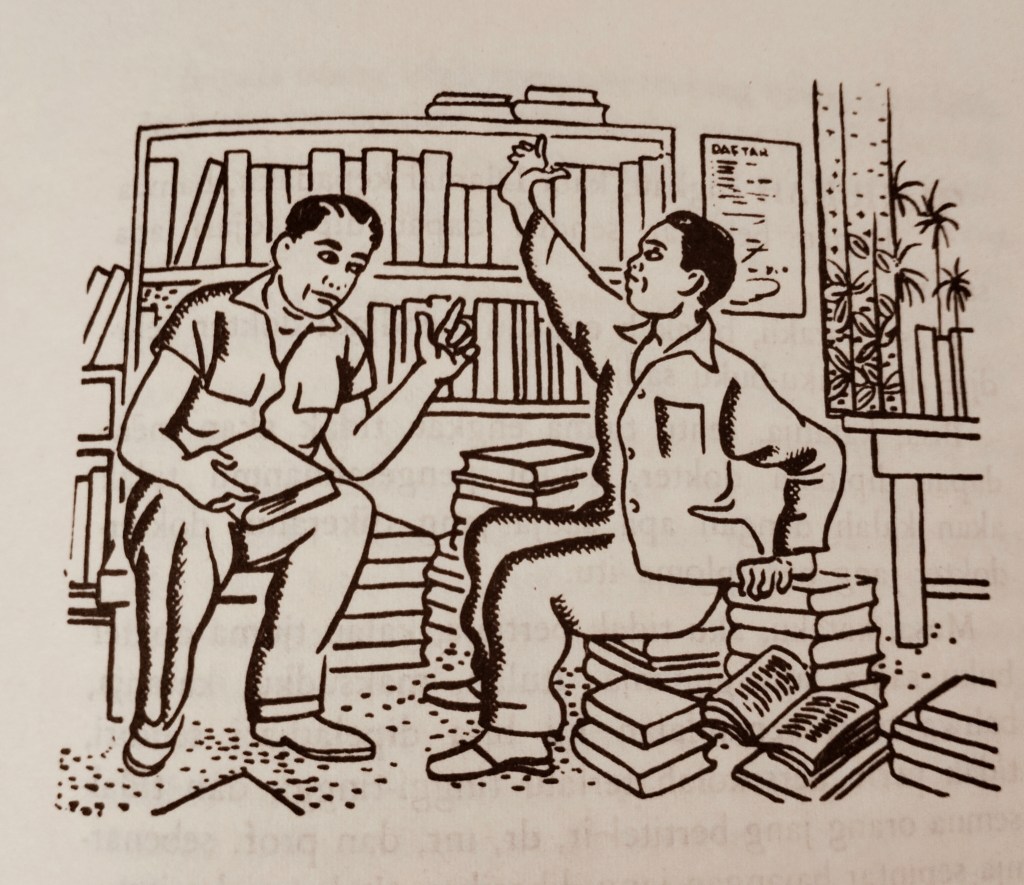
Source: Si Djamal Dan Buku-Buku (Young Jamal And His Books) is a story from the short story collection of Lubis, Mochtar. Si Djamal : dan tjerita2 lain / oleh Mochtar Lubis Gapura Djakarta 1950, p. 5.
Featured image credit: Lieutenant Governor General Van Mook appears with his wife on the steps of the government palace on Medan Merdeka in Jakarta, Indonesia for a festivity (1947) https://resolver.kb.nl/resolve?urn=urn:gvn:NFA02:cas-10076-4. In post image from Si Jamal dan Buku-Buku illustration by Nasrun AS. See other work by and about Nasrun AS:
- Amura. & Nasrun A. S. 1952, Indonesia pertama kali dalam pameran internasional / [disusun oleh Nasroen A. S. dan Amura] Bulan Bintang [Djakarta
- Indonesia. Departemen Penerangan. & Nasrun A. S. & Alimin, H. D. P. Sati. & Man, I.T. 1953, Pahlawan kemerdekaan / Departemen Penerangan, [perentajana-penjelenggara Nasroen A.S. dan D.P. Sati Alimin ; pelukis I.T. Man … dan lain-lain] Departemen Penerangan [Jakarta
- Indonesia. Departemen Penerangan. & Nasrun A. S. & Alimin, H. D. P. Sati. & Man, I.T. 1960, Pahlawan kemerdekaan / Departemen Penerangan, [perentjana-penjelenggara Nasroen A.S. dab D.P. Sati Alimin ; pelukis I.T. Man … dan lain-lain] Departemen Penerangan [Jakarta
- Mappapa, P.L. (2016) Dulu Komik Indonesia Pernah Berjaya, detikx. Available at: https://news.detik.com/x/detail/intermeso/20161228/Dulu-Komik-Indonesia-Pernah-Berjaya/ (Accessed: 2 January 2023).
- Nasrun A. S. & Pandy, J. C. & Indonesia. Departemen Penerangan. 1956, Indonesia, an invitation / [Photographs: Ministry of Information, Republik-Indonesia, Djakarta ; front cover photograph: J.C. Pandy, Sanur (Bali) ; layout: Nasroen A.S., Djakarta] W. van Hoeve Bandung ; The Hague
- Yayasan Idayu; Perpustakaan Nasional. ([1940]). gambar bersama [gambar] : gambar bersama (dari kiri ke kanan) : Masah Alif Baharoedin Turki (wartawan), Nasrun A.S.. (Note: 3 foto : hitam putih ; 11,5 x 8,5 cm.)
Random reflections:

 Stories From Indonesia