False Green Narratives: The Real Impact of the Nickel Mining Behind Electric Vehicles
By Nofi Yendri Sudiar for Kompas.com, June 10, 2025
Electric vehicles are now touted as the symbol of a low-carbon future. Wealthy nations race to adopt them in order to curb emissions and fight climate change. Yet behind these silent, “clean” vehicles lies a loud and wounded story: nickel mines ravaging the environment and sidelining local communities right across eastern Indonesia. This phenomenon begs the question: are we witnessing true technological progress, or global-scale greenwashing?

Electric Vehicles: Green on the Road, Gray at the Source
There is no doubt that electric vehicles produce far fewer emissions than their fossil-fuel counterparts. But to run, they rely on lithium-ion batteries packed with critical metals—nickel chief among them.
Home to the world’s largest laterite nickel reserves, Indonesia has been the prime target for mining and smelter investment over the past decade. Unfortunately, the nickel mining carried out in the eastern parts of the country such as Obi Island, Halmahera Island, and more recently in the Raja Ampat archipelago in southwest Papua, often proceeds with scant regard for its sustainability.

Massive deforestation, coastal sedimentation, river pollution, and the erosion of customary land rights are rampant across many concession areas. Local people—especially fishermen and indigenous land owners and communities—are typically excluded from decision-making and seldom enjoy fair economic benefits.
This is greenwashing: portraying an activity or product as eco-friendly when in reality it inflicts harm.
In this case the nickel industry is packaged into slogans like “for a green future,” “supporting the global energy transition,” and “reducing world emissions.” These messages are broadcast by corporations, governments, and even consumers in the Global North who buy electric vehicles without bothering to find out the ecological footprint of their batteries.
The hypocrisy becomes sharper when mines causing environmental destruction are spun as “contributions to climate-change mitigation.” Emissions reduced in wealthy cities are simply displaced—replaced by pollution and habitat degradation at the mine sites, which ironically lie in areas rich in biodiversity and indigenous cultures.
Damage in Mining Regions
The situation in the Raja Ampat archipelago has drawn fresh scrutiny recently. World-famous for its vibrant pristine reefs and marine life, the region now faces the threat of nickel-mine expansion.
Reports indicate that mining areas there have nearly tripled in the past five years. Sediment runoff from these operations is bleaching coral reefs and disrupting marine ecosystems, including protected species such as the manta ray and hawksbill turtle. Fisherfolk have lost fishing grounds, and tourism operators are growing alarmed. Yet these impacts are buried beneath a chorus of “for the energy of the future.”
A similar story has been unfolding in Halmahera Island, home to the O’Hongana Manyawa indigenous community, whose livelihood and culture continue to depend on the forest. In a viral video recently, community members blocked heavy machinery headed for new mine clearings. They don’t grasp the technicalities of electric vehicles or the global energy transition. What they do know is that their forest is vanishing, their rivers are being polluted, and the song of endemic bird life is fading.
Ironically, these mining ventures are often tied to claims of meeting Sustainable Development Goals (SDGs), especially Goal 13, which focuses on Climate Action. However, a global energy shift that slashes emissions by supercharging ecological and social destruction in developing countries really misrepresents the spirit of the United Nations’ Sustainable Development Goals.
SDG 13 calls not only for climate-change mitigation, but also for equitable adaptation, the protection of vulnerable ecosystems, and respect for the rights of local communities. If nickel mining wrecks coastal lands, contaminates water sources, and sacrifices indigenous peoples, then it’s not a climate solution—it’s just a new face on old global inequities.
A Fair Energy Transition
Swapping gasoline for batteries isn’t enough. A technology shift unaccompanied by changes in extraction practices and power relationships simply perpetuates old injustices: clean North, dirty South.
The answer lies in the principle of a “just energy transition.” Nickel mining must respect the environment, engage local communities meaningfully, and distribute benefits equitably. Rigorous environmental audits, transparent corporate social responsibility disclosures, and formal recognition of indigenous rights are non-negotiable.
Moreover, the world has to invest seriously in resource-efficient battery technologies, critical-metal recycling, and reducing unnecessary energy consumption. We cannot let the obsession with “green vehicles” carve ever-deeper ecological wounds.
The transition to clean energy is both a moral and scientific imperative—but we must not accept the “green” label without asking who pays the costs. Green isn’t just a paint color or corporate slogan; it must be real upstream, downstream, and everywhere in between. If it is not, electric vehicles remain a hollow symbol of an empty progress built on environmental and social destruction.
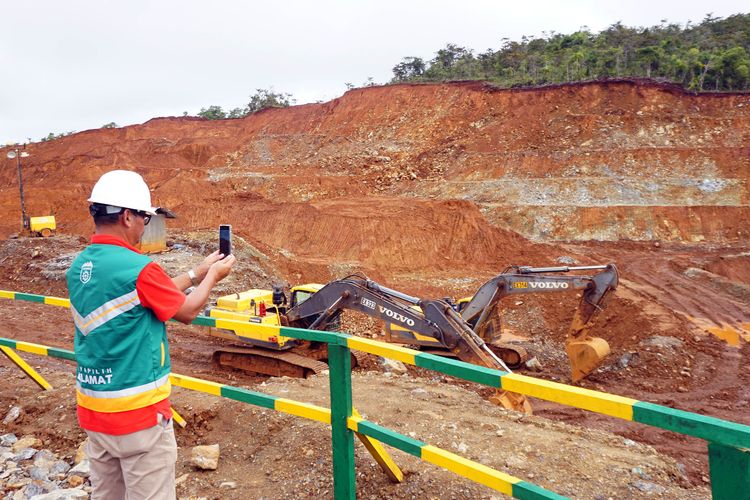
Director of government owned nickel miner PT Gag Nikel, Aji Priyo Anggoro, takes a photo at an open cut pit temporarily halted on Gag Island, West Waigeo District, Raja Ampat Regency, Southwest Papua, Sunday 8 June 2025. PT Gag Nikel is investigating if its mining operations are being carried out in accordance with the principles of sustainable mining and the relevant environmental regulations through the use of post-mining reclamation measures and waste processing that meets quality standards so as not to damage ecosystems on the island. (ANTARA PHOTO/Olha Mulalinda)
Nofi Yendri Sudiar is a university lecturer, head of the Research Center for Climate Change (RCCC) and Coordinator of Climate Change Management at the SDGs Center of Padang State University in West Sumatra.
This post is based on https://lestari.kompas.com/read/2025/06/10/053937886/narasi-hijau-palsu-dampak-nyata-tambang-nikel-di-balik-mobil-listrik. Featured image credit: Floods due to heavy rains at Porto Alegre airport left a plane stranded on the runway in Rio Grande do Sul, Brazil, last year. Photograph: Diego Vara/Reuters https://www.theguardian.com/environment/ng-interactive/2025/jun/24/tipping-points-climate-crisis-expert-doomerism-wealth.
In related news:
- https://nasional.kompas.com/read/2025/08/15/11583091/prabowo-dapat-laporan-ada-1063-tambang-ilegal-kerugiannya-minimal-rp-300
- https://www.bloomberg.com/news/articles/2025-08-15/prabowo-signals-intention-to-go-after-illegal-mines-in-indonesia
- China Downstream: The Tentacles of Indonesia’s Nickel Oligarchy, Project Multatuli & Viriya Singgih, February 2, 2024
- Fatalities, Work Accidents, Union Suppression and Worker Criminalization: The Fate of Indonesian and Chinese Workers at the PT GNI Nickel Smelter #1, Permata Adinda and Muammar Fikrie for Project Multatuli, May 26, 2023
- Indonesia’s Anti-Corruption Police Reluctant to Disclose Powerful Backers of Illegal Gold Mining Operation, Tempo Magazine, By Dinda Shabrina and Iqbal Muhtarom for Tempo.co, October 18, 2024
- What’s the True Cost of Your Nickel? Greenpeace Pictures of the Week, Greenpeace International, 6 June 2025
- Indonesia revokes nickel ore mining permits in Raja Ampat after protest, Reporting by Stanley Widianto; Editing by David Stanway for Reuters, June 10, 2025
- Revocation of PT Gema Kreasi Perdana (GKP)’ Mining Licence: Victory for the People of the Small Island of Wawonii, Mining Advocacy Network, 17 June 2025
- The fate of the O’Hongana Manyawa indigenous people around Tesla’s supply chain in Halmahera by Viriya Singgih, BBC News Indonesia, 1 Agustus 2024
- Raffi Ahmad’s Business Tentacles: Supported by the President’s Family, Nickel Bosses, and Golkar Party Officials, By Alfian Putra Abdi, Project Multatuli, 17 October 2024
- The Apocalypse Has Arrived: Like a slow moving apocalypse, moment by moment, by Iqbal Lubis, Bollo.id, 28 October 2024
- Save the Small Islands of Indonesia, Mining Advocacy Network, 30 April 2021

 Stories From Indonesia
Leave a Reply