
Museum Sebagai Mesin Pengetahuan: Wacana Orientalisme dalam Kritik Edward Said
Orientalism (1978) karya Edward Said adalah teks fundamental dalam studi pascakolonial yang mengkritik bagaimana dunia Barat mengonseptualisasikan dan merepresentasikan suatu tempat yang dinamakan Timur. Meskipun Said tidak membahas secara ekstensif peran khusus museum sebagai institusi dalam membentuk wacana orientalis, analisisnya yang lebih luas memberikan wawasan tentang museum sebagai bagian dari mesin budaya yang membangun dan menyebarkan pengetahuan tentang dunia “Timur.” Berikut adalah beberapa kutipan penting dari Orientalism yang berhubungan dengan institusi museum dan perannya dalam kerangka orientalisme:
1. Museum sebagai Situs Produksi Pengetahuan
“Sepanjang para sarjana Barat menyadari keberadaan orang-orang Timur kontemporer, mereka umumnya menulis tentang mereka sebagai objek studi yang tidak berpartisipasi, yang perannya adalah untuk mengonfirmasi validitas teks-teks kuno yang mereka pelajari.”
(Orientalism, hal. 52)
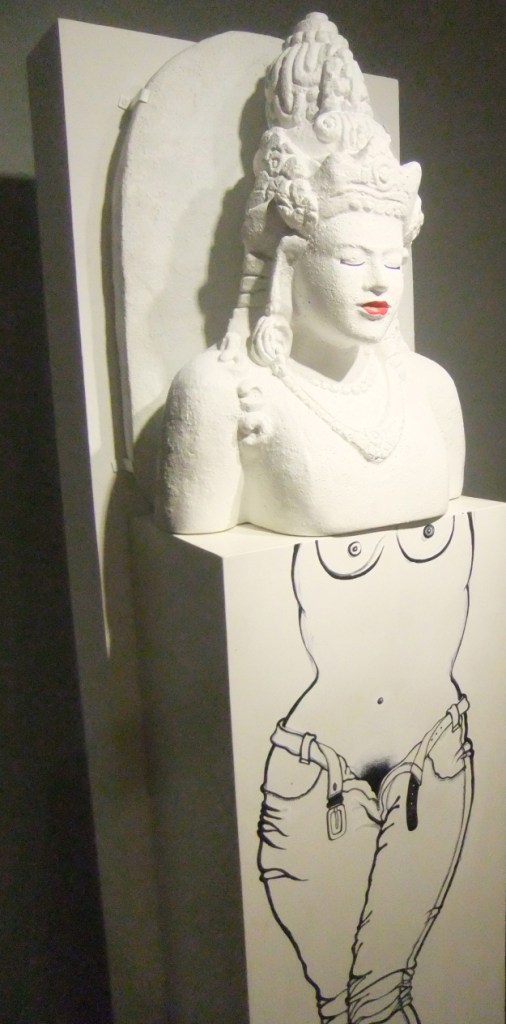
Kutipan ini, meskipun tidak secara eksplisit tentang museum, mencerminkan etos produksi pengetahuan orientalis. Museum, sebagai institusi yang memamerkan benda-benda dari Timur, mewujudkan perlakuan terhadap budaya Timur sebagai sesuatu yang statis dan terobjekkan, bukan dinamis dan kontemporer.
https://www.nationalgallery.sg/sg/en/our-collections/search-collection.artwork.html/national-collection/jim-supangkat/1996/1996-00215.jpg.html)
2. Kekuasaan Institusional dan Produksi Pengetahuan
“Pengetahuan tentang Timur, karena dihasilkan dari kekuatan, dalam arti tertentu menciptakan Timur, Orang Timur, dan dunianya. Dengan cara yang cukup konsisten, orientalisme bergantung pada strategi ini, yang memberikan keunggulan posisi kepada orang Barat dalam berbagai hubungan dengan Timur tanpa pernah kehilangan kedudukannya yang lebih unggul.”
(Orientalism, hal. 40)
Museum mencerminkan “keunggulan posisi” ini dengan mengatur, mengategorikan, dan memamerkan artefak-artefak Timur dalam kerangka Barat, yang pada akhirnya membentuk narasi yang memperkuat dominasi Barat.
3. Museum dan Representasi Statis Budaya
“Seseorang tidak boleh menganggap bahwa struktur orientalisme hanyalah struktur kebohongan atau mitos yang memutarbalikkan kebenaran tentang Timur. Sebaliknya, orientalisme lebih merupakan disiplin sistematis dalam pengumpulan material manusia dan gagasan untuk mengelola—dan bahkan memproduksi—Timur secara politis, sosiologis, militer, ideologis, ilmiah, dan imajinatif.”
(Orientalism, hal. 73)
Kritik terhadap orientalisme sebagai “disiplin sistematis” ini dapat diperluas pada museum sebagai institusi yang berpartisipasi dalam pengumpulan dan pengorganisasian artefak, menyajikan budaya Timur secara statis dan eksotis.
4. Mengumpulkan dan Mengapropriasi Timur
“Pada abad ke-19, pengunjung Eropa ke Timur dapat menyaksikan hampir setiap detail sejarah kuno dan modernnya, warisan dan monumen klasiknya, serta kebiasaan ‘Oriental’ yang khas, dengan mata yang terpelajar (dan tidak selalu imajinatif).”
(Orientalism, hal. 100)
Museum sering menjadi puncak dari pandangan ini, tempat “mata yang terpelajar” dapat melihat budaya material Timur yang dikurasi melalui lensa otoritas dan ketidakpedulian ilmiah Barat.
5. Keilmuan Orientalis dan Kerangka Institusional
“Hubungan antara Barat dan Timur adalah hubungan kekuasaan, dominasi, dan berbagai bentuk hegemoni yang kompleks… ini lebih merupakan distribusi kesadaran geopolitik ke dalam teks-teks estetis, ilmiah, ekonomi, sosiologis, historis, dan filologis.”
(Orientalism, hal. 12)
Museum termasuk dalam “distribusi kesadaran geopolitik” ini, mengubah artefak menjadi simbol pengetahuan dan kontrol Barat, menyajikannya melalui narasi estetis dan ilmiah yang hegemonik.
Sintesis dan Analisis
Meskipun Orientalism karya Said tidak secara eksplisit menganalisis museum sebagai subjek yang berdiri sendiri, kutipan-kutipan di atas menunjukkan kritik institusional yang lebih luas yang relevan dengan museum sebagai bagian dari mesin Barat untuk membangun pengetahuan tentang Timur. Museum bertindak sebagai tempat penyimpanan di mana “pengumpulan material manusia” dan “keunggulan posisi” mewujud secara fisik melalui koleksi dan pajangan yang mencerminkan ideologi orientalis.
The Museum and Orientalism
Edward Said’s Orientalism (1978) is a foundational text in postcolonial studies that critiques how the West conceptualizes and represents the East. While Said does not devote extensive discussion specifically to the role of museums as institutions in shaping Orientalist discourse, his broader analysis provides insights into the museum as part of the cultural machinery that constructs and disseminates knowledge about the “Orient.” Below are key quotes from Orientalism that relate to museums and their institutional role in Orientalist frameworks:
1. Museums as Sites of Knowledge Production
“To the extent that Western scholars were aware of contemporary Orientals, they generally wrote about them as non-participating objects of study whose role was to confirm the validity of the timeless texts they studied.”
(Orientalism, p. 52)
This quote, while not explicitly about museums, captures the ethos of Orientalist knowledge production. Museums, as institutions that display objects from the Orient, embody this treatment of cultures as static and objectified, rather than dynamic and contemporary.
2. Institutional Power and the Production of Knowledge
“Knowledge of the Orient, because generated out of strength, in a sense creates the Orient, the Oriental, and his world. In a quite constant way, Orientalism depends for its strategy on this positional superiority, which puts the Westerner in a whole series of possible relationships with the Orient without ever losing him the relative upper hand.”
(Orientalism, p. 40)
Museums reflect this “positional superiority” by organizing, categorizing, and displaying artifacts of the East within a Western framework, thus constructing a narrative that reinforces Western dominance.
3. Museums and the Static Representation of Culture
“One ought never to assume that the structure of Orientalism is nothing more than a structure of lies or myths which were the truth about the Orient but distorted through prejudice. Rather, Orientalism is more particularly a systematic discipline of accumulation of human material and ideas to manage—and even produce—the Orient politically, sociologically, militarily, ideologically, scientifically, and imaginatively.”
(Orientalism, p. 73)
This critique of Orientalism as a “systematic discipline” can be extended to the museum as an institution that participates in the accumulation and organization of artifacts, presenting them in a way that reinforces the static, exoticized image of the Orient.
4. Collecting and Appropriating the East
“By the nineteenth century, the European visitor to the Orient could survey almost every detail of its ancient and modern history, its ‘classical’ heritage and monuments, its peculiar ‘Oriental’ customs, with a learned (and not necessarily an imaginative) eye.”
(Orientalism, p. 100)
Museums often served as the culmination of this gaze, where the “learned eye” could behold the Orient’s material culture, curated through a lens of Western authority and scholarly detachment.
5. Orientalist Scholarship and Institutional Frameworks
“The relationship between Occident and Orient is a relationship of power, of domination, of varying degrees of a complex hegemony…it is rather a distribution of geopolitical awareness into aesthetic, scholarly, economic, sociological, historical, and philological texts.”
(Orientalism, p. 12)
Museums fit into this “distribution of geopolitical awareness,” transforming artifacts into symbols of Western knowledge and control, presenting them through a hegemonic aesthetic and scholarly narrative.
Synthesis and Analysis
While Said’s Orientalism does not analyze museums explicitly as standalone subjects, these quotes illustrate the broader institutional critique that applies to museums as part of the Western machinery for constructing knowledge about the East. Museums act as repositories where the “accumulation of human material” and “positional superiority” manifest physically through collections and displays that reflect Orientalist ideologies.
Examples
Certainly! Below are examples of Indonesian objects or texts held in European or North American museums that illustrate each category discussed in my previous response:
1. Museum as a Site of Knowledge Production
- Example: The Lontar Manuscripts held at the British Library (UK)
These are ancient Javanese texts written on palm leaves. The manuscripts are often presented as exotic artifacts of a “lost” or “timeless” culture, reinforcing the Orientalist framing of Indonesian civilization as ancient and static rather than part of a living, evolving tradition.
2. Institutional Power and the Production of Knowledge
- Example: The Makara from Borobudur at the Tropenmuseum (Netherlands)
This intricate stone carving from the 8th-century Buddhist temple Borobudur is displayed in a way that emphasizes Dutch expertise in archaeology, while sidelining the indigenous spiritual and cultural significance of the artifact.
3. Museums and the Static Representation of Culture
- Example: Kris (Traditional Javanese Dagger) at the Metropolitan Museum of Art (USA)
The Kris is often exhibited as a decorative or ceremonial object, detaching it from its complex symbolism, spiritual meaning, and the living cultural practices surrounding it in contemporary Indonesia.
4. Collecting and Appropriating the East
- Example: Textiles from Sumatra at the Victoria and Albert Museum (UK)
These textiles, prized for their craftsmanship, are displayed as luxury goods or examples of exotic design, rather than products of vibrant local economies and cultural expressions of identity and social status.
5. Orientalist Scholarship and Institutional Frameworks
- Example: Wayang Kulit Puppets at the Smithsonian Institution (USA)
These puppets are often displayed without the context of the complex storytelling traditions and philosophical teachings they embody, reducing them to mere curiosities rather than dynamic cultural artifacts that convey moral and social narratives.
Summary
These examples illustrate how Orientalist frameworks, as described by Edward Said, manifest in the curation and presentation of Indonesian cultural artifacts. Museums in the West often privilege their own scholarly interpretations over the voices and living traditions of the cultures they represent, thus participating in the broader project of knowledge production critiqued in Orientalism.
Featured image credit: Litho naar een oorspronkelijke tekening van F.C. Wilsen. 3728-434 (litho, papier, kleurenlitho), Koloniale Wereldtentoonstellingen, Koninklijk Instituut voor de Tropen/Tropenmuseum. Copyright Koninklijk Instituut voor de Tropen/Tropenmuseum.
In related news:





Leave a Reply