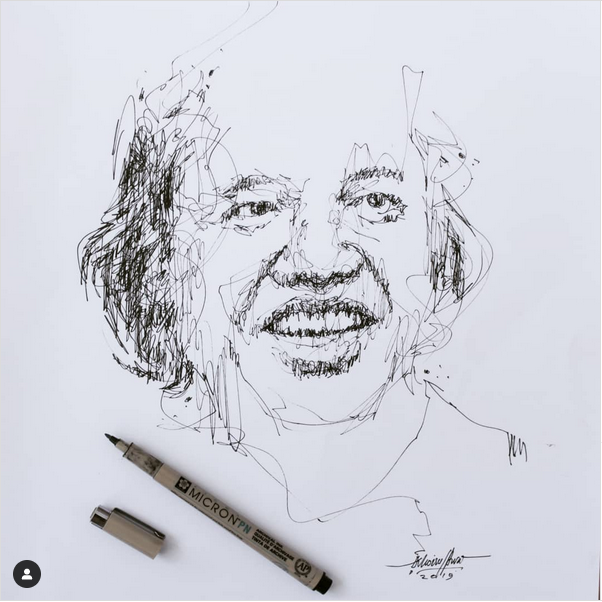
Mrs Geni in December
A Short Story by Arswendo Atmowiloto1
For Mrs Geni, every month is December. Last month, this month, or next month, they all mean December. So if you have to deal with Mrs Geni, it’s better not to rely on dates but rather on the day. If you want to book her, you have to say, “Two Fridays from this Friday.” If you say the seventeenth, you could be in trouble because the seventeenth won’t necessarily be a Friday. If you book her for the seventeenth, she just might not show up on the day.2
The problem is a great many people deal with Mrs Geni. For anyone wanting to arrange the wedding of a child, there is only one choice. Mrs Geni. Bridal makeup artist.3 There are many other bridal makeup artists, but none that can match Mrs Geni. Even after considering the many other beauty salons, people stay with the choice of Mrs Geni.
According to past clients, Mrs Geni is no ordinary makeup artist. She can transform a would-be bride and make her so beautiful she is truly stunning. Unrecognizable. One of her specialties is infusing cigarette smoke onto the face of a would-be bride.4 According to tradition, she explains, this is bronzing. The application of a bronze, not golden, hue to the skin. Almost every bridal makeup artist uses the technique, but none can match her skill. At one wedding, the host fainted because she thought the daughter she was marrying off had disappeared. The mother of the bride-to-be fainted, the father was embarrassed, and all the relatives started to search for the bride at friends’ houses. Even after she was found, the mother of the bride-to-be couldn’t accept it. “That is not my child! That is not my child!” she exclaimed.
“Well, if she isn’t your child, that makes her my child. Let’s go home.”
Only later the mother of the bride-to-be realized, and said, “How is it possible that my child could be as beautiful as this?”
Despite this, Mrs Geni does not always please everyone. Her voice is loud and the people who have to listen to her do become annoyed. “This child is already pregnant. Why are you hiding it? Why are you embarrassed? To have children, to be able to become pregnant, is a gift. This is not something to be covered up, to be squeezed down with clothes. After all, it’s your own child.”
If I am not mistaken, the incident happened at the house of a district head. As a result the news spread and continued to reverberate long after the incident was over. Another wedding ceremony was almost cancelled simply because Mrs Geni could see an unhappy face on the bride-to-be. Usually two or three days before a ceremony, Mrs Geni needs to meet with the bride-to-be in person. Why not with the bridegroom-to-be? “Well, his fate rests right here, doesn’t it.”
When she met the soon-to-be bride who she felt was wearing a sad face, Mrs Geni said, “Can’t be like this. You have to start off happy.” No matter that the invitations had already been sent out, the reception hall paid for in advance, and more importantly, the food already prepared. If it had ended in cancellation, the story would have been unremarkable. What was unusual was that two days later, a bus crashed over a cliff into a gorge. It turned out that if the wedding had actually gone ahead and had not been cancelled, the bridegroom-to-be would probably have gone into the gorge, because he had, in fact, planned to travel on that very bus at that very time. Mrs Geni’s story continues next with the time she was asked to prepare the makeup of the daughter of a government minister – possibly a senior coordinating minister – but she replied, “Just tell the daughter come to my house. A lot of people here are going to be inconvenienced if I have to leave them.”5
Last 17th of August, the residents of her neighborhood waited to see whether Mrs Geni would put up the national red and white flag at her house, because according to Mrs Geni that is the essence of the 17th of August. As it turned out, Mrs Geni did have a flag put up. “What’s wrong with flying the flag on the 17th of December?” she asked.
The officials in the village were happy too, because if Mrs Geni hadn’t displayed the flag on the anniversary of independence, there could have been trouble. On the following the 31st of December, Mrs Geni didn’t object to having a party at her house. But to her, the following day wasn’t New Year’s Day but rather the first of December again.
Many people say that Mrs Geni’s magic is to always appear young. And Mrs Geni does indeed seem to have always looked the same, whether it was doing the makeup for a neighbor, or doing it for her own child. Her face and presentation have been the same. Photos taken at the time can prove this along with photos taken over the succeeding twenty years. And maybe the twenty years before that.
“Marriage is the most illogical of ceremonies. It causes a lot of trouble. You all stress about working out an auspicious date, what sort of matching clothes to wear. And none of it has any connection with the marriage itself. Just look at the people who make the speeches at weddings, the people delivering advice to the newlyweds. That is the most boring part, the part listened to the least. But it’s always included. That’s weddings for you.” It is rather strange for these words to come from Mrs Geni, because she in fact makes her living from weddings. “Yes, it is strange. Isn’t marriage a strange thing. Because something strange is thought of as normal, the people who do not marry, who are widows or widowers, are even thought of as strange.”
On a different occasion Mrs Geni said, “The strange expression ‘soul mate’ hides the fear or questions that we don’t have the courage to answer. ‘Oh, such and such is my soul mate.’ We commonly speak like that. Or if it fails, ‘Oh, such and such was not my soul mate.’” Mrs Geni then laughs at length. “So, is my soul mate actually Mr Geni? Because I married Mr Geni, he becomes my soul mate. Not, because Mr Geni was my soul mate therefore I married him. It would have been different if before that I hadn’t married Mr Geni. Then he wouldn’t have been my soul mate.”
Why marry Mr Geni at the time?
“Well, because it was time to get married, like everybody else.”
Does that then mean it wasn’t out of love that I married Mr Geni?
“As with soul mates, as soon as you marry, well, that has to be accepted as love. That is more important. Because if you rely on love beforehand, it might not last. What you have, that is what you love, whether there is love there before or not.”
The question arises because there is word that Mr Geni is to marry again. “Yeah, don’t worry about that. And I will do the makeup for the bride,” she says easily in a flat, almost emotionless tone. “To try to forbid it would be hard and it would be useless anyway. Just let him do it.”
Maybe that is the reason Mrs Geni is still happy to do the makeup of the soon-to-be brides who are to become second or third wives. “Let people experience joy once in their lives.” For Mrs Geni marriage is joy, happiness. “If someone does not even experience joy when they marry, they aren’t going to find any other joy.”
According to Mrs Geni, no marriage really fails because marriage itself is not a success. “All you need is a little courage and a lot of foolishness. That is what is needed for a marriage. In order to divorce, on the other hand, you need to have a lot of courage and a small amount of foolishness.”
Has Mrs Geni ever thought about divorcing Mr Geni?
“I’ve never thought about getting divorced. Have I thought about killing him? Often.”
And so, Mrs Geni, bridal makeup artist, has done the makeup for all the women in her village. You could say for everyone who has been married, as well as for those who have not. The latter Mrs Geni makes up as bodies when women pass away having never married. Before burial, Mrs Geni makes them up completely. Many people do not approve. For many people it is regrettable. Still others fear being made up. “Frightened it will come to pass during the marriage. Frightened of being too happy, too free, too enjoyable. So that is why we commit ourselves to a marriage that regulates responsibilities so much, regulates obligations, including the provision of a living and the raising of children. Only it’s strange, but basically we’re afraid of our own happiness and limit it through the existence of the power of God.”
Even though she says humanity’s most limiting and frightening discovery is marriage, Mrs Geni continues to prepare people’s makeup, still uses the infusing of cigarette smoke. For someone who is able to make time for herself – even though it is still tied to December – Mrs Geni is able to do the makeup for people, bodies, bridal statues and trees, as well as buffaloes. Mrs Geni also chants the bridal mantra, breathes the three breaths onto the crown of the bride’s head, with the same seriousness she uses to fast before making someone up. “Let the buffaloes experience happiness, just as we have believed all this time that marriage is happiness.”
Fortunately all of this only happens in December.
Mrs Geni in December (Bu Geni di Bulan Desember) by Arswendo Atmowiloto was first published in the national daily newspaper Harian Kompas on 20 May 2012. Retrieved from https://cerpenkompas.wordpress.com/2012/05/20/bu-geni-di-bulan-desember/
For a contrasting representation of marriage, consider comparing the short story Inem by Pramoedya Ananta Toer.
Featured image credit: “Tribute to Arswendo Atmowiloto” by Karikatoer (Khoirul Anwar), https://www.instagram.com/karikatoer/.
“The procession pours water over the heads of the bride and groom in a traditional Deli wedding. The Deli people are a Malay community who inhabit the Deli Serdang area and Medan City.“
Footnotes:
- Arswendo Atmowiloto (born March 4, 1948) is a renowned Indonesian writer, journalist, and playwright known for his impactful contributions to Indonesian literature and media. He began his literary career in the 1970s, writing novels, short stories, and essays that often explored complex social and political issues in Indonesia. Arswendo’s writing is marked by its thought-provoking narratives and a deep understanding of Indonesian society. He has a unique ability to capture the intricacies of human relationships and the evolving dynamics of the nation in his works. Some of his most celebrated literary works include “Kekasihku” (My Love) and “Satu Jam Lebih Dekat” (One Hour Closer). Apart from his literary accomplishments, Arswendo is also recognized for his influential role in Indonesian journalism. He has worked for various prominent media outlets and has been a strong advocate for press freedom and ethical journalism in the country. He’s been involved in numerous social and political issues, using his writing and media presence to address important topics. Arswendo’s enduring legacy in Indonesian literature and media is a testament to his dedication to intellectual discourse and his commitment to raising awareness about crucial societal matters. His work continues to inspire and provoke thought among readers and journalists in Indonesia and beyond. A short bio and list of works is available at https://badanbahasa.kemdikbud.go.id/tokoh-detail/3380/arswendo-atmowiloto. Arswendo passed away at Jakarta on 19 July 2019 aged 70. ↩︎
- Each year on the 17th of August, Indonesia commemorates its Independence Day with various festivities and traditions. One of the notable practices in villages across the country is the Panjat Pinang (Pole Climbing) competition. This is a fun and traditional game where a tall, greased pole (pinang) is erected, and various prizes are placed at the top. Participants, often children and young adults, form teams to climb the slippery pole in an attempt to reach the prizes. The challenge lies in the slippery surface, making it a comical and exciting event. The Panjat Pinang competition is a symbol of the struggle for independence, as it reflects the determination, unity, and teamwork needed to overcome challenges. It also serves as a reminder of the hardships faced by Indonesians during their fight for freedom from colonial rule. In addition to Panjat Pinang, Independence Day celebrations in villages typically include flag-raising ceremonies, traditional dances and music, parades, and various community activities. The day is a time for Indonesians to come together, showcase their national pride, and honor their hard-won independence. ↩︎
- Bridal make-up artists have a variety of roles in the community. They are essential in various aspects of the wedding process and the preservation of cultural traditions. Here’s a very broad general overview of their roles:
Wedding Preparation and Guidance: Perias pengantin, often referred to as wedding makeup artists and cultural consultants, are responsible for preparing the bride and groom for their wedding day. This includes applying traditional makeup, hair styling, and dressing the couple in accordance with cultural and regional customs. They ensure that the bride and groom look their best while adhering to the traditions.
Cultural Knowledge and Rituals: Perias pengantin possess a deep understanding of cultural and regional wedding customs and rituals. They guide the couple and their families through the various ceremonial stages of the wedding, ensuring that each tradition is followed correctly. This knowledge is crucial in preserving the cultural significance of the wedding ceremony.
Symbolism and Meaning: These professionals are experts in the symbolic meaning of each ritual and the attire worn by the bride and groom. They help convey the cultural significance of each element to the couple, enhancing their understanding of the traditions they are partaking in.
Community Connection: Perias pengantin often have strong ties within the community and access to local resources. They can help the couple find the right vendors, such as caterers, decorators, and musicians, who are experienced in traditional wedding customs.
Emotional Support: In addition to their practical roles, perias pengantin also offer emotional support to the bride and groom, helping them navigate the stress and excitement of their wedding day. You might find some useful background in the following:
https://repository.dinamika.ac.id/id/eprint/2555/ (Chapter 2)
https://gpu.id/author/35900/m-deddy
https://ejournal.unesa.ac.id/index.php/jurnal-tata-rias/index
https://ejournal.unp.ac.id/index.php/jhet/article/view/10594 ↩︎ - The practice of using asap rokok (cigarette smoke) is also described in Prasdi, A.K. and Putra, D.R., 2023. Perancangan Visual Book Tentang Prosesi Riasan Pengantin Khas Solo Putri untuk Pelestarian Budaya Jawa [Designing a Visual Book About the Typical “Putri Solo” Bridal Makeup Procession for Preserving Javanese Culture]. Desainpedia Journal of Urban Design, Lifestyle & Behaviour, 2(1), pp.42-51. http://ojs.upj.ac.id/index.php/Desainpedia/article/view/727 on p. 48 and Kurniawati, S.U.C.I., 2019. Ajian Sembogo dalam Merias Pengantin dan Implikasinya Terhadap Aqidah Islam di Desa Ngadimulyo Kecamatan Kedu Kabupaten Temanggung [The copper spell in bridal make-up and its implications for Islamic faith in Ngadimulyo Village, Kedu District, Temanggung Regency] [Universitas Islam Negeri Walisongo]. http://eprints.walisongo.ac.id/id/eprint/12203/. ↩︎
- On 24 November 2011, in what at the time was seen by some as the marriage of two important political dynasties, the youngest daughter of Coordinating Minister for Economic Affairs and General Chair of the National Mandate Party (PAN) Mr. Hatta Rajasa, Ms Siti Ruby Aliya Rajasa, married the youngest son of Indonesia’s President Mr. Susilo Bambang Yudhoyono and Chair of the national executive committee of his father’s Democrat Party (PD), Mr. Edhie Baskoro Yudhoyono (know as Ibas). See Efriza (2011). Perkawinan Politik 2011 [Political Marriage 2011]. DetikCom. [online] 22 Nov. Available at: https://news.detik.com/opini/d-1772715/perkawinan-politik-2011 [Accessed 4 Nov. 2023]. The writer is coordinator of Forum Demokrasi untuk Indonesia (FD.I); and https://www.thejakartapost.com/news/2011/04/27/ibas-and-aliya-get-engaged.html. For the history of another important political dynasty see Narratives to power: The case of the Djojohadikusumo family dynasty over four generations. ↩︎
Related:
- https://www.detik.com/jatim/berita/d-7211096/ibas-rajai-suara-pileg-dpr-ri-2024-di-jatim-bahkan-puan-pun-dilibas/amp
- https://nasional.tempo.co/read/1837300/real-count-kpu-ibas-jadi-caleg-dengan-perolehan-suara-terbanyak-se-indonesia-ungguli-puan
- https://news.detik.com/berita/d-7203871/ibas-turut-hadiri-pelantikan-ahy-jadi-menteri-atr-bpn


 Stories From Indonesia
Leave a reply to Obit: Vale Arswendo Atmowiloto – Indonesian Translation Service Cancel reply