Poorly Prepared for Forest Fires
Tempo.co Editorial, April 19, 2026
Based on the experience of how the Indonesian government managed the country’s recent catastrophic floods and landslides, we can imagine what might unfold as forest and land fires start to impact parts of the country in the wake of this year’s El Niño phenomenon. To begin with, the President might delay visiting affected areas due to “ineffective communication by his aides”.
Then response efforts might be inconsistent, relying on local community charities due to budget constraints. Disaster management organizations might not function properly because of non-technical issues, including competition among the President’s aides. The President’s impulsive leadership style might exacerbate the situation, with disasters being addressed superficially, rather than the root cause being tackled: how to prevent the fires, not just how to extinguish them.
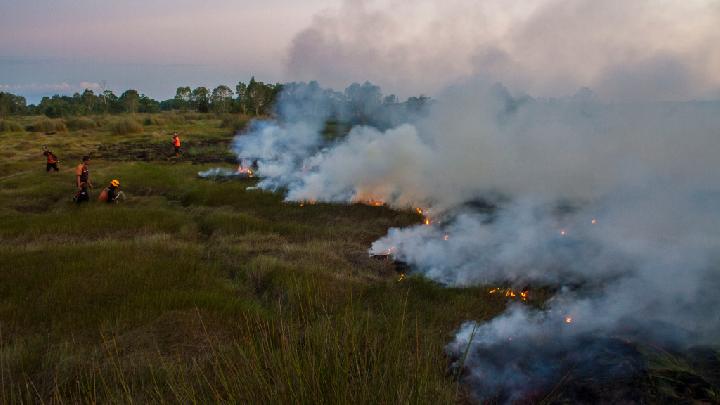
In the lead-up to the current extended dry season, forest and land spot fires have already broken out in parts of Riau, Central Kalimantan, and West Kalimantan provinces. There are predictions that drought and forest and land fires will continue to spread throughout the coming year. Fatalities have already been reported at the sites of some fires: in Bengkalis regency in Riau province neighboring Singapore a firefighter has lost their life while on duty and an elderly resident of West Kalimantan has died of smoke inhalation.
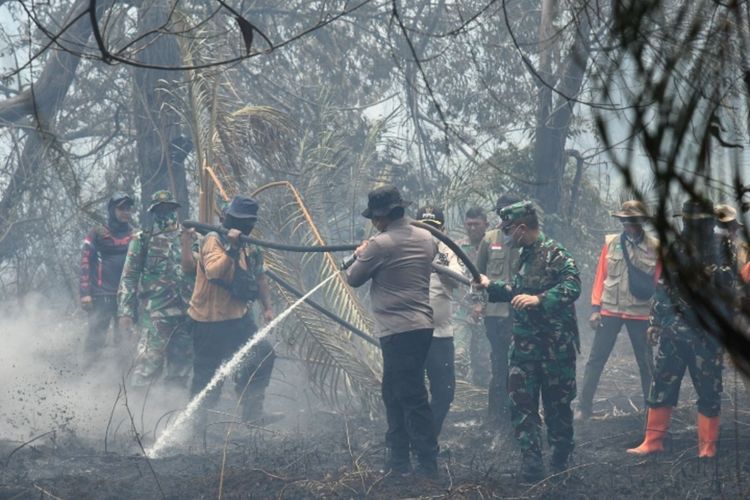
SiPongi, a fire monitoring platform operated by the Ministry of Forestry, records that the area affected by fires so far from January to March 2026 has reached 55,324 hectares, an area almost the size of the capital city Jakarta. By contrast, the area affected by fires in the first three months of 2015 was only 45,756 hectares.
That year was also impacted by an El Niño, with fires ultimately consuming 2.6 million hectares of forest and other land. The World Bank estimates that total losses from that disaster reached Rp 221 trillion ($13.3 billion), representing twice the cost of rebuilding northern Sumatra’s Aceh province after the 2004 Boxing Day tsunami.
Tempo magazine’s coverage has uncovered the government’s ineffective response to long-standing warnings from researchers. Forest fire management has suffered from a lack of clear coordination. In October 2025, the Coordinating Ministry for Political and Security Affairs disbanded the Forest and Land Fire Task Force, devolving the management of these issues to a range of ministries and agencies.
The disbanding of the Peatland and Mangrove Restoration Agency (BRGM) in late 2024 by the Prabowo government has further complicated the situation. Established to restore areas affected by the 2015 fires, the agency’s shuttering has left ambiguity about responsibility for the protection of peatlands. While some of BRGM’s former assets are now managed by the Ministry of Environment, many employees were assigned to the Ministry of Forestry.
The fragmented approach has resulted in the neglect of peatland management.
The destruction of peatland ecosystems, primarily due to forestry and plantation activities, is the principal cause of widespread forest and land fires.
At the end of August 2025, the government created the Peat and Mangrove Ecosystem Management Center under the Ministry of Environment. However, before it could commence operations, fires broke out. As the flames spread, the government, including ministries and government agencies, and regional governments, faced funding shortages due to government budget cuts.
The central government claims it has allocated an unlimited budget for forest and land fire management, but the reality is different. The National Disaster Management Agency, for instance, has a budget of only Rp 491 billion ($30 million), down from Rp 2.1 trillion ($127 million) the previous year. The budget shortfall has also been noticeable at the regional level, with Riau province for instance, rich in peatlands, allocating only Rp 3.6 billion ($0.22 million) for fire mitigation.
Given the chaotic nature of government disaster management, it is challenging to hope that the government can contain the spread of forest and land fires. As in previous years, a number of regions—including neighboring countries like Malaysia and Singapore—will have to brace for the impact of smoke haze.
Read the coverage in the April 19, 2026, Edition.
- Why Have Forest and Land Fires Spread to 22 Provinces
https://majalah.tempo.co/read/lingkungan/176217/mengapa-kebakaran-hutan-dan-lahan-meluas-hingga-22-provinsi (Indonesian) - Scramble to Halt the Forest Fires https://majalah.tempo.co/read/lingkungan/176215/lintang-pukang-menghalau-api-kebakaran-hutan-dan-lahan (Indonesian)
- How Severe Will the Impact of Super El Nino Be on Indonesia? https://majalah.tempo.co/read/lingkungan/176209/seberapa-parah-dampak-super-el-nino-pada-indonesia (Indonesian)
- Budget Strains to Combat Forest Fires https://majalah.tempo.co/read/lingkungan/176211/anggaran-seret-menangkal-kebakaran-hutan (Indonesian)
- Improving Peatland Governance: Where to Start? https://majalah.tempo.co/read/lingkungan/176201/membenahi-tata-kelola-rawa-
gambut-dari-mana-mulainya (Indonesian)
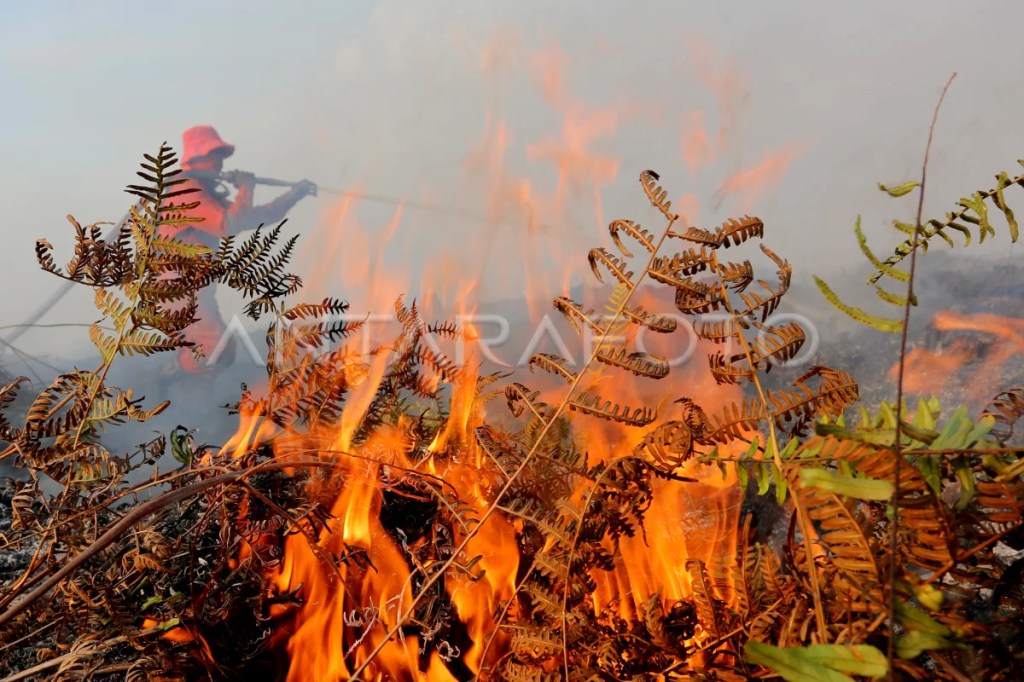
This post is based on https://www.tempo.co/kolom/tambal-sulam-mitigasi-kebakaran-hutan-2130042. Featured image credit: West Aceh Regional Disaster Management Agency (BPBD) officers fight forest and land fires in peatlands of Suak Nie Village, Johan Pahlawan, West Aceh, Aceh, Sunday (25/1/2026). Fires raging since Thursday (15/1) are suspected of being set to clear new land and continue to spread over 12 to 17 hectares across the districts of Johan Pahlawan, Woyla and Meureubo. ANTARA FOTO/Syifa Yulinnas/wpa, https://www.antarafoto.com/id/view/2714154/upaya-penanganan-karhutla-di-aceh-barat.
In related news:
- Heading into the Dry Season, the Meteorology, Climatology, and Geophysics Agency (BMKG) is Warning of Forest Fires in Riau and South Sumatra, kumparanNEWS, April 13, 2026 (Indonesian)
- https://www.tempo.co/lingkungan/karhutla-ribuan-hotspot-di-kawasan-konsesi-di-sumatera-2132098
In earlier news…
Bad News for South Sumatra: Palembang District Court Rejects Smoke Haze Lawsuit from Dozens of Residents
Greenpeace Indonesia, July 4, 2025
Palembang, July 4, 2025 – The Palembang District Court’s decision to reject a lawsuit filed by dozens of victims of smoke haze, along with an amicus motion by environmental NGO Greenpeace Indonesia against three timber companies – PT Bumi Mekar Hijau, PT Bumi Andalas Permai, and PT Sebangun Bumi Andalas Wood Industries[1] — marks a significant setback in the fight against ecological crimes in Indonesia’s South Sumatra province.
The ruling, declaring the lawsuit inadmissible (niet ontvankelijke verklaard), was posted on the e-Court website of the Palembang District Court on July 3, 2025. It disregards the community’s right to a clean and healthy environment and diminishes the avenues available for residents to seek justice. The lawsuit filed by the victims is a legitimate expression of citizens’ rights, guaranteed by Indonesia’s constitution and law, to hold accountable those responsible for the suffering caused by forest and land fires (known locally as “karhutla”).
“The plaintiffs are clearly affected by the smoke haze resulting from peatland fires linked to the defendants’ concessions. They have suffered both material and immaterial losses, and now they must contend with this distressing news. Also, the intervenor, Greenpeace Indonesia, has the right to demand restoration of the damaged environment caused by the defendants’ peatland drainage activities. The court appears to have ignored the testimonies of witnesses and experts, as well as the ongoing threat of peatland fires and smoke haze in South Sumatra,” said Belgis Habiba, Forest Campaigner for Greenpeace Indonesia.
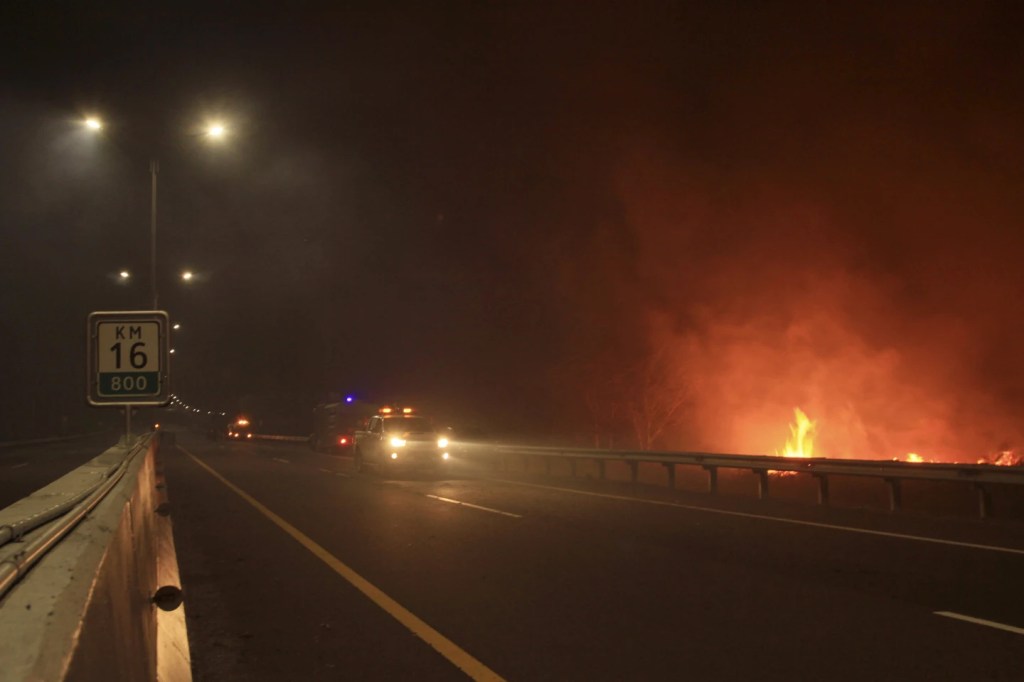
This ruling comes amid increasing risks of forest fires, as the South Sumatra provincial government has recently declared a Smoke Emergency Alert. By rejecting this lawsuit, the judges have weakened the country’s commitment to mitigating and addressing the recurring smoke crisis each year.
The plaintiffs’ legal team announced plans to study the official decision, which has yet to be published, and will consider an appeal. “We believe that the people of South Sumatra have a right to clean and healthy air that must be fought for. As the panel of judges have allowed the plantation companies responsible for the smoke haze to evade accountability, the adverse effects of the haze will continue to haunt the residents of South Sumatra,” emphasized Ipan Widodo, representing the plaintiffs’ legal team.
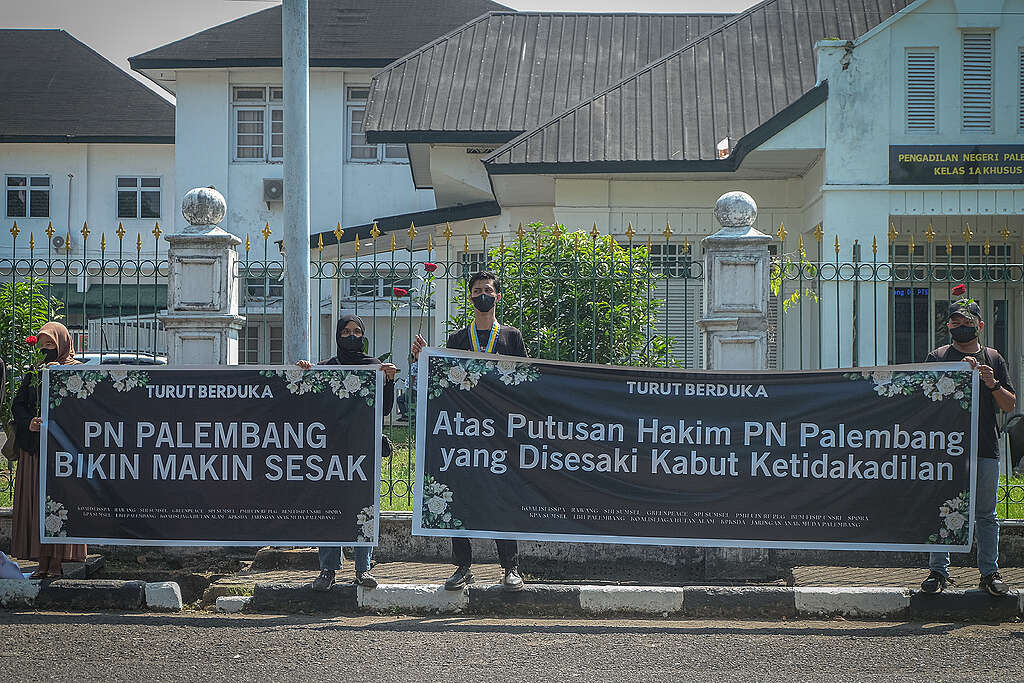
In a show of disappointment, victims of the smoke haze and community members in South Sumatra held a wreathe-laying ceremony in front of the Palembang District Court. Messages reading “Justice for Smoke Haze Victims,” “Condolences for the Death of Justice at the Palembang District Court,” and “Palembang District Court Makes It Even Harder to Breathe” adorned the front of the courthouse. Dressed in black, the participants symbolized the death of justice for the smoke haze victims.
“Amid the declaration of a smoke emergency by the South Sumatra provincial government, the decision appears to conflict with the commitment of law enforcement authorities and the government to combat forest fires and smoke haze. While the judges’ decision is disappointing, it will not dampen our spirit to continue fighting until we prevail,” said Muhkamat Arif, one of the eleven plaintiffs.

Referring to Supreme Court Circular No. 1/2017, the judges’ decision should reflect an essential principle of the justice system: that substantive justice—related to the essence and purpose of law to achieve true justice for society—should take precedence over formal justice, which merely considers procedural or technical rules in legal proceedings. The inadmissibility ruling indicates a crisis of judicial bias against the right to a healthy environment in the middle of a climate emergency. For this reason, the South Sumatra Smoke Plaintiffs Initiative (ISSPA)[3] urges Indonesia’s Supreme Court Supervisory Agency and the Indonesian Judicial Commission to investigate how the lawsuit has been handled and to look into similar decisions that have the potential to exacerbate the country’s ecological crisis.
Editor’s Notes:
[1] PT Bumi Mekar Hijau, PT Bumi Andalas Permai, and PT Sebangun Bumi Andalas Wood Industries are listed in the APP Business Group documentation for their application to re-enter the Forest Stewardship Council (FSC) certification standards.
[2] Photos and videos can be downloaded at the following link: https://media.greenpeace.org/Detail/27MZIFJR8YT89
[3] South Sumatra Smoke Plaintiffs Initiative (ISSPA): Greenpeace Indonesia, Pantau Gambut, Yayasan Lembaga Bantuan Hukum Indonesia (YLBHI), YLBHI-LBH Palembang, Indonesian Centre for Environmental Law (ICEL), Public Interest Lawyer Network (PIL-Net) Indonesia, Spora Institute, Perkumpulan Rawang, Perkumpulan Tanah Air, Dewan Pimpinan Wilayah Serikat Petani Indonesia Sumatera Selatan, Konsorsium Pembaruan Agraria (KPA) Wilayah Sumatera Selatan, Solidaritas Perempuan Palembang, Sarekat Hijau Indonesia Sumatera Selatan, Spektakel Klab, Kontra Visual, Diskomik, Himpunan Mahasiswa Pertanian Universitas Sriwijaya (Himasperta UNSRI), Badan Eksekutif Mahasiswa Fakultas Ekonomi Universitas Sriwijaya (BEM FE UNSRI), Badan Eksekutif Mahasiswa Fakultas Ilmu Sosial dan Ilmu Politik Universitas Sriwijaya (BEM FISIP UNSRI), Pergerakan Mahasiswa Islam Indonesia Universitas
This article is based on https://www.greenpeace.org/indonesia/siaran-pers/63918/gugatan-kabut-asap-palembang-greenpeace-sinarmas-kebakaran-hutan/.
In related news:
- Vetrita, Y., Diwyacitta, K., Sukarno, K. M., Albar, I., Usman, A. B., Ritonga, R. P., … Cochrane, M. A. (2025). Evaluating the capabilities of high-resolution PlanetScope and Sentinel-2 images for mapping burned area and vegetation regrowth in Indonesia’s savannas. International Journal of Remote Sensing, 1–23.
- https://nasional.kompas.com/read/2025/07/28/15072781/200-personel-tni-polisi-disiagakan-menjaga-riau-dari-karhutla-dengan
- Indonesians suing pulpwood firms over haze face intimidation, seek human rights protection, Hans Nicholas Jong, Mongabay.com, March 25, 2025
- South Sumatra Residents Testify in Landmark Haze Pollution Lawsuit, Igor ONeill, Greenpeace.org, March 20, 2025
- Fires on Indonesia’s Sumatra island cause smoky haze, prompting calls for people to work from home, By Muhammad Hatta and Edna Tarigan, Apnews.com, October 2, 2023
- Firefighters battle peatland fires on Indonesia’s Sumatra island, By Muhammad Hatta, Apnews.com, August 18, 2023
- https://www.theguardian.com/commentisfree/2026/sep/15/rise-global-temperatures-super-el-nino
- https://www.theguardian.com/world/ng-interactive/2026/sep/16/indonesia-fires-borneo-el-nino-women-haze
- https://www.tempo.co/kolom/kebakaran-hutan-gambut-mangrove-bpgmn-2297283






Leave a Reply