Jordan: Politics in An Accidental Crucible
By Sean Yom, Published by OUP
From the Publisher: In Short
- Provides a comprehensive, systematic approach to Jordan covering all aspects of its history, government, society, economy, and foreign relations
- Combines theoretical knowledge from social science scholarship with firsthand information gained from decades of fieldwork in Jordan
- Emphasizes the importance of Jordan by linking its politics to relevant Middle East affairs, such as the Israeli-Palestinian conflict, the Arab Spring revolutions, and US foreign policy
Publisher’s Description
Jordan is the runt of the Middle East. Compared to neighboring Israel, Lebanon, Syria, Iraq, Saudi Arabia, it has the smallest population, scarcest resources, and greatest vulnerability to regional violence. And yet this contrived place, with its divided society and antiquated monarchy, has outlasted endless predictions of collapse to become a veritable oasis of stability. Jordan is an accidental crucible where titanic forces have converged to create an important, if misunderstood, state.
In Jordan, Sean Yom provides a concise yet authoritative synthesis of the Hashemite Kingdom’s development from its founding over a century ago to the present. He explores Jordan’s government, society, economy, and foreign policy in a systematic manner, offering an immersive tour of this vital Arab country. Uniquely, Yom combines theoretical work from political science, sociology, and other scholarly fields with firsthand knowledge of Jordan garnered over decades of study. His insights show how Jordan’s political experiences form a microcosm for understanding the entire Middle East. Among the topics covered are its colonial legacies, fractious national identity, authoritarian rule, civil society, democratic protests, economic development, neo-liberal corruption, geopolitical conflicts, and Western hegemony.
A comprehensive and rigorous study of politics in Jordan, this book underscores the urgency of the country’s historical struggles and contemporary affairs, which will shape the future of democracy, prosperity, and peace in the Middle East.
Table of Contents
Preface
Acknowledgments
Notes on Transliteration
Chapter 1: Myth-busting over the River Jordan
Chapter 2: The Breadth and Depth of Jordanian Society
Chapter 3: The Hashemite Regime and State Institutions
Chapter 4: How Coercion and Coalitions Create Stable Authoritarianism
Chapter 5: From Democratic Dreams to Liberalized Autocracy
Chapter 6: Opposition and Protest in the Twenty-First Century
Chapter 7: The Little Economy That Stayed Little
Chapter 8: Foreign Policy in a Small State and Rowdy Region
Chapter 9: Expect the Unexpected…and Nothing Is Unexpected
Notes
Index
Author Information
Sean Yom, Associate Professor of Political Science, Temple University
Sean Yom is Associate Professor of Political Science at Temple University. He is a specialist on regimes and governance in the Middle East, especially in Arab monarchies like Jordan, Kuwait, and Morocco. His research engages authoritarian politics, democratic reforms, and economic development in the region, as well as their implications for US foreign policy. He is the author of From Resilience to Revolution (2015) and a co-editor of The Political Science of the Middle East (with Marc Lynch and Jillian Schwedler; Oxford 2022).
Details
Published: 17 December 2025 (Estimated)
320 Pages
235x156mm
ISBN: 9780190097264
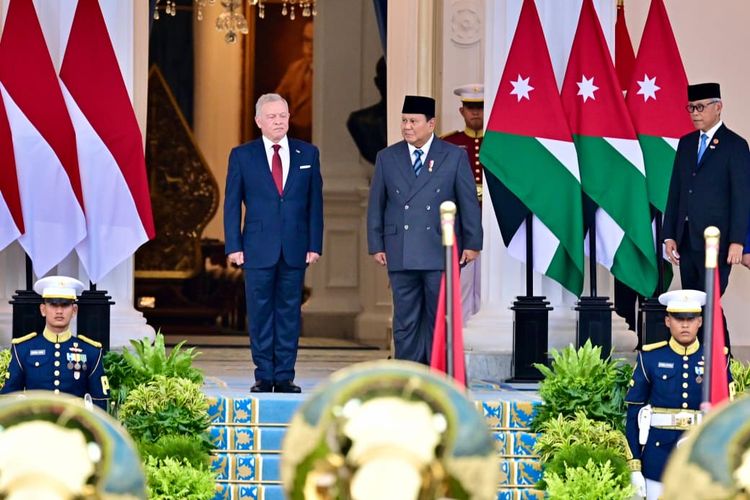
Buy at https://global.oup.com/academic/product/jordan-9780190097264. Featured image credit: President Prabowo Subianto welcomes King of the Hashemite Kingdom of Jordan Abdullah II ibn Al Hussein at Merdeka Presidential Palace Complex, Central Jakarta, Friday Nov 14, 2025. (Doc. Presidential Secretariat) https://nasional.kompas.com/read/2025/11/14/20184371/raja-abdullah-ii-kagumi-determinasi-prabowo-konsisten-layani-rakyat-sejak.
In earlier news…
Indonesia to Form Key Component of International Force in Gaza, Indonesian Foreign Ministry, Voice of Indonesia
By Ahmad Fauzi Iyabu for VOI, October 23, 2025
VOI JAKARTA – The Indonesian Ministry of Foreign Affairs confirmed Indonesia is ready to send peacekeeping troops to the Gaza Strip, with preparations and coordination currently underway, emphasizing that the deployment would be carried out under a United Nations auspices.
Indonesian Foreign Ministry Spokesperson Yvonne Mewengkang said this in response to Arab media reports that Indonesia would be one of the countries serving as a key component of the International Stabilization Force (ISF) in the Gaza Strip.
“The Indonesian government continues to closely monitor developments in Gaza and fully supports post-war reconstruction efforts,” Yvonne told Indonesia’s government owned overseas news service Voice of Indonesia (VOI.id) on Thursday, October 23.
“As Indonesia’s President indicated in his speech at the recent UN General Assembly, Indonesia stands ready to contribute concretely by sending peacekeeping troops, should the UN Security Council produce an official mandate,” she said.
Earlier, Arab media outlets reported, citing sources familiar with the ISF, that Egypt is expected to lead a joint international force in Gaza under a UN Security Council mandate.
According to Saudi English-language news service Arab News, the contingent would include Egypt, Indonesia, Turkey, and Azerbaijan.
Meanwhile, the Abu Dhabi-based English language news outlet, The National, citing sources familiar with the matter, claimed that the number of troops deployed from the four countries would be around 4,000. However, the distribution of troops from each of the countries cited was not specified.
The Nation reported its sources said, “the International Stabilisation Force will be made up of at least 4,000 troops from Egypt, Azerbaijan, Turkey and Indonesia. Egypt, in collaboration with the US, will be seeking a UN Security Council resolution establishing the force and spelling out its mandate.”
Quoting President Prabowo’s address regarding Indonesia’s readiness to send 20,000 troops at the 80th UN General Assembly last month, Yvonne said that preparations and coordination are currently underway.
“Currently, Indonesia is in the preparation and coordination stage between agencies. In principle, every deployment takes place in accord with UN decisions following UN frameworks,” Yvonne stated.
“The Indonesian President has expressed Indonesia’s readiness to send 20,000 peacekeepers. Naturally implementation will be adjusted to the needs and mandate set by the UN,” she concluded.
Meanwhile, The Guardian reported over the weekend that the proposed force would have broad powers similar to those granted to international forces in Haiti to combat armed groups. According to the Guardian, “Turkey, Indonesia and Azerbaijan are also being billed alongside Egypt as the main troop contributors. Egypt is still being consulted on whether the force should be a full UN-led operation.”
Washington is reported to support a UN mandate for the mission, without making it a full-fledged UN peacekeeping operation.
The National’s sources, however, said the force would not include heavy weapons, relying solely on self-defense firearms and armored vehicles.
The force would initially be deployed in areas from which the Israeli military has withdrawn under the first phase of the plan, the sources claimed.
The force would later expand its deployment area as the Israeli military forces further withdrawals under the plan.
They would work alongside approximately 3,000 Palestinians appointed by the Ramallah-based Palestinian Authority. The Palestinians would be responsible for intelligence gathering and preventive security in Gaza, the sources said.
Some of them have been trained by Egypt and Jordan. However, the ISF troops would not enter the proposed Israeli security line, which would run along the Gaza side of the border, extending 1.5 km in depth in some areas.
The proposed force’s mandate is to include overseeing the construction of a field hospital to take account of the significant damage to health facilities in the area. The force is also to be mandated to repair bakeries and other vital infrastructure.
The deployment of the stabilization force as known is to be part of the second phase of United States’ peace proposal, which includes potentially problematic steps such as Hamas’ disarmament, long-term ceasefire negotiations, Hamas’ future, and Gaza’s post-war governance.
Yvonne emphasized that Indonesia’s willingness to participate affirms the country’s principle of having an independent and active foreign policy.
“The step affirms Indonesia’s commitment to continuing to play an active role in maintaining peace and assisting in the reconstruction of Gaza in accordance with the country’s principles of an independent and active foreign policy and based on an international mandate,” Yvonne concluded.
Meanwhile, senior researcher at Indonesia’s National Research and Innovation Agency (BRIN), Irine Hiraswari Gayatri, commented separately in an opinion piece for NU Online, “Even if Indonesia deploys peacekeepers or engages in mediation, the outcomes could be mixed or counterproductive. A failed peacekeeping mission, for instance, might tarnish Indonesia’s reputation rather than enhance it.”
This post is based on https://voi.id/berita/526762/indonesia-dikabarkan-akan-menjadi-komponen-utama-pasukan-internasional-di-gaza-begini-penjelasan-kemlu. Featured image credit: UN troops from Indonesia. Wikimedia Commons/3116 akbarur ilmi.
In related news:
- https://nu.or.id/opini/indonesia-s-middle-east-dilemma-can-moral-diplomacy-deliver-real-peace-MWBw5
- https://storiesfromindonesia.com/2025/06/09/op-ed-indonesias-gaza-plan-divides-muslims-fulcrum-singapore/
- https://www.theguardian.com/world/2025/oct/18/egypt-expected-to-lead-global-stabilisation-force-in-gaza-say-diplomats
- https://dawnmena.org/un-security-council-impose-arms-embargo-end-to-siege-and-fact-finding-mission-in-international-stabilization-force-resolution
- https://nu.or.id/nasional/pbb-desak-israel-patuhi-putusan-baru-mahkamah-internasional-soal-gaza-WYKp3
- https://en.wikipedia.org/wiki/Faisal_II
- https://dawnmena.org/jordan-is-encaged-by-the-iran-war/
- https://www.nytimes.com/2026/07/29/world/middleeast/jordan-us-military-iran-war.html





Leave a Reply