Young Jamal The Schemer
A Short Story by Mochtar Lubis (1950)
It had been months since I last saw him. The last time was in Yogyakarta when I brought him a few books. So I was glad to see him suddenly walk through the front door, call out, “Freedom, brother!” and shake my hand before I could even get up from my chair. He set down a thick, heavy leather bag on the table and said, “Can you get me a glass of cold water. Jakarta’s heat is killing me.”
I went to the back, got him a glass, and he drank it down in one gulp.
“When did you get here?” I asked.
“Took the special delegation train,” he said, his eyes shining, as if riding on that train was the most incredible thing in the world.
“You part of a delegation now?” I asked.
“No,” he said.
“Then, how did you get on the train?”
He grinned, reached into the inner pocket of his jacket and pulled out a thick wallet. From that he took out a card.
“Good Offices Committee white card,” he said, smirking and handing the card to me.
It had three languages on it. The Indonesian writing read…
Allied Nations
Good Offices Committee of the Security Council on Indonesian Affairs
To Mr.: (Handwritten in ink) Jamal, freelance journalist
(Stamped and signed)
“With this,” Jamal said, waving the card in front of my face, “I can go back and forward between Yogyakarta and Jakarta whenever I want.”
“Since when are you a freelance journalist?” I asked. “Aren’t you still with the Republic’s planning Brains Trust?”
“Still am,” he said. “But I also write for some magazines in the interior from time to time.”
Then, like he was afraid someone might overhear, he lowered his voice.
“I actually need a favor,” he said. “You’ve been in Jakarta all this time, and you have good connections with the outside overseas. We need you to be the Republic’s representative here, handling foreign contacts and correspondence. We’ll cover the costs,” he added.
“Who’s ‘we’?” I asked.
He ignored the question and went on.
“We’ve got three plans. I put them together,” he said, opening his big, heavy leather bag and pulling out a folder.
“This is the economic plan,” he said, showing me a sheet covered in lines and numbers. In little boxes, he had scribbled words like production center, distribution center, oversight committee, pricing board, foreign trade, currency control board, and more I don’t remember.
“We can stockpile sugar, tobacco, and vanilla in Tuban over in East Java, then add white pepper and other commodities from Sumatra’s ports,” Jamal said. “Everything’s in place. We just have to put it into action. Some of it we’ll barter, and some we’ll sell for dollars we hold overseas. Since it’s hard to communicate with the outside world from Yogyakarta, we need you here to handle the correspondence.”
And before I could even say yes or no, he had pulled out another folder.
“This is the second plan,” he said. “But it can only start once the first one is running and the money starts flowing. This one’s about information dissemination in the Dutch-occupied areas and overseas.”
“Isn’t that what the Ministry of Information, Antara News Agency, and newspapers are for?” I asked.
“What? That Ministry and Antara?” he scoffed. “Bunch of fools. We’re going to buy our own printing press with the profits from the first plan and put out our own newspapers and magazines. Completely different from what anyone else is doing.”
Then he pulled out a third folder.
“And this is for internal information distribution within the Republic. We’ll also need your help getting books and other materials.”
From the economic plan folder, he took out a list of stores and firms in Singapore, Manila, and New York, along with a breakdown of stock supposedly ready at various ports—so many tons of sugar, so many tons of vanilla, so many tons of tobacco.
“This is for you,” he said. “You’ll need some funds for correspondence. How much do you think you’ll need?”
“I don’t know,” I said. “Have you even contacted the trading offices on this list?”
“Not yet. That’s your job. We’ve got ten tons of cigars waiting in Tuban, ready to ship to Jakarta. As soon as they arrive, I’ll get you funds. Five thousand rupiah should be enough to start, I think,” he said.
Five thousand rupiah. That number lit up my heart. At first, I didn’t believe any of Jamal’s plans. But hearing about a ship carrying cigars to Jakarta made me think—maybe this was real.
“When do you think the ship will get here?” I asked.
“I came here to handle it,” Jamal said. “Before I go back to Yogyakarta, it’ll be here, and I’ll leave the money with you. So, we’re all set?”
“Yeah, if there’s money, everything’s set,” I said.
Jamal got up and browsed my bookshelf. After a moment, he shook his head.
“You haven’t changed a bit,” he said. “Why do you waste your time reading these novels, detective stories, and cowboy books?”
Then he left. And I started daydreaming about life on a salary of 500, 600, or 700 rupiah a month. Hmm.
A week later, he came back.
“I have to go back to Yogyakarta tomorrow,” he said.
“What about the money?” I asked.
“Oh, it’s settled. Just waiting on a permit from the Department of Economic Affairs. Seems like it hasn’t been issued yet. But don’t worry—I’m leaving a letter with a friend who’s handling it. Once the shipment arrives, they’ll give you the five thousand rupiah. Well, goodbye for now. Keep me updated.”
He left. I looked at the letter. It said exactly what he’d told me.
I waited a week. There was nothing. The friend handling it kept saying the permit hadn’t been issued yet. A few days later, I got a letter from Jamal. He wrote that the cigars weren’t coming after all—the price had dropped in Jakarta, and they’d take a loss if they went through with the deal.
But, he said, they now had 100 tons of sugar lined up, everything was set, and I would be getting even more money—maybe ten thousand rupiah. No need to worry about cash for months. And any day now, the money would be in my hands. That made me happy again.
A few days later, Jamal himself showed up again in Jakarta.
“Caught a ride on the Good Offices Committee plane,” he said.
“What about the sugar?” I asked.
“That’s what I’m here to handle. I have to do everything myself, or it won’t get done. The sugar’s already in Gombong, down in Central Java. Everything’s set, just waiting on the permit from Economic Affairs. But I was just there today—got a friend working on it on the inside. Says it’ll be issued tomorrow, or the day after.”
Then he leaned in.
“I’ve got another plan. Maybe some friends here can help with it.”
“What is it?”
“We need to start an English-language newspaper here. Send it abroad, too. People overseas are dying to know what’s happening in Indonesia. And with ad money from foreign and local companies, the paper could fund itself. Think about it,” he said.
This time, he didn’t tell me when he went back to Yogyakarta. When I wrote asking about the sugar money, he replied that the deal had fallen through—the Dutch had wanted to set their own price.
But now, he said, he was working on chartering a plane to export vanilla and quinine powder.
“And with the dollar income,” he wrote, “we’ll be able to do so much more.”
That was the last I heard. And from a friend, I learned that Jamal was now waiting for a flight to Sumatra. He was planning a massive mining operation there they said.
And I’m still waiting for those dollars.
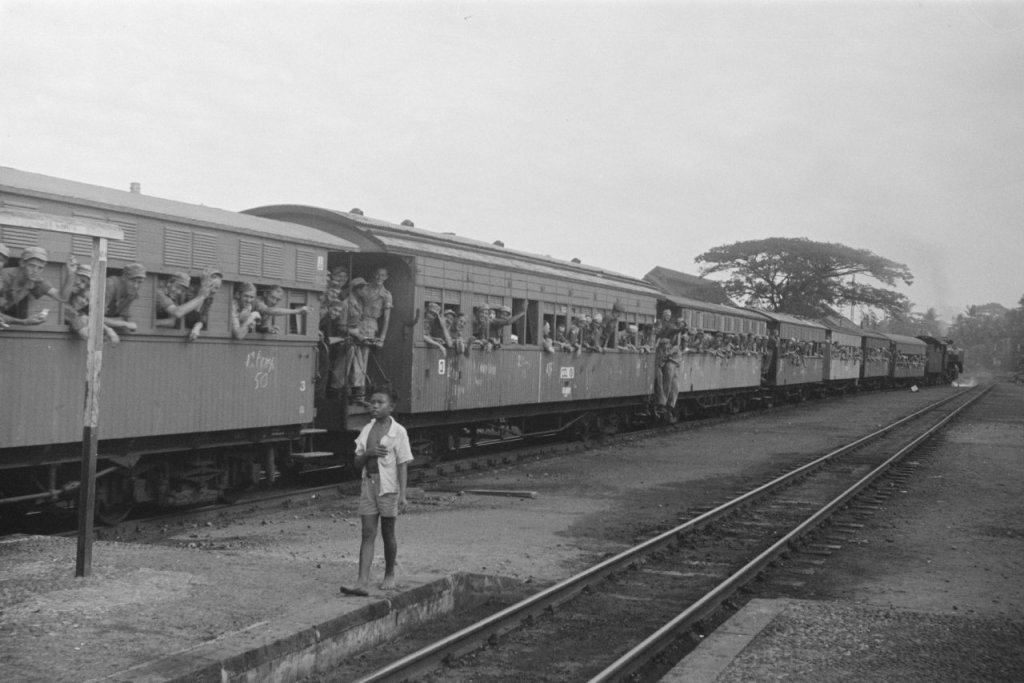
Source: Si Djamal perencana (Young Jamal The Schemer) is a story from the short story collection of Lubis, Mochtar. Si Djamal : dan tjerita2 lain / oleh Mochtar Lubis Gapura Djakarta 1950, p. 17. Feature image credit: Dutch war train http://www.collectienederland.nl/
Background:
- https://www.theatlantic.com/magazine/archive/1949/04/indonesia/643155/
- https://tirto.id/latar-belakang-pembentukan-komisi-tiga-negara-ktn-tugasnya-guTL
- https://ejournal.undip.ac.id/index.php/jscl/article/download/17341/pdf
- https://esi.kemdikbud.go.id/wiki/Komisi_Tiga_Negara_(KTN)
- https://www.kompas.com/stori/read/2021/04/19/184909279/komisi-tiga-negara-latar-belakang-anggota-dan-tugas?page=all