
President Hardi: 45 Years On
By Dian Yuliastuti for Tempo.co, January 18, 2025
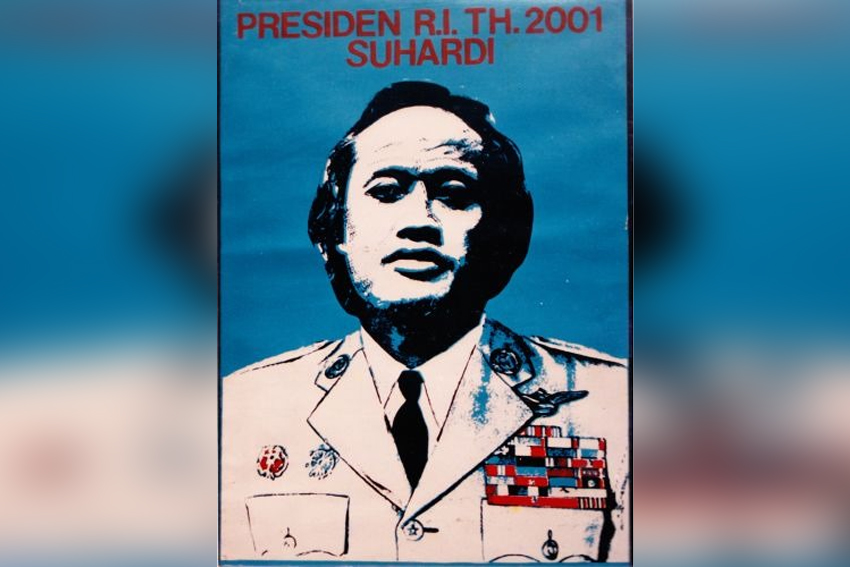
JAKARTA — The screen print President of Indonesia, Year 2001 currently greets visitors to Building A of the National Gallery of Indonesia. The president in question is artist Raden Soehardi Adimaryono, known simply as Hardi. The print, titled President of Indonesia, Year 2001: Suhardi, portrays the artist in a white safari suit, chest adorned with a variety of military medals. Unlike typical presidential portraits featuring a black suit and fez, this depiction resembles a naval officer in formal white dress uniform. Nonetheless, the caption “President of Indonesia, Year 2001: Suhardi” above the image makes the artist’s satirical intent clear.
The artwork caused a controversy in both artistic and political circles when it debuted at the Young Artists’ Exhibition at the Taman Ismail Marzuki (TIM) arts center in Jakarta in December 1979. Police confiscated the piece, and Hardi was arrested for three days at the detention center of the Greater Jakarta Area Special Administrator of the Operational Command for the Restoration of Security and Order, part of the notorious security apparatus established by President Soeharto following the 1965 military putsch. In an era when Soeharto’s uncontested re-elections spanned three decades, even humorous references to the presidency were taboo—let alone representations of alternative presidents, even in parody.
Forty-five years on, the controversy surrounding the piece remains visceral. The print takes center stage at the exhibition “Record of Resistance: ‘The President 2001’ — A Tribute to Hardi (1951–2023),” running from January 10 to 26, 2025. The gallery’s rear hall is dedicated to this historic work.
Half of the room reconstructs Hardi’s studio, displaying his painting equipment, including an easel with a canvas sketch, a wooden chair, paint bottles, a traditional Javanese blangkon headpiece, and two traditional Javanese beskap jackets. The other half houses books and exhibition catalogs linked to Hardi, along with two additional screen prints featuring his likeness set against red and green backgrounds.
An interactive multimedia room presents a large-scale projection of President of Indonesia, Year 2001: Suhardi. A nearby AI-powered face-swapping application allows visitors to superimpose their own faces onto the image, creating personalized versions of the artwork. Similar to mobile apps like Reface and Face Swap, the feature has proven popular, with long queues forming on January 9, 2025, as visitors took turns generating their own presidential portraits.
The exhibition also commemorates a year since Hardi’s passing. Born in Blitar, East Java, on May 26, 1951, Hardi died at 72 on December 28, 2023. He studied at the Indonesian Art Institute (ASRI) in Yogyakarta but was expelled for protesting jury decisions at a 1974 national painting competition that favored figurative works by A.D. Pirous, Aming Prayitno, and others. Hardi later continued his education at the Jan van Eyck Academy in the Netherlands. A key figure in the New Art Movement, he collaborated with artists from Yogyakarta and Bandung, including F.X. Harsono and Jim Supangkat.
The exhibition, curated by Dio Pamola Chandra, a lecturer at Tamansiswa University, Yogyakarta, features 78 works: 69 paintings and sketches, five kujang daggers, and four keris blades. Drawn from the National Gallery’s collection, family archives, and private collections—including those of Culture Minister Fadli Zon and businessman E.Z. Halim—the works are arranged into thematic clusters: social-political critique, landscapes, female figures, and cultural motifs.
Dio organized the exhibition within two weeks after the National Gallery canceled a planned showcase of senior artist Yos Suprapto. According to Dio, this tribute to Hardi seeks to honor his legacy while revisiting his artistic journey. As an artist active during the authoritarian U.S.-backed New Order regime, Hardi wielded art as a form of defiance, channeling collective unease and voicing explicit protests against injustice.
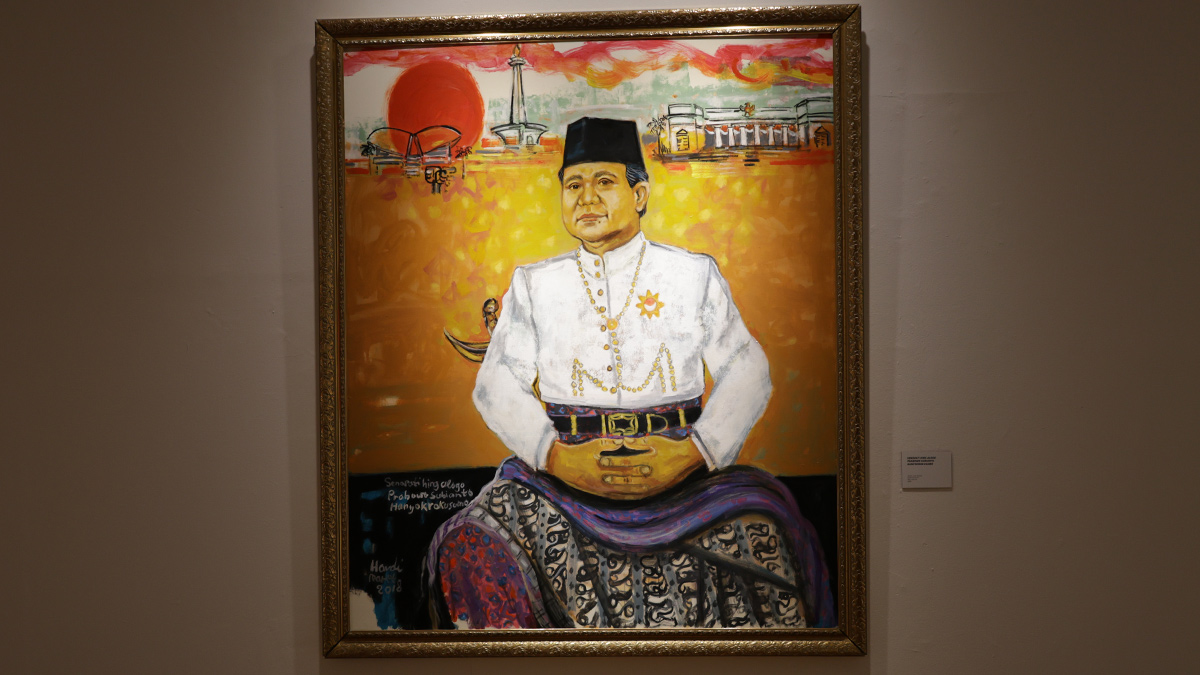
“Resistance in this exhibition is not about Hardi’s likes or dislikes, but his works as a record of defiance, a heritage,” Dio said on January 14, 2025. This includes his portrayal of current President Prabowo Subianto as a military leader in Senopati Hing Alogo Prabowo Subianto Hanyokrokusumo (2018).
Art critic Agus Dermawan T. described Hardi as a painter driven by boundless curiosity and a wide-ranging thematic repertoire. “His works bear his unmistakable signature,” he wrote in the exhibition catalog.
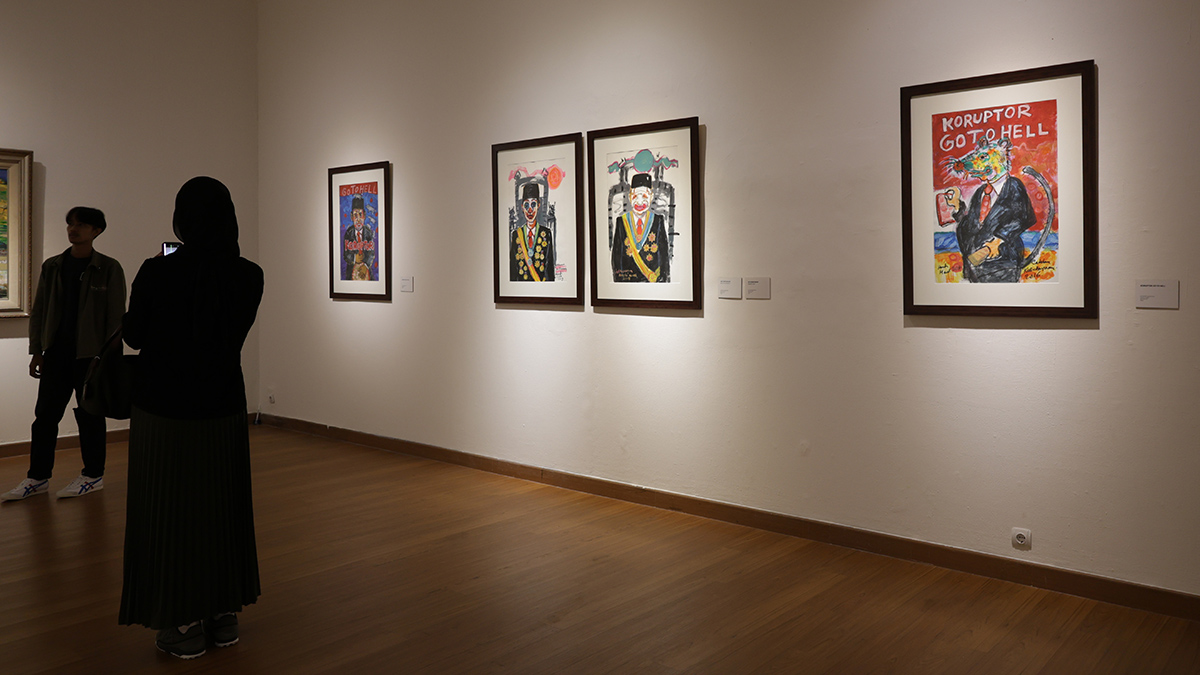
Hardi also explored corruption as a central theme. The Corrupter (1986), an acrylic painting, depicts a grinning man in a suit, tie, and fez, clutching a black bag. Behind him stands a red-clad woman in undergarments. Both figures’ faces are blurred by smears of paint. Adjacent are two other satirical works: The Suit of Power and The Grand Suit, caricatures of leaders dripping with medals and ribbons, their clownish visages a biting commentary on corruption.
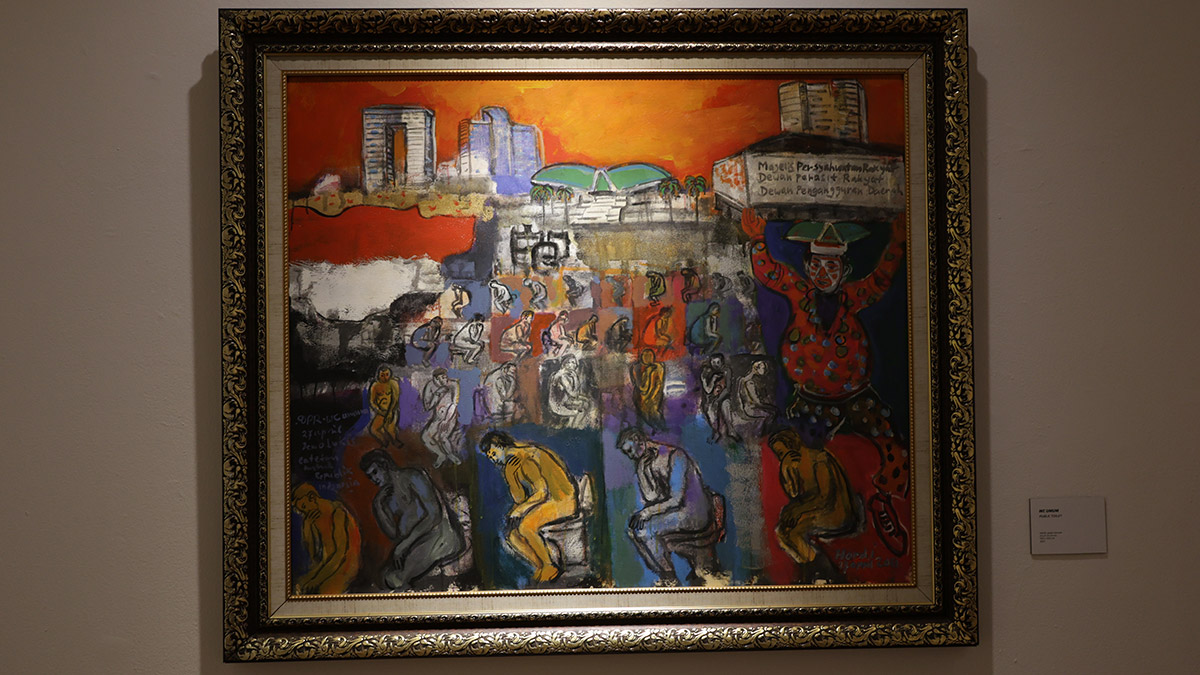
Hardi’s ire toward the country’s legislature is evident in Public Restroom (2011), where he lampoons Indonesia’s House of Representatives. A structure resembling the iconic turtle-shaped building of the House of Representatives is inscribed with graffiti-like text mocking the institution. In the foreground, figures sit on toilets, mirroring Rodin’s The Thinker, while a clown with a House-shaped hat watches. I’m Angry at You, People’s Representatives (2011) continues the critique, depicting Hardi in a blue suit brandishing a tradition ceremonial keris dagger, set against a background of political satire.
Three other acrylics criticize excesses of the legislature: Reject KPK Law Revision features a figure with three rat-like faces clutching money bags, while Party Representative 2019 and Panic Committee Against KPK offer similarly biting depictions critiquing legislative weakening of the country’s anti-graft agency, the Corruption Eradication Commission (KPK).
Themes of poverty also pervade Hardi’s work. Republic of the Poor (2000) shows a man with a vacant stare sitting beside a sickle, awaiting food on a stove. The backdrop features Sosrobahu flyover construction. In Becak Driver from Sukamiskin (1986), street vendors flee from municipal police. Asian Children Calling contrasts cleanly dressed children with an emaciated boy in a junkyard, reflecting harsh disparities in wealth and income.
Hardi’s fascination with portraiture extended to notable figures. Besides President Prabowo, he painted the cleric former President Abdurrahman Wahid in regal traditional Javanese garb, seated amid symbols of religious diversity. His Never Ending Story (2005) juxtaposes New Order President Soeharto in full regalia with one-time imprisoned writer Pramoedya Ananta Toer, surrounded by banned books.
At the exhibition opening, Indonesia’s Minister of Culture Fadli Zon praised Hardi’s fearless critiques. “Art, as Hardi showed, is a tool for justice, change, and a more humane civilization,” Fadli said, revealing his own 20-year collection of 70 Hardi works, while humorously admitting that business magnate E.Z. Halim owned even more.
Minister Fadli referred to a need for boundaries in artistic expression, referencing Germany’s restrictions on Nazi symbols. “There are limits—not to critique itself, but to its display,” he said, without elaborating on where these lines should be drawn.
This article is based on https://www.tempo.co/teroka/mengenang-pelukis-hardi-galeri-nasional-1195689.
In related news:



Leave a Reply