
To What Extent Does Indonesia Support Palestinian Independence? Tempo Magazine
By Broto Wardoyo, Head of the Department of International Relations, University of Indonesia, for Tempo Magazine, October 5, 2025
Indonesia supports Palestine through a two-state solution. But what obstacles remain?
Significant Debate
Recent developments in Indonesia’s stance on Palestinian independence have sparked significant debate. Statements from President Prabowo Subianto and Foreign Minister Sugiono have raised public concern and suspicion, particularly in relation to the government’s willingness to accept refugees from Gaza, support for peacekeeping troops, and conditional recognition of Israel, contingent on its acknowledgment of Palestine.
This article addresses two critical issues. First, what limitations exist in Indonesia’s approach to the Palestinian situation? Second, what are the fundamental debates shaping the issue?
Should Indonesia Continue to Endorse the Two-State Solution?
The discourse surrounding support for Palestinian independence can be viewed through two main debates. First, what form should this support take? Are verbal commitments sufficient, or is there a need for tangible actions such as economic or security assistance? Second, what is the rationale for such support? More succinctly, should Indonesia continue to endorse the two-state solution?
The latter question merits thorough examination. A survey conducted by the Center for International Relations Studies (Cires) at the University of Indonesia in late 2024 revealed that 56 percent of respondents favored a one-state solution—a distinct Palestinian state—as the resolution to the Israel-Palestine conflict, while only 44 percent supported the existing two-state framework.
Government Out of Step?
This finding stands in stark contrast to the government’s long-standing advocacy for a two-state solution as the cornerstone of peace negotiations between Palestine and Israel. President Prabowo, in his address to the United Nations General Assembly, framed the recognition of Palestine as a critical aspect of the two-state solution, reiterating Indonesia’s commitment to this pathway.
Meanwhile, U.S. President Donald Trump has dismissed the feasibility of the two-state approach. In his remarks during the same assembly, he criticized the recognition of Palestine by several nations, including some of America’s allies, labeling it a mistake. This perspective not only overlooks the humanitarian crisis in Gaza, but also reinforces support for a one-state solution, specifically favoring the state of Israel.
The Dilemma of the One-State Solution in the Israeli-Palestinian Conflict
Support for the two versions of the one-state solution is not a novel concept; advocates can be found on both sides of the Israel-Palestine divide. Typically, proponents of the one-state solution align with the right-wing end of the political spectrum in both Israel and Palestine.
In Israel, right-wing factions, including those of the prime minister and his supporters, champion the idea of a Greater Israel. A significant turning point came in 1999, when the Prime Minister lost power after agreeing to the Wye River Memorandum, which proposed a land-for-peace framework. This decision was perceived as a betrayal of the one-state vision by his political base.
On the Palestinian front, Hamas has historically been a staunch opponent of the two-state solution. Initially, their position was unyielding, but in recent years, younger factions within Palestinian society have adopted a more pragmatic outlook, prompting some shifts in Hamas’s stance.
Different Commitments, Different Realities
According to Barnett et al. (2023), the current landscape in Israel and Palestine is gravitating toward a one-state reality. Policies enacted by the current Israeli government have altered demographics, particularly in the West Bank. The territory known as Area A, governed fully by the Palestinian Authority under the Oslo Declaration, is shrinking, which poses a threat to its de facto existence.
The debate surrounding the two-state solution has persisted for decades. The rationale behind this approach is the mutual recognition of both Palestine and Israel, yet ambiguity surrounding the borders of the two states has long been a sticking point.
Currently, two boundary proposals are circulating, both derived from UN resolutions. The first is based on the UN General Assembly Resolution 181 of 1947, while the second comes from UN Security Council Resolution 242 of 1967, referencing the 1947 Armistice Agreement. The distinctions between these two boundary delineations are substantial.
The Oslo Process has further complicated the implementation of the two-state solution, often at the expense of Palestinian autonomy. The inherent weakness of the current two-state approach lies in the inability of all the parties to devise specific, actionable arrangements for its execution.
For instance, the concept of a two-state solution inadvertently encouraged former Israeli Prime Minister Yitzhak Rabin to initiate policies that construct barriers between Palestinian and Israeli territories. Over time, what began as a fence evolved into a wall, effectively delineating Palestinian territories in the West Bank and isolating communities from one another.
Moreover, the economic dependence of Palestine on Israel poses another significant challenge. Although the 1993 Declaration of Principles aimed to foster two separate states, it simultaneously endorsed the establishment of a joint economic zone. Israeli industries were meant to be situated along the border to facilitate greater employment access for Palestinians. However, this potential for collaboration has been left unfulfilled due to security concerns, further complicating relations between both sides.
Indonesia’s Stance on the Palestine-Israel Issue
Indonesia’s position on the Palestine-Israel conflict is unequivocal: it opposes Israel’s occupation of Palestinian territories. However, the government rarely specifies which territories it considers to be Palestinian. A vital first step towards clarity is to define the boundary references used as a foundation for resolving territorial disputes between Palestine and Israel.
The Need for Clarity
An ambiguous stance only serves to widen the gap between the government and the public. As mentioned earlier, formulating a clear position is essential; while negotiations must account for current conditions on the ground, it is imperative to delineate the extent and location of any proposed territorial exchanges.
There should also be a definitive acknowledgment of the demographic changes enacted through structured policies by the Israeli government. Establishing a clear position against these occupation policies is crucial, as is clarifying Indonesia’s stance regarding the ongoing situation in Gaza.
Currently, Gaza is experiencing spatial changes enforced through excessive violence and coercion. Such actions must be unequivocally condemned. This viewpoint will also influence Indonesia’s plans for reconstruction in Gaza. The government’s decision to accept Palestinians from Gaza, for instance, should be based on this understanding, rather than merely serving as a means to pursue narrower interests.
Bridging the Perception Gap
Efforts are needed to reconcile public perception with governmental choices. Research conducted by the Center for International Relations Studies has highlighted variations in elite acceptance of the two-state solution. Academics tend to be more amenable to this solution, while Muslim groups are generally more supportive of a one-state option for Palestine. These bridging efforts are crucial to ensure alignment between the government’s position and the sentiments of the public and political elites.
Indonesia’s policy regarding the Palestine-Israel conflict requires a more comprehensive development approach. The Palestinian issue is a significant political commodity for local politicians, resonating deeply at the grassroots level as a matter intertwined with religious sentiments. Without a fundamental shift in perspective, support for Palestinian independence risks becoming nothing more than empty rhetoric.
This post is based on https://www.tempo.co/internasional/indonesia-palestina-solusi-dua-negara-2076362. Featured image credit: Wikipedia https://en.wikipedia.org/wiki/Nakba and https://www.haaretz.com/2015-05-26/ty-article/.premium/ben-gurion-ordered-prevent-arabs-from-returning-to-haifa/0000017f-e967-da9b-a1ff-ed6f52530000.
Cover Story
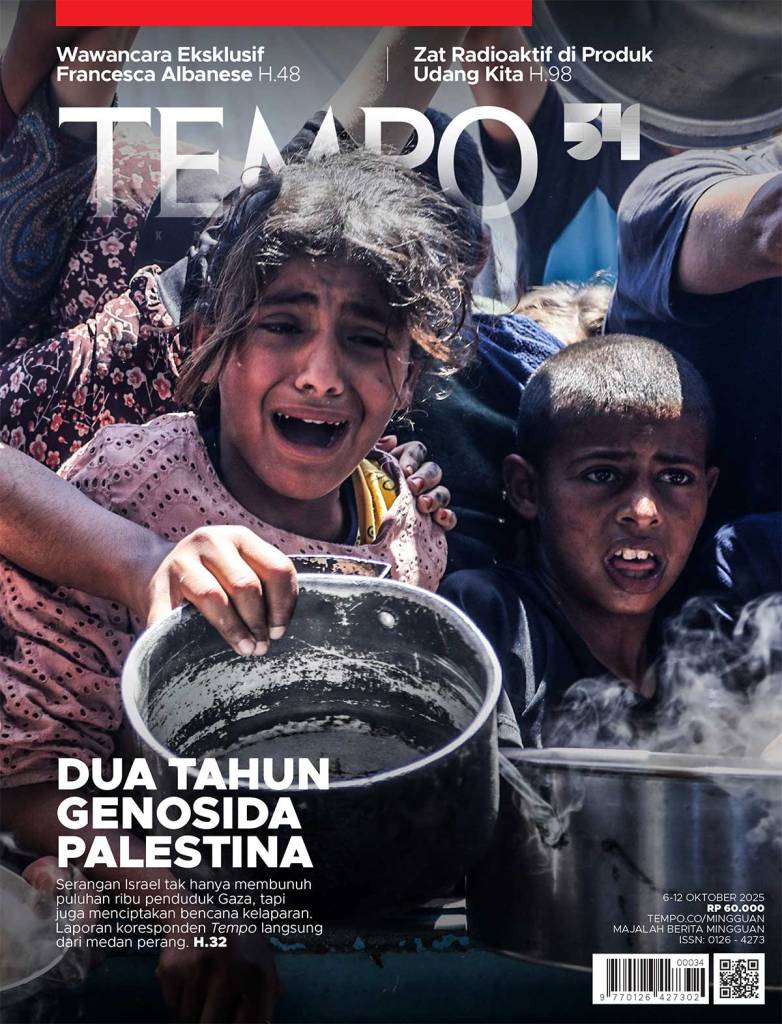
Two Years of the Palestinian Genocide
By Bagja Hidayat, for Tempo Magazine, October 5, 2025
PALESTINE, Noam Chomsky asserts, is fundamentally a story of colonialism and dispossession. Yet, the global narrative surrounding it often seems far more convoluted.
Chomsky, a Jewish intellectual residing in the United States, has long been unflinching in his critiques of Israeli policies while expressing solidarity with the Palestinian cause. As a renowned linguist and philosopher at the Massachusetts Institute of Technology (MIT), he maintains that his perspective is rooted in a commitment to humanity rather than a conflict of identities.
Humanitarian Concerns
His position highlights a stark contrast with the prevailing attitudes around him. A Jewish man advocating for Palestinian rights in a country where the government predominantly supports Israel underscores a complex moral landscape. Chomsky’s stance is clear: he prioritizes humanitarian concerns above all.
Recent reports from Gaza, as covered by a Tempo correspondent, reveal the devastating human toll of the conflict. The brutal assault on October 7, 2023, has led to the deaths of at least 65,000 people. The ongoing blockade has further exacerbated conditions, leading to mass casualties and widespread starvation.
UN Official Declares Gaza Situation a Genocide
Francesca Albanese, a prominent figure at the Office of the United Nations High Commissioner for Human Rights, has labeled the events in Gaza a genocide. The 48-year-old Italian presented her findings in a comprehensive 27-page report detailing the aftermath of the Israeli assault. This edition of Tempo includes an exclusive interview with Albanese.
Failed to Mention
Albanese’s presentation aligns with the conclusions drawn by Noam Chomsky, highlighting a troubling reality: the Palestinian issue has become obscured by widespread denial among international leaders regarding the severity of the situation in Gaza. The reluctance to acknowledge the genocide is evident, even in high-profile speeches, such as that of Indonesia’s President Prabowo Subianto at the United Nations on September 23, 2025, which notably failed to mention the word “genocide.”
This denial contributes to the stagnation of any potential solutions for peace in Palestine. The two-state solution—once a beacon of hope—now appears futile, as the concept of Palestinian sovereignty has stalled. Israel’s refusal to accept the proposal submitted to the UN in 1974, largely due to disagreements over the pre-1967 borders, underscores the persistent occupation that has continued since that time.
Moreover, discussions surrounding Palestinian sovereignty risk shifting the narrative away from critical issues of colonialism, genocide, and the deprivation of rights, reducing them to a mere territorial dispute. Albanese emphasizes that while sovereignty talks are necessary, they do not alleviate the grim reality faced by many Gazans, who continue to suffer and perish from violence and the humanitarian aid blockade.
The Path to Peace Requires Acknowledgment of Colonialism
In the pursuit of peace, recognizing the truth is essential for any reconciliation efforts. Francesca Albanese emphasizes that before advocating for peace in international forums, state leaders must first confront the reality of colonialism. She urges that all nations should sever ties with Israel to facilitate serious discussions about a peaceful resolution. Without this foundational acknowledgment, dialogue will inevitably become convoluted and ineffective.
Numerous writers have delved into the complex roots of the ongoing conflict in Palestine. Among these is On Palestine, which provides the basis for Noam Chomsky’s earlier observations in this article. Another significant contribution is Rise and Kill First: The Secret History of Israel’s Targeted Assassinations by Ronen Bergman, a journalist for Yedioth Ahronoth, Israel’s largest newspaper.
Covert Operations
Unlike Chomsky and other scholars who examine the broader causes of the conflict, Bergman focuses on the covert operations carried out by Israeli intelligence to eliminate Palestinian leaders. His findings are supported by thousands of interviews with agents and substantial documentation from Mossad, Israel’s intelligence agency. The revelations contained in Bergman’s book often surpass the thrilling narratives found in Hollywood spy films, such as the Jason Bourne series.
The title of Bergman’s 2018 publication is derived from the Talmud’s principle: “If someone comes to kill you, get up and kill them first.” This axiom encapsulates the rationale behind many Israeli intelligence operations and poses a disturbing reflection of the deep-rooted Israeli-Palestinian conflict that has persisted for over two centuries.
The historical context of British occupation in Jerusalem, compounded by the Holocaust in Germany, fostered an inferiority complex among Jewish advocates of Zionism. This sentiment bred a profound resentment and an ever-present sense of threat, driving some to take aggressive actions against those who opposed the establishment of the state of Israel. In turn, this inferiority complex evolved into a sense of entitlement, bolstered by considerable support, leading to increasingly assertive and, at times, violent responses.
Bagja Hidayat joined Tempo Magazine in 2001. An alumnus of IPB University and Binus Business School. Recipient of the Jakarta Journalist Award and the Mochtar Lubis Award for several investigative reports. His book published in 2014 is titled #kelaSelasa: Journalism, Media, and News Writing Techniques. Since 2023, he has served at Tempo as a deputy editor-in-chief.
This post is based on https://www.tempo.co/prelude/sampul-tempo-2-tahun-genosida-palestina-2076386. Featured image credit: Indonesian Foreign Minister Sugiono attends the Organization of Islamic Cooperation (OIC) conference in Antalya, Türkiye, Friday (04/11/2025). (Photo credit: Indonesian Ministry of Foreign Affairs)
In this edition:
- Empty Rhetoric in Response to the Gaza Genocide
- How Israel Neutralizes Gaza: Cutting Off Food Supplies
- Hunger Strangling Gaza, While Israel Continues to Deny
- Children and Pregnant Women in Gaza Starve Due to Israeli Blockade
- Finally Western Countries Recognize the State of Palestine
- How Far Has Indonesia Supported Palestinian Independence?
- Francesca Albanese: Leaders Reluctant to Acknowledge Genocide in Palestine


 Stories From Indonesia
Leave a Reply