
Editorial: The Middle Way of Armed Forces’ Politics, TNI’s Dual Function, from Tempo.co
Tempo Magazine Editorial, August 17, 2025
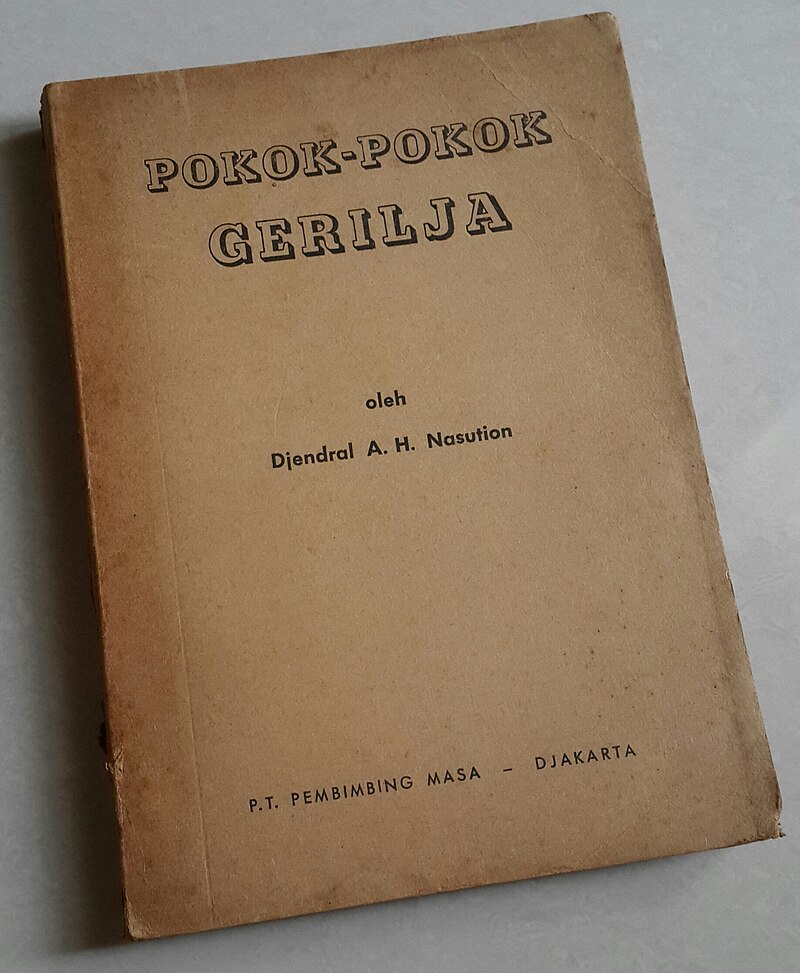
Of all the members of Indonesia’s military elite in the early days of independence, Abdul Haris Nasution (1918 – 2000) was a key figure in shaping the role of the military in Indonesian politics. He laid the foundations for Indonesia’s guerrilla war against the Netherlands from 1945 to 1949. His doctrine stated that civilians and the military must fight together, with no separation between the two. This doctrine also served as the foundation for General Nasution’s “middle way” concept in 1958.
This concept did not emerge suddenly. The collapse of Indonesia’s parliamentary democracy in the 1950s was one of the triggers for Nasution to reformulate the relationship between civilian society and the military. Political instability resulting from frequent cabinet changes prompted him to reconsider the military’s role not only as an element of defense and security but also as a balancing force.
The middle way concept emerged after Nasution reorganized the Indonesian Army in 1952. As the supreme commander of the organization, he aimed for the military to become a professional entity, sending many officers to study abroad. In the early days, Nasution focused more on internal consolidation. He did not view himself as an instrument of government power, but neither did he want the Indonesian armed forces to be isolated from politics.
The Middle Path
It is not surprising that Harold Crouch, in “The Army and Politics in Indonesia” (1978), described Nasution as more than just a soldier. He was also an organizer and a thinker. He influenced Indonesian politics by shaping doctrine, organization, and the military’s role as a power balancer between the political parties, the government of President Sukarno, and the armed forces.
However, after 80 years of independence, the concept of a middle path that allowed the armed forces to be involved in many areas of civilian life has become problematic. Today militarism has regained strength and become a political tool for the ruling regime.
History records that the military gained greater freedom to engage in politics and business after Nasution initiated his doctrine of the middle path. Since Guided Democracy was promulgated in 1959, the Indonesian military has been involved in government bureaucracy, contributing to policymaking, and influencing political and security stability. This included determining foreign policy during Indonesia’s confrontation opposing the formation of Malaysia from 1963 to 1966. The Indonesian military emerged as a counterweight to the power of the nation’s political parties, particularly the Indonesian Communist Party.
According to the late historian Herbert Feith, this also prompted the Indonesian Army to intervene to prevent Dutch assets from coming under the control of “left-wing workers” affiliated with the Indonesian Communist Party. With President Sukarno’s support, Nasution led the nationalization of Dutch companies. Active-duty officers without military positions began to occupy strategic roles within these companies. These positions were certainly more lucrative than those held in the military.
Nasution later expressed regret. He was upset that nationalization had provided the military with a gateway to business. His regret deepened after he learned that Ibnu Sutowo, a former subordinate in the Army, was involved in corruption at the state-owned oil company Pertamina starting in 1968. Under President Suharto, the middle path transformed into the concept of the dual function, or dwifungsi, which became one of the linchpins of the New Order regime’s rule for over three decades.
Dimmed after the 1998 democracy Reform (Reformasi) movement, militarism has reemerged after 27 years. President Prabowo Subianto has deployed the military to work in a wide range of projects: from food warehouses and forest management to free school meal programs and supporting peasant “Red and White” cooperatives. As under the New Order government, a number of active-duty Indonesian National Armed Forces (TNI) officers also hold civilian positions in several government ministries and state-owned enterprises. This military dominance has weakened the supremacy of civilian rule which is essential for democracy.
In his memoir, Nasution warned that the military should be an instrument of the state, not an instrument of those in power. Today Indonesia’s military has become a political tool for those in power. General Nasution’s ideas have been distorted by his own juniors.
This post is based on https://www.tempo.co/kolom/jenderal-nasution-dwifungsi-abri-2059768. Featured image credit: Cover image of Tempo Magazine’s 80th Independence Day Anniversary Edition, 17 August 2025.
In related news:


 Stories From Indonesia
Leave a Reply