The Death of Banowati
A Short Story By Susanto Aboge
“Father, I am willing to be married to Brother King Duryodhana. But, I have one condition. When it comes time for the ritual bridal shower I wish for Brother Arjuna to perform the washing,” said Banowati to King Shalya.
“Isn’t there some other condition? That is impossible,” said the King of Mandaraka, gazing at his daughter, aware that Arjuna and Banowati loved each other so deeply.
On hearing this Duryodhana’s face flushed crimson. He knew that Banowati’s love was indeed only for the mediator prince of the Pandava. However, in order to secure a political alliance he was willing to enter into a political marriage even though it meant loving her alone from afar. In fact right to the end of his life Duryodhana would never enjoy the love of his lawful wife.
During the marriage proposal ceremony, Arjuna lingered outside the palace. From that moment forward, as a kshatriya warrior, Arjuna could no longer distinguish victory from defeat. What was the use of true love if not sanctified by the holy bonds of matrimony?
As a man in that time, Arjuna berated himself constantly for everything. His supernatural powers, his prowess as an archer – all seemed utterly without point. All his life force and manhood seemed to wither as the beloved for whom he yearned was taken away by the evil king of the Kauravas.
Such was their condition that all he and Banowati could do was endure the forbidden longing, seeking each other in secret yet never satisfied, each time they made love feeling empty and forever unfulfilled.
“One day I will make you my lawful wife,” Arjuna promised. “That is a certainty, even on the battlefield of Kurukshetra. No matter how long it takes, my beloved. That is certain. I promise,” vowed Arjuna.
Each time they satisfied their forbidden desire, they always knew they were being watched – by the eyes of Ashwatthama.
***
These events felt as if they had happened only yesterday, so vivid were they in Arjuna’s mind. Now Banowati, the woman he had loved from their first encounter, lies lifeless and cold in his arms. Death has truly become the ultimate irrevocable end of their love story.
Duryodhana has perished, Kurukshetra has fallen silent. But what is the meaning of the Pandavas’ victory? How is their victory different from defeat? Banowati – the beautiful woman adored both by mortals and gods – has met her end at the hands of the coward Ashwatthama. The wedding night, only three days away, is now never to take place. Once again Arjuna has failed to make good his promise. The woman he has longed for all those years is gone forever.
The lifeless corpse of Ashwatthama, this spy of the Kurawas, lies sprawled on the ground. But Arjuna can not erase the coward’s eyes still glaring at him after his life was extinguished by the Pasupata weapon released by the innocent infant Parikshit. Worse, Ashwatthama had laughed as he suffered.
“I am not dead. I have won this war!” Ashwatthama’s cry echos in the ears of the third son of Princess Kunti. In an instant as if they happened only yesterday the recent events cascade before Arjuna’s eyes.
“If I cannot have Banowati, then it is better that she die so that neither you nor Duryodhana may possess her,” Ashwatthama had said on catching Arjuna and Banowati one night making love beneath the frangipani tree behind the royal women’s quarters.
Lifting Banowati’s lifeless body at dawn, Arjuna arises to his feet, gazes into the heavens and shouts with all his might. “Is this your will, O gods? Are you satisfied with our defeat as mortals? What good is beauty if it is forever shrouded in suffering? What good is merit and victory if they are merely relative and meaningless?” He staggers from Banowati’s hiding place, still bearing her cold, rigid body. He does not weep. Rather he laughs, surveying his surrounds. His gaze settles on Ashwatthama’s lifeless form.
Before him is the body of Ashwatthama, still mocking, growing louder as Arjuna approaches. With all his might Arjuna kicks the lifeless body of his master teacher’s beloved son.
As his body moves it seems like Ashwatthama’s corpse divides itself into countless forms then surrounds Arjuna. His laughter grows ever more piercing, ringing ceaselessly in Arjuna’s ears.
“I am truly defeated, O gods. Mock me as Ashwatthama mocks me. I, Arjuna, am nothing. I, Arjuna, are nobody. Enjoy your games,” cries Arjuna, kneeling, still cradling the cold body of Banowati.
***
That morning Kurukshetra is no longer a battlefield for the blood feud of the Bharata. It is transformed into the site for the last rites for the fallen warriors including those from the Pandava side. They are busy preparing for the funeral rites of Dristadyumna, Pancawala, and Srikandi. However, before the ceremony begins, Yudhishthira, Bhima, Nakula, and Sahadeva glance at each other. Where is their brother, Arjuna?
Yes, before the sun rises, Arjuna is no longer cradling and carrying Banowati’s lifeless form. Arjuna has left Kurukshetra. Is he alone? Certainly not! He is with his Banowati who he has placed in a casket and covered with diaphanous white lace.
Arjuna departs in the chariot he used in the battle against Karna. As a man he refuses to allow Banowati to be carried like the other fallen. He will not participate in the funeral rites for her. Banowati to him continues to live or she must live with him. He is determined to make his case to the gods.
That morning Arjuna no longer needs the incantations of King Dwarawati, the incarnation of Vishnu who served as his charioteer during the war. Now he drives the chariot forward as fast as the winds of Lord Bayu. From time to time he glances back to make sure the casket bearing the body of his beloved is securely placed in the chariot.
“We are going to Nirvana, my dear Banowati. If we cannot be together in this world we shall be united in that world. Do not worry, my beloved,” he whispers.
After days of driving his horse forward, Arjuna arrives at the foot of Mount Mahameru. The chariot comes to a halt. Arjuna glances at the casket. He opened the casket that is covered with translucent lace. For some reason the body of his beloved has not decayed over these days. Rather the fragrance of musk and sandalwood emanates from within.
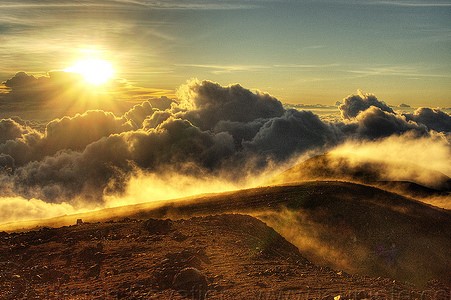
Arjuna places a kiss on the forehead of Banowati, then pausing he gazes up at the towering peak of Mount Mahameru. The summit of Mount Mahameru is not visible. All he can see are clouds, resembling cotton wrestling to envelope the peak. Arjuna looks back at the casket.
Finally he raises the casket bearing his beloved. With all his strength, driven by his love, Arjuna continues to ascend Mount Mahameru. It is unclear where his thoughts are wandering but he can from time to time hear the laughter of Ashwatthama. Arjuna continues to climb the eternal mountain with his beloved. He continues to bear upward her the casket. Step by step Arjuna makes his way through the white snow.
Ashwatthama’s laughter continues to surround him. During his journey Arjuna glaces back at the now silent city of Kurukshetra. Only a few days ago the smoke was clearly visible rising from the site of the Bharata bloodshed. It now appears no larger than a fingernail. The summit of Mount Mahameru remains distant. There is still a long and treacherous, snow-covered path to traverse. Arjuna continues to move forward.
Then in the midst of his journey there appears the wise sage Narada. He laughs and asks Arjuna, “What are you seeking here, my child? Was your adventure in your mortal world not enough?”
“Grandfather, I will keep walking till I can walk no longer. I desire to understand how time determines all things,” replies Arjuna.
“I am still with Banowati even if only as a lifeless form. I wish to be with her for eternity, like this pure snow,” he says.
“Grandfather, why are humans created in this world to suffer? Why must so many people live without the love of their true love?” he asks.
“What is the true nature of victory and defeat? Why are humans granted the feeling of love only to have it capriciously thwarted by the gods? Shouldn’t there be times when the gods and humans exchange places? And finally, if possible, I want Banowati to be brought back to life,” says Arjuna. Then Arjuna collapses together with the casket containing Banowati onto the pure white snows of Mount Mahameru.
***
Purwokerto, 2020-2022
The Death of Banowati (Kematian Banowati) was published in the newspaper Suara Merdeka on 21 August 2022. Retrieved from https://ruangsastra.com/27426/kematian-banowati/.
According to Ruangsastra.com, Susanto Aboge is the pen name of Susanto, who was born in Banyumas, Central Java province, on July 17, 1984. A 2008 graduate in Sociology from UNSOED (General Soedirman University) Purwokerto, he works as a journalist for the Banyumas bureau of Central Java’s major daily newspaper Suara Merdeka. He is also active in the Banyumas branch of Nahdlatul Ulama Mosque Management Institute (Lembaga Takmir Masjid Nahdlatul Ulama), the Luar(K)otak Writing School, and the Indonesian Marginalized Communities Network (Komunitas Orang Pinggiran Indonesia, or KOPI). His short stories, essays, and poems have appeared in various print and online outlets. In 2020 he published a collection of journalistic works, Pitutur Kiai Ronggeng – Wawancara Ahmad Tohari. Between 2015 and 2020 he won several national journalism awards.
In related news:

 Stories From Indonesia
Leave a Reply