Young Jamal, Young Jamal
A Short Story by Mochtar Lubis (1950)
A few friends have accused me of mocking young Jamal, of just making fun of him, ridiculing him, with my stories about him. “What’s the point of writing stories like those about little Jamal?” they say to me. “Poor thing’s become the butt of jokes and scorn.” They’re rather angry, and I can see it. I have to admit honestly that I have no intention of mocking, or ridiculing him, or making fun of him. In fact, I have never written about young Jamal without feeling respect and affection for him, for the qualities that make him who he is.
And what’s more, I am aware that mocking, ridiculing, and making fun of little Jamal, or anyone else for that matter, serves no purpose. It benefits neither the mocker, nor the mocked. It only makes other people bored.
I do love a laugh. I laugh loudly, freely, without holding back. And I invite others to laugh. I want Jamal to join in the fun. To laugh at himself, at you, at everyone, at this world, at life, and ultimately of course, at me myself. For this reason I have never taken my eye off young Jamal. His life, his behavior, all of it, reflects the actions and characteristics of a real human who’s alive.
These are the qualities of everyone, including myself. And if we don’t laugh at ourselves, how can life in this world be joyful and happy?
I myself find it rather surprising that my friends are a little angry with me for writing stories about young Jamal, while little Jamal himself, every time he bumps into me never shows any anger or frustration. In fact, he often finds the stories amusing and he often feels proud to read the stories about himself. Maybe the ones who are angry feel the stories might be about them. Who knows? But, let my friends be angry, so long as little Jamal doesn’t change. There’s one more thing I want to say. Young Jamal is not just a figment of my imagination. He really exists. He is flesh and blood just like any other person. And all the stories about Jamal are real, not exaggerated in the slightest. The characteristics and behaviors of young Jamal that I describe are indeed the traits and actions of a real person.
One more quality of little Jamal that I do really admire is his optimism. He bounces back like a rubber ball. No matter the disappointment, the sadness, our Jamal always manages to rise up again full of joy.
This little tale is necessary to prevent any misunderstanding that might arise from the story about young Jamal wanting to travel to The Hague. Maybe it will make a good number of friends angry with me.
So as I mention earlier, as I am about to return home to Jakarta from Jogjakarta, with the Republic’s government being restored in Jogjakarta, little Jamal says at Maguwo airport that he’s been given the job of managing the people who are traveling to The Hague to attend the Round Table Conference.
Then he comes to Jakarta, and I see him all the time at the delegation office. He’s always busy, clutching a new leather bag, wearing new clothes, and sporting a straw hat, a remnant of his days as urban guerrilla that he hasn’t dropped yet. It’s a keepsake from his time in the city’s guerrilla movement, he tells me. For some time he doesn’t have the time for a good chat with me because he’s been busy compiling this and that list. Lists of advances for the members of the delegation who are attending, a list of advances for the members of the delegation’s support team, advances for delegation staff, advances for delegation advisors. Everyone gets an advance, says young Jamal. Then there is the list of daily allowances for when they arrive in the Netherlands. If you’re a member, you get more than the others, Jamal adds.

He also has a list of the people who need to be vaccinated. Some people are already mad with me, says young Jamal, because, to start with they are on the list to be vaccinated, but then after they get vaccinated and have had a fever for two days, their names are removed by Bung Hatta. But they’re angry with me, he says, shrugging his shoulders. There is also a list of the attendees who need to be provided warm clothing, overcoats, suitcases, and other necessaries. A list of who’s leaving on flight number one, number two, number three, and number four. Ah, it’s a headache, but it has to be done, says our Jamal.
“I’m actually really tired of these Republic people,” says young Jamal, when he’s not longer too busy making lists.
“You know, I’ve sold everything I can to support the independence struggle, help with this and that… But what’s the point of telling you about all of this? It’s not good to boast about the good things you’ve done, is it? Anyway you know what I’ve done for the struggle, don’t you?”
The day of departure for The Hague is drawing nearer. Over the past few days I’ve noticed that our Jamal seems very anxious. He can’t sit still for long, and I can see that his face is a little pale, as if he’s not sleeping well.
“You’re working too hard, Jamal,” I say to him.
“You look thin and pale.”
Then, suddenly, he says to me, “Do you know what happened yesterday?”
“No,” I reply, “what’s happened?”
“A friend told my fortune,” he says. “I was born in August, and according to my friend in the next few days I’m going to be offered a chance to make a journey across the ocean. And I should accept the offer right away because it will bring me good fortune. Now I’m having doubts about whether I’m going to be offered the chance to travel to The Hague, or perhaps somewhere else. Maybe my uncle who’s in Makassar will call me back there, because my engagement to his daughter was a long time ago now.”
“Ah, you really want to go to The Hague, don’t pretend, you don’t,” I say.
“No,” he says, earnestly, “for me it doesn’t matter whether I go or not.”
“Well, which one would bring better fortune for you, going to The Hague, or going to Makassar to marry your fiancée?”
“That’s just what I don’t know yet,” he replies. “If I accept the call to Makassar and end up stuck in marriage there, what’s going to happen? It’d be a disaster, wouldn’t it, losing my independence. But if we go to The Hague we’re going to receive our independence, is what Mr. Yamin says.”
And he laughs out loud, like an old monkey with a bellyache. But of course I don’t say that.
The next day I meet young Jamal again at the delegation office. From a distance he’s already calling out to me.
“Do you know what happened yesterday?” he asks.
“No,” I reply, “what happened?”
“Yesterday I had a long conversation with Bung Sjahrir. And Bung Sjahrir said that if I have the opportunity to go to The Hague it will be good if I go, because it will be very useful. So now I’m thinking it might be a good idea if I go after all.”
“Oh!”
“Don’t misunderstand me. I also know that we shouldn’t a hundred percent be blindly rushing off to The Hague. Like Mr. Sumanang said at the recent meeting of the Journalists’ Union at the General Society for Young Men, and there is still a lot of work waiting here. Only I’ve just been thinking about the information from Bung Sjahrir. I need to go to The Hague,” he says.
The next day, I meet him again.
“Do you know what happened yesterday?”
“No,” I reply. “What happened?”
“My name is already on the invitation list from the Government Information Service,” says our Jamal, “but they haven’t communicated that to me yet.”
“Go and sort it out with them quickly,” I urge him.
“Just now Wim Latumeten (the head of the Republic delegation’s press section, a writer) said that the issue of the invitation has already been handed over by the Government Information Service to the Information Department. So now I’m not sure which one I have to go to?”
“Can it really be that difficult,” I say to him. “If you’ve been invited, just be patient. Wait for them to come pick you up.”
“Waiting is not a problem,” he replies, “but I still have to have my clothes packed, get this and that ready. The organization of the Republic delegation is really disorganized,” says Jamal angrily.
I hurry off quickly.
After that I do not see young Jamal for ages. Hatta has already left. The other delegates have left as well, and the delegation office is rather quiet. I do not see young Jamal there anymore. I assume he has also left for The Hague.
So I am surprised one day when I run into him at Senen Markets, buying fried bananas across from the Rex cinema.
“Hey Jamal,” I call out to him, “you’re here? You didn’t go to The Hague?”
“Ah, no,” says young Jamal, grinning cheerfully. “Why should we all rush off to The Hague? It’ll just be a waste of time. There is plenty that needs doing here.”
He doesn’t seem anxious anymore. He is really happy.
“What are you working on now?” I ask.
“Studying,” he replies, laughing.
“Studying?”
“Yes, I’m learning Kanji or Chinese characters now,” he says with a secretive smile.
I know that he will put on his secretive, superior smile, if I ask him what I am about to ask him. But I ask anyway.
“Why Kanji characters?”
His secretive, superior smile creeps slowly across his lips, and leaning in, he whispers to me.
“Mao Tse Tung is almost here, friend!”
I’ve told you, haven’t I. Young Jamal is really smart?
Source: Si Djamal Si Djamal (Young Jamal, Young Jamal) is a story from the short story collection of Lubis, Mochtar. Si Djamal : dan tjerita2 lain / oleh Mochtar Lubis Gapura Djakarta 1950, p. 57.
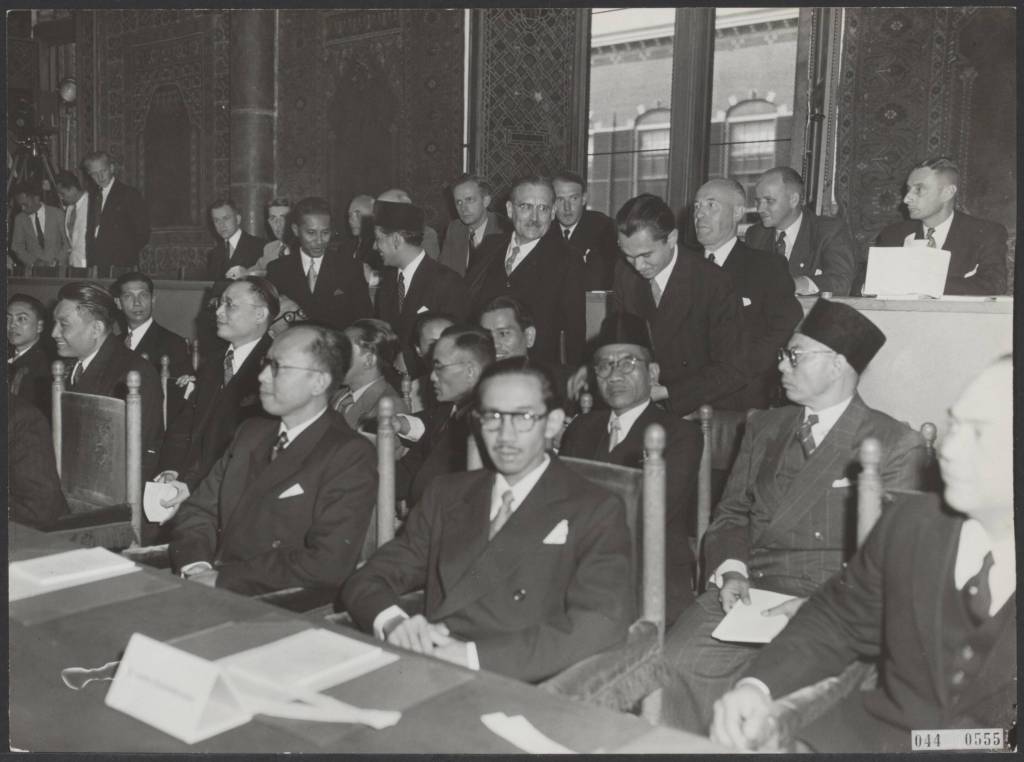
Featured image credit: Round Table Conference in The Hague [The Federal Delegation (BFO)? Standing in the middle Prime Minister W. Drees] – http://hdl.handle.net/10648/a8c28f34-d0b4-102d-bcf8-003048976d84 – 23 August to 2 November 1949.


 Stories From Indonesia