
The Military’s Growing Role: Is Prabowo Carrying Out an Autogolpe?
By Made Supriatma for Project Multatuli, May 14, 2025
Made Supriatma is a researcher and member of the Knowledge Council team of the Indonesian Legal Aid Foundation (YLBHI).
Few recognize the Indonesian military’s rapid expansion under the government of President Prabowo Subianto and Vice President Gibran Rakabuming Raka, where both its organizational structure and personnel have swelled to unprecedented levels.
In truth, this surge began long before Prabowo Subianto assumed the presidency: as Minister of Defense, he quietly rolled out a series of growth-oriented policies that have gone largely unnoticed by the public.
Throughout his ministerial tenure, Prabowo never released a formal defense white paper to articulate Indonesia’s strategic vision. Instead, official statements have fixated on upgrading the armed forces’ primary weapons systems—particularly for the Navy and Air Force—an urgency underscored by the 2021 sinking of submarine KRI Nanggala-402, which laid bare the decrepit and dysfunctional state of the nation’s military hardware.
Few acknowledge that beyond hardware upgrades, Indonesia’s Ministry of Defense and the Indonesian National Armed Forces (TNI) harbor a less visible—but equally ambitious—vision for national defense: a wholesale expansion of structure and manpower.
Since early 2023, defense authorities have quietly proposed boosting Regional Military Commands (Kodam) from 15 to 37 by creating 22 new commands.
In 2022, Prabowo also unveiled plans for a Reserve Component (Komcad), targeting 25,000 reservists by year’s end. Yet by 2024, the Ministry had mustered only 9,776 personnel—far short of its original goal.
The momentum behind modernizing and procuring new defense equipment gradually dissipated.
By contrast, the Prabowo government pressed ahead with sweeping domestic initiatives—free nutritious school meals, food and energy self-sufficiency programs, a sovereign wealth fund (Danantara), and a pledge to build three million homes—many of which integrate the military on a grand scale.
Simultaneously, it rewrote the legal framework to legitimize a deeper military footprint in civilian life. In a move executed with little public debate, the government amended Law No. 34/2004 on the Indonesian National Armed Forces (TNI), effectively codifying the armed forces’ already expansive role across non-defense sectors.
Long before the legal overhaul, the military had entrenched itself in civilian domains through a web of memoranda of understanding with non-defense institutions—agreements that project the veneer of civilian invitation.
This expansive role reflects Prabowo Subianto’s conviction that Indonesia’s path to progress lies in a command economy and state capitalism, echoing the reforms of Deng Xiaoping in 1980s China.
In his 2017 book, The Paradox of Indonesia and Its Solutions, Prabowo warns that Indonesia’s wealth of natural resources leaves it perpetually vulnerable to foreign predation—and he outlines a sovereign wealth fund, now realized as Danantara, as a bulwark against external exploitation.
All these maneuvers by the Prabowo government prompt a provocative question: Is Prabowo orchestrating an autogolpe against his own government? An autogolpe is a coup d’état executed by a legitimately elected leader, who leverages state institutions—above all, the military—to entrench his power. It unfolds through the aggrandizement of the armed forces and the systematic erosion of civilian pillars of democracy, from parliament and political parties to the free press and the integrity of elections.
Military Organization and Personnel Swelling
The Indonesian military, particularly the Army, is implementing plans to establish 22 Kodam (Regional Military Commands). If all goes according to plan, Kodam will be present in 37 of the current 38 provinces.
Each province will have one Kodam, similar to the Regional Police (Polda). This organizational expansion will undoubtedly increase the number of personnel, budget, and combat equipment, given that Kodam is the Main Command (Kotama) within the Indonesian Army.
The exact number of additional personnel required to establish one Kodam is unknown, both in terms of staff and soldiers. However, this organizational expansion will undoubtedly lead to organizational expansion at the lower levels.
Each Kodam has 2-3 Korem (Military Resort Commands); and each Korem should ideally oversee at least 10 Kodim (District Military Commands), which exist parallel to regencies/cities in the civil bureaucracy. Each Kodim will oversee a Subdistrict Military Command (Koramil), which is equivalent to a sub-district in the civil bureaucracy. The Military Rayon Commands are to oversee the Village Guidance Non-Commissioned Officers (Babinsa) in each village.
One can imagine how large the military organization will be if this plan comes to fruition. While some argue that the new Kodams to be formed are merely upgrades to the status of Type A Korems. Some Kodams do not have Korems, such as in the Indonesian Capital City (IKN), most of the Kodams to be formed will undoubtedly have Korems that will be established later.
As Kotama, Kodams will have strike battalions (infantry), possibly cavalry battalions or regiments, construction engineers (zikon), air defense artillery (arhanud), field artillery (armed), and so on. This force will undoubtedly require weaponry such as rifles, troop transport vehicles, tanks, and so on.
This is not to mention the civil and military staff who will fulfill military needs, from administration, legal and judicial institutions, to health. One can imagine the vast infrastructure, personnel, and funding required to establish a Kodam.
Territorial Development Battalion
In a working meeting with the Indonesian House of Representatives (DPR-RI) just five days after Prabowo was inaugurated as president, Defense Minister Sjafrie Sjamsuddin unveiled his ministry’s plan to establish a Territorial Development Battalion (BTP).
Sjafrie stated, “The President has established a national strategy to ensure that each of the 514 districts will be guarded by one Territorial Development Infantry Battalion. This battalion will be reinforced by two reserve component battalions.”
One Territorial Development Battalion and two Reserve Component Battalions will be stationed at each District Military Command (Kodim), which will be established in all 514 districts/cities. Besides being a combat unit, the BTP has a special purpose as it will support the Prabowo government’s program to achieve food self-sufficiency. Each BTP will have agricultural, livestock, fisheries, and health companies.
If this plan is actually implemented, it will result in 514 infantry battalions (BTP) across Indonesia. A typical infantry battalion in the Indonesian military has a strength of 700 personnel. If this plan is implemented in the next 4.5 years, there will be an additional 359,800 personnel in the Indonesian Army. This will undoubtedly be a significant cost to the state.
All of these personnel are perennial, meaning they are funded by the state for a long period: from training to retirement. With the increase in the retirement age for soldiers, the significant costs the state must incur for military personnel can be estimated.
Meanwhile, a soldier’s effective physical strength is limited. The older a person is, the further they fall short of military physical fitness standards. Those who do not meet the physical requirements are usually assigned to staff positions. With the increase in the retirement age, the need for staff positions increases. How will staff positions be provided for these senior soldiers?
Reserve Component
Furthermore, there are plans to establish a Reserve Component (Komcad). This is a national defense component that is not mandatory military service, but rather consists of civilians who voluntarily enlist to acquire military skills.
They will be mobilized by the President when the country faces war. Reserve Component personnel are people with permanent jobs, such as civil servants, laborers, farmers, and so on. Initially, many state-owned enterprise employees and some civil servants will become Reserve Components.
Komcad personnel do not receive salaries, but they do receive an allowance during training. The age limit for Komcad membership is also limited. If the plan to establish two Komcad battalions in each Kodim (District Military Command) is implemented, there will be at least 700,000 Komcads across Indonesia.
The Indonesian military is quietly expanding rapidly. The Ministry of Defense’s budget, currently the largest of all state budget items, could be used to recruit new soldiers, both for the BTP (Bandar) and to fill new Kodam personnel positions.
Expanding the Military’s Role in Non-Military Areas
Civil society activists, academics, and observers of the Indonesian military have generally focused their attention on the revision of the Indonesian National Armed Forces Law, which they believe will expand military involvement in civilian spheres. However, one thing has been overlooked: this expansion has already occurred on a massive scale.
Most observers criticize the military’s role at the national level but overlook the fact that its role in the regions has been present since the beginning of President Joko Widodo’s government in 2014.
In 2015, the Minister of Agriculture, then also Amran Sulaiman, issued a regulation on Special Efforts for Rice, Corn, and Soybean Production (Upsus Pajale). One key point of this policy was the involvement of Village Development Non-Commissioned Officers (Babinsa) in the implementation of the Upsus Pajale, much like it had been under the New Order regime.
Babinsa officers (village supervisory officers) will manage planting schedules, seeds, fertilizer and pesticide availability, as well as harvest and post-harvest management activities. The results were evident in Indonesia achieving rice self-sufficiency in 2016-2017. However, the following year, the program was discontinued because of its high cost.
The Role of Babinsa officers in Agriculture
The involvement of Babinsa officers, who are not agricultural experts, was reinstated when Prabowo appointed Amran Sulaiman as Minister of Agriculture in his cabinet. Agriculture has even become a priority in Prabowo’s cabinet.
The role of Babinsa officers has grown even greater because Prabowo’s food self-sufficiency program is not limited to the Upsus Pajale program.
The Ministry of Agriculture also has a Food Security Task Force led by Major General Ahmad Rizal Ramdhani. This task force is tasked with ensuring food security.
His mandate spans the length of Indonesia. However, his focus appears to be on the implementation of the food estate development program in Merauke, South Papua, which is to open one million hectares of rice fields and 1.6 million hectares of other horticultural crops.
Food Brigade Program
The Ministry of Agriculture also has a Food Brigade program. This program brings together around 12-15 millennial farmers. They are to be given 200 hectares of land to cultivate.
The government will provide agricultural machinery, production inputs (seeds, fertilizers, and medicines), and post-harvest processing of agricultural products. These millennial farmers will be assisted by armed force Babinsa officers (village-based village military officers) as mentors, trainers, and monitors.
Many government promotional flyers indicate that millennial farmers who join the Food Brigade are expected to earn a net income of around Rp 10 million ($620) per month.
Babinsa officers and village-level Subdistrict Military Command (Koramil) personnel are also to be utilized to purchase unhusked rice from farmers.
Under the leadership of the head of the Indonesian National Logistics Agency (Bulog), Major General Novi Helmy Prasetya, farmers are to be encouraged to sell unhusked rice to Babinsa officers (village supervisory officers) and Subdistrict Military Commands (Koramil) at a price of Rp 6,500 ($0.40) per kg. This was done to ensure high prices for unhusked rice, benefiting farmers and protecting them from middlemen. The program appeared highly popular as Bulog had eliminated grain quality requirements, in particular moisture content, and the percentage of empty grain.
Forest Area Control Task Force
The military is not only involved in agriculture. In January 2025, President Prabowo issued Presidential Regulation No. 5/2025 concerning the establishment of the Garuda Forest Area Control Task Force (PKH). This policy was followed up with the signing of an MoU between the Indonesian National Armed Forces (TNI) Headquarters and the Ministry of Forestry.
The PKH Task Force’s task is to “control” forest areas that are not being used according to their intended purpose. The Garuda PKH Task Force is led by the Chief of Staff of the Indonesian National Armed Forces (Kasum TNI), Lieutenant General Richard Tampubolon.
It is easy to suspect that many forest areas are being encroached upon to make way for oil palm plantations. The Garuda Task Force claims to have confiscated approximately 1.1 million hectares from oil palm plantation companies. This area is only a fraction of the 3.3 million hectares of oil palm plantations in forest areas.
Were these confiscated oil palm plantations subsequently reforested? Absolutely not.
These are productive oil palm plantations. To that end, the Prabowo government established a company under the Ministry of State-Owned Enterprises, called PT Agrinas Palma Nusantara.
This company originally managed 221,000 hectares of oil palm plantations belonging to the Duta Palma Group, which were confiscated by the Attorney General’s Office. By the end of March 2025, the Garuda PKH Task Force had successfully confiscated 538,868 hectares of oil palm plantations to be managed by PT Agrinas. All of these are productive plantations.
Food & Cooperative Program
The military’s largest involvement as an implementer of the Prabowo government’s policies is undoubtedly in the Free Nutritious Meals (MBG) program. At the start of this program, TNI Headquarters announced that it had prepared 351 District Military Commands (Kodim), 14 military bases (Lantamal), and 41 Air Force Bases (Lanud) to establish public kitchens to ensure the success of the MBG program.
The actual implementer of the MBG program is the National Nutrition Agency (BGN). However, it takes time to establish an agency with such an ambitious program. The Indonesian National Armed Forces (TNI) stepped in to fill this void.
The BGN will recruit 30,000 Indonesian Development Driving Graduates (SPPI) to run the MBG. They are to receive two months of basic military training, before starting their duties. It is unclear whether this training also qualifies SPPI as Komcad members.
80,000 Village Cooperatives
Another major program of the Prabowo government is the Red and White (Merah Putih) Cooperative movement.
The government plans to establish 80,000 cooperatives at the village level. These cooperatives are to be multi-purpose cooperatives engaged in production, consumption, agricultural input provision, savings and loans, and so on.
Estimated Cost $24.5 Billion
Each cooperative is to have capital of Rp 5 billion ($300,000). This capital will be drawn from village funds, which amounts to Rp 1 billion ($60,000) per year. The shortfall is to be covered by the Association of State-Owned Banks (Hiimbara). Rp 400 trillion ($24.5 billion) is needed to finance these cooperatives.
Military Involvement in Cooperatives
Military involvement will be at least through the involvement of Babinsa officers (village supervisory officers) or commanders of District Military Commands (Danramil), who are usually present at the Special Village Deliberation meetings (Musdesus) to establish the Red and White Cooperative. In fact, TNI has prepared pharmaceutical production to supply the needs of the pharmacies that are to form one of the economic units of each Red and White Cooperative.
Ministry of Transmigration Resurrected
The Prabowo government also revived the Ministry of Transmigration, which had been closed since the fall of the New Order regime. This program was widely criticized for changing the demographics of destination areas. It was also opposed because it only shifted poverty from densely populated areas in Java to areas outside Java.
The Ministry of Transmigration is to offer the Patriot Transmigration program to young Indonesians. This is not to be a regular transmigration program, but rather a program for educated individuals.
Participants are to receive scholarships from the Ministry of Finance’s Regional Development Planning Agency (LPDP) to pursue undergraduate, master’s, or doctoral studies at various universities. They will be required to live for three months among a local community, providing guidance and counseling. They are also to be required to undergo military training, and be willing to serve as reserve soldiers.
Military Civilian MoUs
As mentioned earlier, the military’s increasing involvement in all aspects of civilian life is a result of numerous memorandums of understanding (MoUs) signed between TNI and civilian institutions. These MoUs have been signed with various universities, both state and private, as well as with several regional governments.
Army-West Java Provincial Government MoU
This collaboration between the military and civilian institutions has not been uncontroversial. For example, take the MoU between the Indonesian Army (TNI-AD) and the West Java Provincial Government, signed in March 2025.
2029 Presidential Campaign Rumblings
In this MoU, the West Java Provincial Government granted TNI extensive authority to participate in economic development activities in the province. West Java Governor Dedi Mulyadi, who is rumored to have ambitions of running for president or vice president in 2029, has used Indonesia’s military for all sorts of purposes, from building roads, bridges, and irrigation, to providing military training for delinquent high school students, and educating adults addicted to alcohol and gambling.
Does the Democracy Reform Movement (Reformasi) Have to Start from Scratch?
In less than six months, we have seen how the Prabowo-Gibran government has drastically transformed civil-military relations after the New Order. It’s hard to deny that the military now occupies a front seat in a variety of government programs.
Two things have happened rapidly. First, the development of the military organization, such as the addition of 22 Regional Military Commands (Kodam), the formation of Territorial Development Battalions (BTP), and the formation of the Reserve Component (Komcad).
Instead of modernizing defense equipment, the Prabowo government (and that of President Joko Widodo before it) has opted for a massive boost in personnel.
This increase in Indonesia’s military personnel, if planned, will double the number of Indonesian personnel and could even reach nearly 1 million by the end of Prabowo’s term of office in 2029.
That number doesn’t include the Regional Military Reserves (Komcad), which, when combined with the number of District Military Command (Kodim) personnel and personnel trained in various departments, would total at least 700,000 personnel.
Talk of War
This massive mobilization seems like a war mobilization. Even though there are no signs of war breaking out, President Prabowo has repeatedly spoken of the possibility of nuclear war and World War III, and that Indonesia would be affected.
Second, there is the military’s involvement in implementing a variety of Prabowo government policies.
This use of the military is very intensive, especially at the community level, both in villages and cities. As we have seen, the military is to have a role in agriculture, the Red and White Cooperatives, transmigration, and even forestry.
Command Economy
The military is to become the policy implementer and reduce the role of the civilian bureaucracy that has previously fulfilled this role. President Prabowo has done this out of distrust of the civilian bureaucracy and a desire to implement a command economy, which he considers more efficient.
This massive expansion of the military’s organization will significantly increase the number of military personnel. Meanwhile, the postponement of the retirement age will result in many military personnel being placed as staff. Where will these personnel be employed, as it seems unlikely that all of them can be accommodated within the military organization?
While the Indonesian military is still relatively lean, we see many mid-level and high-ranking officers without positions or titles. Even since the military organization has been expanded, reportedly hundreds of officers still remain without positions. They have been dropped into state-owned enterprises, particularly PT Agrinas Palma Nusantara, which is looking after the oil palm plantations confiscated by the Garuda Forest Area Control Task Force.
This reality makes the question I posed at the outset logical: Isn’t President Prabowo carrying out a coup against his own government (autogolpe) by expanding the military to such a scale and using military personnel to implement his strategic policies?
If the plan to increase the number of Regional Military Commands (Kodam) and establish the BTP is successfully implemented in 2029, when Prabowo completes his term, the military will become a very significant political force.
Even if it doesn’t demand legislative or executive positions as it did during the New Order’s dual function (dwifungsi) policy, the military will become a political bloc that all parties will have to reckon with. They would be able to install civilian politicians as proxies in power. And civilian politicians who are unable to rule democratically will warmly welcome the military’s “assistance.”
If we use the definition of autogolpe above, we are clearly headed in that direction.
The process is happening slowly, discreetly, quietly, and even with the support of those who once fought for democracy and have now become totems to deceive democracy’s demise.
The question now is not what if it happens. It is already happening on a scale that activists, academics, or civil society organizations never realized.
We are not experiencing democratic regression. We are waiting on a democracy that is dying.
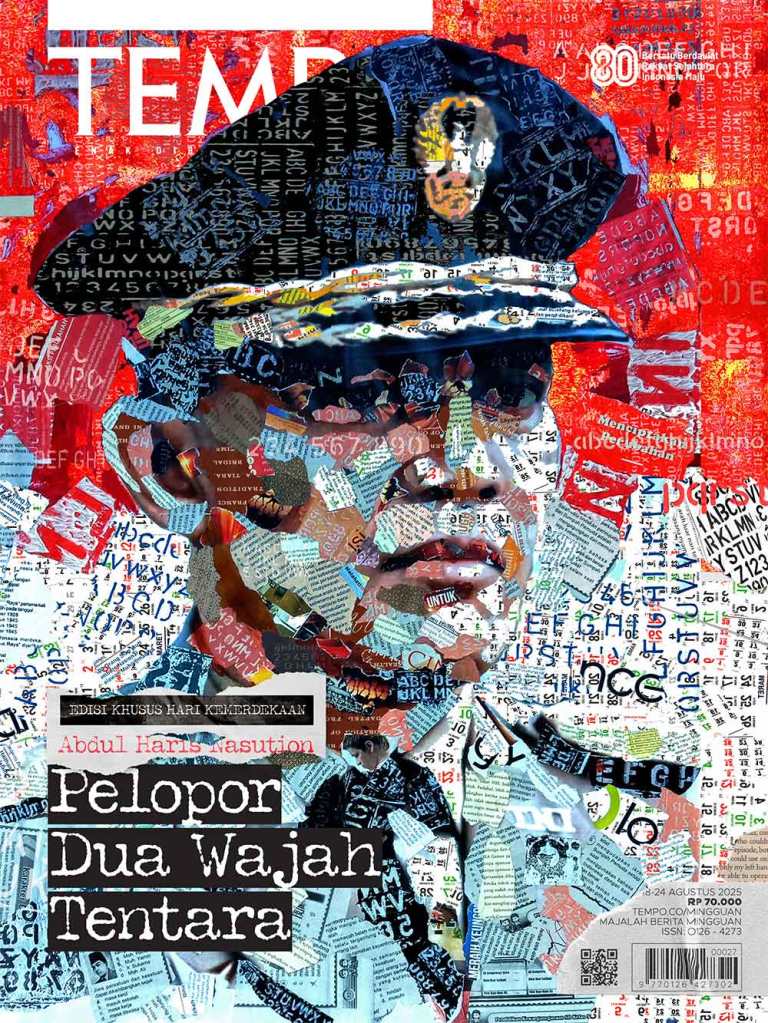
This post is based on https://projectmultatuli.org/peran-militer-membesar-apakah-prabowo-sedang-melakukan-autogolpe/. Featured image credit: Cover image of Tempo Magazine’s 80th Independence Day Anniversary Edition, 17 August 2025
In related news:
- https://www.theguardian.com/world/2025/aug/28/indonesia-president-prabowo-subianto-military-civilian-affairs
- https://www.bloomberg.com/news/articles/2025-08-21/ministers-back-prabowo-s-plan-to-use-military-in-social-programs
- Pioneer of the Military’s Two Faces, Tempo Magazine, 17 August 2025 Edition
- https://www.tempo.co/kolom/jenderal-nasution-dwifungsi-abri-2059768
- https://nasional.kompas.com/read/2025/08/15/13501731/prabowo-ungkap-alasan-tambah-satuan-di-tni-kondisi-geopolitik-tak-menentu
- https://www.tempo.co/politik/anggota-dpr-ungkap-potensi-kenaikan-anggaran-tni-setelah-penambahan-6-kodam-baru-2058210
- https://regional.kompas.com/read/2025/08/12/123022378/terima-telegram-panglima-tni-pangdam-diponegoro-kerahkan-pasukan-ke-kejati
- https://www.bloomberg.com/news/articles/2025-08-12/prabowo-s-food-estate-chief-quits-citing-zero-budget
- Profil Dirut Agrinas Joao Mota, Dulunya Aktivis Timor Timur Pro-NKRI, Kompas.com, 12 Agustus 2025
- Indonesia Expands Military as Defense Budget Soars, Bloomberg, 11 August 2025
- When the Military is Involved in Student Orientation, Tempo, 10 August 2025
- The Reason the Indonesian Armed Forces Has Added Six New Regional Military Commands, Tempo, 10 August 2025
- TNI Forms 6 New Regional Military Commands, Inaugurated on August 10, Kompas.com, 8 August 2025
- Kopassus, Kopasgat, and Marines Should No Longer be Led by a Commandant and Should be Headed by a Commander, Kompas.com, 8 August 2025
- Three Elite TNI Elements to be Headed by Three-Star General, Kompas.com, 8 August 2025
- Position of Deputy TNI Commander Revived, What’s the Reason? Kompas.com, 8 August 2025
- Indonesia’s new leader expands military’s role in test of fragile democracy, Reuters, 31 January 2025
- Army Chief of Staff: The Formation of New Regional Military Commands Requires Consideration and Time, Kompas.com, 2 June 2024
- Indonesian Army Wants to Create 22 New Regional Military Commands, Army Chief of Staff Says This is to Bring the Army in Line with Regional Police Commands, Kompas.com, 7 March 2024
- https://clinecenter.illinois.edu/coup-detat-project/statement_dec.15.2022

 Stories From Indonesia
Leave a Reply