
Behind the Manipulation of Fines Imposed on Palm Oil Companies
Tempo Magazine Cover Story, March 2, 2025
Without the misappropriation of fines imposed on palm oil companies that have encroached on Indonesia’s forests, President Prabowo Subianto wouldn’t have needed to resort to the current severe round of budget cuts affecting public services. He could have focused instead on reducing unnecessary spending without slashing funding for school construction, judicial oversight, or human rights protections.
According to estimates by the Task Force for the Implementation, Supervision, and Control of the Omnibus Law at Indonesia’s Ministry of Environment and Forestry, fines imposed on approximately 2,000 palm oil companies for encroaching on forests could have totaled as much as IDR 300 trillion ($20 billion). This amount would have been sufficient to finance President Prabowo’s signature free school lunches program currently being rolled out nation wide.
However, adjustments made by the task force resulted in significant losses in potential non-tax revenue for the government. The IDR 300 trillion figure was based on the fine calculation outlined in Ministerial Decree No. 661/2023, which factored in the economic value of forests, including potential timber harvests.
The fine amount changed following the release of a new decree, No. 815/2023, just one month after Ministerial Decree No. 661 was enacted in June 2023. The new decree calculated fines based only on forest resource provision fees and reforestation funds for areas actually planted with oil palm. As a result, by February of last year, the actual fines collected had shrunk to less than half the original estimate.
Prosecutors are now investigating suspected irregularities in the handling of these fines. They have searched the Ministry of Environment and Forestry’s offices, confiscated officials’ mobile phones, and seized electronic devices from their workspaces for examination. Authorities are still awaiting an official assessment of government losses from Indonesia’s national audit authority the Financial and Development Supervisory Agency.
Fines are a mechanism introduced under the Omnibus Law to address palm oil plantations that operate illegally in forests. The Ministry of Environment and Forestry refers to these violations as “overreach.” Business operators have cleared forests without legal authorization, leading to around 3.3 million hectares of Indonesia’s 17.1 million hectares of palm oil plantations to be classified as illegal.
This is a key reason why the European Union has condemned Indonesia’s palm oil industry for contributing to illegal deforestation. It is worth noting that Indonesia recognizes “planned deforestation”—a form of deforestation accounted for in forest land use planning. In its Nationally Determined Contribution (NDC) report to the United Nations, the Indonesian government includes planned deforestation in its carbon emissions calculations related to forest clearing.
The Omnibus Law sought to resolve licensing chaos in the palm oil sector by imposing fines. Plantation owners operating inside forests could avoid imprisonment by paying fines and securing the necessary permits. Under the Omnibus Law, this resolution follows the ultimum remedium (last resort) principle, prioritizing administrative sanctions over criminal punishment.
Given this approach, it is unsurprising that many view palm oil fines as a strategy to legitimize corporate land grabs. Environmental destruction, deforestation driving the climate crisis, and the devaluation of Indonesia’s natural commodities in global markets can all be settled with a fine. This culture of impunity has been further reinforced by allegations that fine amounts have been manipulated to be more favorable to businesses.
Recently, amnesty measures have expanded. Indonesia’s President Prabowo Subianto has broadened immunity by including mining operations inside forests under Presidential Regulation No. 5/2025 Concerning the Regulation of Forest Areas. The only option under this regulation is for the government to take over plantations or mining concessions after fines have been paid.
Fines for environmental violations could, in principle, be justified. They can be a means of assessing government losses caused by natural resource exploitation, factoring in economic losses, ecological damage, and restoration costs. In the case of the Bangka Belitung Province tin corruption scandal, the losses have been estimated at IDR 271 trillion because they included all three components. Like the tin scandal, palm oil operations in forests should not be exempt from criminal prosecution.
For this reason, Tempo’s editorial team selected a cover image of two individuals shaking hands in the middle of a deforested area to illustrate the suspicion of corruption in the application of fines imposed on palm oil companies in this week’s main report. Depicting a cash-filled tractor or crows circling a suitcase of money would have been too literal for “Behind the Manipulation of Fines Imposed on Palm Oil Companies.“
Source: Tempo.co
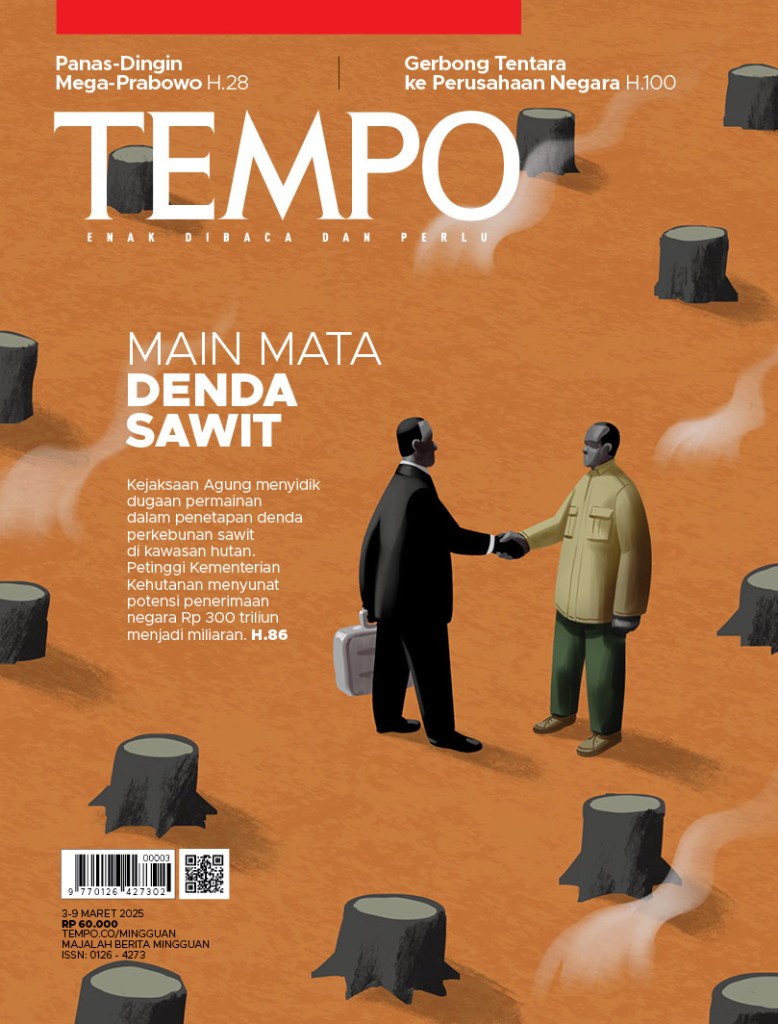
Alleged Corruption in the Administration of Fine Imposed on Palm Oil Companies That Encroach on Forests
By Riky Ferdianto for Tempo.co, March 2, 2025
Attorney General’s Office Yet to Name Suspects in Forestry Ministry’s Palm Oil Fine Corruption Case
JAKARTA—The interrogation of a senior Indonesian government official, who we will refer to as DI, from the awkwardly named Non-Tax Government Revenue Sub-Directorate for Forestry Utilization at Indonesia’s Ministry of Forestry, concluded at 8:00 p.m. on Monday, February 24, 2025. DI had arrived alone at the Special Crimes Division of the Attorney General’s Office in South Jakarta to be deposed in relation to the alleged misappropriation of administrative fines levied against palm oil plantation companies that have been operating in designated forests.
Investigators also ask DI to provide additional documentation on the implementation and tariff calculations of the fines imposed on palm oil plantation companies that have encroached on forests. DI submitted a bundle of financial accountability reports and administrative fine settlements related to PT MSM, a company suspected of irregularities in the administration of fines at the Ministry of Forestry, formerly known as the Ministry of Environment and Forestry (KLHK).
“The witness summons are still being processed, but no suspects have been named yet,” said the official spokesperson for Indonesia’s Attorney General’s Office, Harli Siregar, on Friday, February 28, 2025.
Despite five months of investigation, the Attorney General’s Office has yet to officially name any suspects in the corruption case involving the administration of fines for palm oil companies operating in forests. The Special Crimes team previously raided the Secretariat General and Legal Bureau offices of KLHK on October 3, 2024, confiscating documents, mobile phones, and electronic devices. However, little progress has been publicly disclosed to date.
Two individuals familiar with the investigation revealed that authorities initially pursued a covert approach in September 2024, aiming to catch perpetrators in the act using a sting operation. However, they failed to track financial transactions because of a lack of evidence, prompting a shift to an open investigation. “There’s suspicion that the plan to use a sting operation was leaked,” said one source.
Alleged Collusion in the Determination of Fines
Prosecutors suspect that collusion between palm oil business owners and Forestry Ministry officials occurred in the Implementation, Supervision, and Control Unit under the Secretariat General. Established in June 2021 by then-Minister of Environment and Forestry Siti Nurbaya Bakar, the unit was tasked with enforcing Articles 110A and 110B of the Job Creation Law that related to the forestry and environment sectors. These provisions set fines for companies operating palm oil plantations inside forests, whether with or without local government permits.
The two additional articles in the Law Concerning the Prevention and Eradication of Forest Destruction aimed to “legalize” previously unlawful activities. Companies that paid the fines and obtained the necessary permits could retain control of the land legally. However, if they ignored government warnings for three years, they faced potential criminal prosecution. This process opened loopholes for alleged abuse of power by ministry officials, leading to corruption and extortion.
Sources involved in the investigation said the formula for the calculation of fines for palm oil plantations operating inside forests was outlined in Government Regulation No. 24/2021. The regulation stipulated that fines would be based on the area of encroached forest, duration of occupation, and a percentage of the company’s profits. However, investigators found that personnel within the Implementation, Supervision, and Control Unit manipulated these regulations through the use of complex enforcement policies. “Two conflicting regulations were applied simultaneously,” explained one source.

Discrepancies in the Assessment of Fines
The two conflicting regulations were Ministerial Decree No. 661/2023, issued on June 21, 2023, and Ministerial Decree No. 815/2023, issued on July 26, 2023. Decree No. 661 calculated fines on the basis of the exploitation of other natural resources in forests such as timber, while Decree No. 815 only took into consideration the area planted with palm oil. The fines under Decree No. 815 were significantly lower.
If the government had applied the formula laid down by Decree No. 661’s, potential non-tax government revenue from palm oil fines could have reached IDR 300 trillion. However, with Decree No. 815, the amount collectable was limited to IDR 637 billion. This discrepancy allowed officials to collude with palm oil business owners, offering them the option to pay lower fines in exchange for kickbacks.
Companies enrolling in the program in order to legitimize their plantations were reportedly presented with two fine options: a higher official fine, or a significantly reduced fine if they made irregular additional payments to ministry officials. Investigators suspect that even obtaining a fine assessment required bribes. “Business owners had to pay just to see the fine amount,” a source said.
Ongoing Investigation and Delay in the Naming of Suspects
On November 2, 2023, the Ministry of Forestry issued Ministerial Decree No. 1170, annulling Decree No. 815 and reinstating the methodology for calculating fines set down by Decree No. 661. However, the new decree was issued just one day before the deadline for companies to register for the legalization program, causing further confusion.
Documents from the Supervisory Board of the Implementation, Supervision, and Control Unit indicate that senior officials were aware of the scheme. An internal review dated June 27, 2024, found that 234 fine assessments had been calculated using the more favorable formula under Decree No. 1170, without on-site verification of the reported areas, raising concerns about further financial losses to the government.
According to the Forestry Ministry’s legal documentation network, 2,130 companies should have been subject to fines, however, only 394 expressed interest in participating in the legalization program.
Indonesia’s Attorney General’s Office has held seven case review meetings since October 2024 and has questioned key witnesses, including senior Forestry Ministry officials such as Bambang Hendroyono, the former Secretary-General of the Ministry and head of the Implementation, Supervision, and Control Unit. While the minister signed the regulations, prosecutors view Bambang as a central figure in the scheme. “His team managed hundreds of billions of rupiah over the past five years. That’s what prosecutors are pursuing,” one source told Tempo.co.
Bambang, now retired, remains at the Forestry Ministry office in the central Jakarta Senayan district, as the Forestry Minister’s senior advisor. Tempo.co sought his response on February 26-27, 2025, however, staff claimed he was unavailable. He also did not respond to phone calls or written requests for interviews. Former Minister Siti Nurbaya Bakar similarly did not respond to interview requests.
Role of Presidential Task Force
Although the legal framework for the alleged corruption case is well established, prosecutors have yet to name any suspects. Attorney General Sanitiar Burhanuddin has said that suspects include high-ranking ministry officials, but cited an ongoing audit by the nation’s audit agency the Financial and Development Supervisory Agency (BPKP) as the reason for the delay.
The BPKP is still recalculating the estimated IDR 300 trillion in lost revenue, using satellite imagery from the government’s Geospatial Information Agency. However, officials believe that actual forest encroachment exceeds the mapped areas. “Our team is still conducting field verifications,” said Gunawan Wibisono, BPKP’s legal and communications chief.
Meanwhile, Indonesia’s President Prabowo Subianto has established a Presidential Task Force for Forest Enforcement (Satgas PKH) under Presidential Regulation No. 5/2025. Led by Indonesia’s Defense Minister Sjafrie Sjamsoeddin, with Deputy Attorney General for Special Crimes Febrie Adriansyah as its operational head, the task force has begun negotiating land handovers from palm oil companies back to the government.
A palm oil industry executive told Tempo.co that he had signed a land transfer agreement with the Task Force to avoid legal repercussions, claiming the land would be managed by a government owned plantation enterprise. The formation of the Task Force has led to increased caution among prosecutors about discussing the corruption case.
Defense Minister Sjafrie Sjamsoeddin did not respond to Tempo.co’s requests for an interview. A Defense Ministry spokesperson stated that a written response was forthcoming, but as of publication, no reply has been received.
Source: Tempo.co
More from this edition
- Rumus Rumit Menghitung Denda Sawit
- Jika Tentara Mengurus Kebun Sawit di Kawasan Hutan
- Benarkah Denda Sawit Tak Menghapus Pidana?
This post is based on https://www.tempo.co/prelude/sampul-tempo-korupsi-denda-sawit-1213919 and https://www.tempo.co/arsip/korupsi-denda-sawit-di-kawasan-hutan-1213915 and is not authorized.
In related news:
- https://www.reuters.com/markets/commodities/indonesia-gives-more-seized-plantations-state-palm-oil-company-agrinas-2025-07-09/
- https://www.tempo.co/lingkungan/kata-menteri-kehutanan-soal-viral-tim-folu-net-sink-diisi-kader-psi–1216184
- https://m.kumparan.com/kumparannews/pimpinan-komisi-iv-soroti-banyak-kader-psi-di-folu-net-sink-bagi-bagi-kekuasaan-24dOf6uyL0v


 Stories From Indonesia
Leave a Reply