
Atnike Nova Sigiro on Human Rights Enforcement: It Can’t Be Driven by Political Maneuvering
By Sunudyantoro, For Tempo.co, Nov 17, 2024
Chair of Indonesia’s National Human Rights Commission discusses challenges under Indonesia’s newly-elected President Prabowo Subianto.
JAKARTA — Human rights in Indonesia have already come under scrutiny within the first days of President Prabowo Subianto’s new administration. On October 21, 2024, a day after the inauguration, Yusril Ihza Mahendra, the newly appointed Coordinating Minister for Law, Human Rights, Immigration, and Corrections, declared that the violent events of 1998 did not constitute gross human rights violations.
The statement by the constitutional law professor, and former chair of the Crescent Star Party, appeared to disregard the established historical context and political statements of earlier governments. During the 1998 pro-democracy movement referred to as the Reformasi (Reform) period, student protesters were killed during clashes with security forces, and elite units of the Indonesian Army abducted pro-democracy students and activists to silence dissent against the New Order regime of President Suharto. The National Commission on Human Rights (Komnas HAM) has classified these events as gross human rights violations.
At the time, Prabowo Subianto, now president, was the commander of the Indonesian Army’s Special Forces Command (Kopassus) and led the unit implicated in these abductions. The controversy led to his dismissal from military service. In recent years, Prabowo has claimed that many of his former opponents now support him.
Atnike Nova Sigiro, Chair of Indonesia’s National Commission on Human Rights, acknowledged that the next five years would be fraught with challenges for human rights enforcement. She affirmed that Komnas HAM would remain vigilant and critical under Prabowo’s government. “We will maintain our independence and our critical stance,” she said on November 1, 2024.
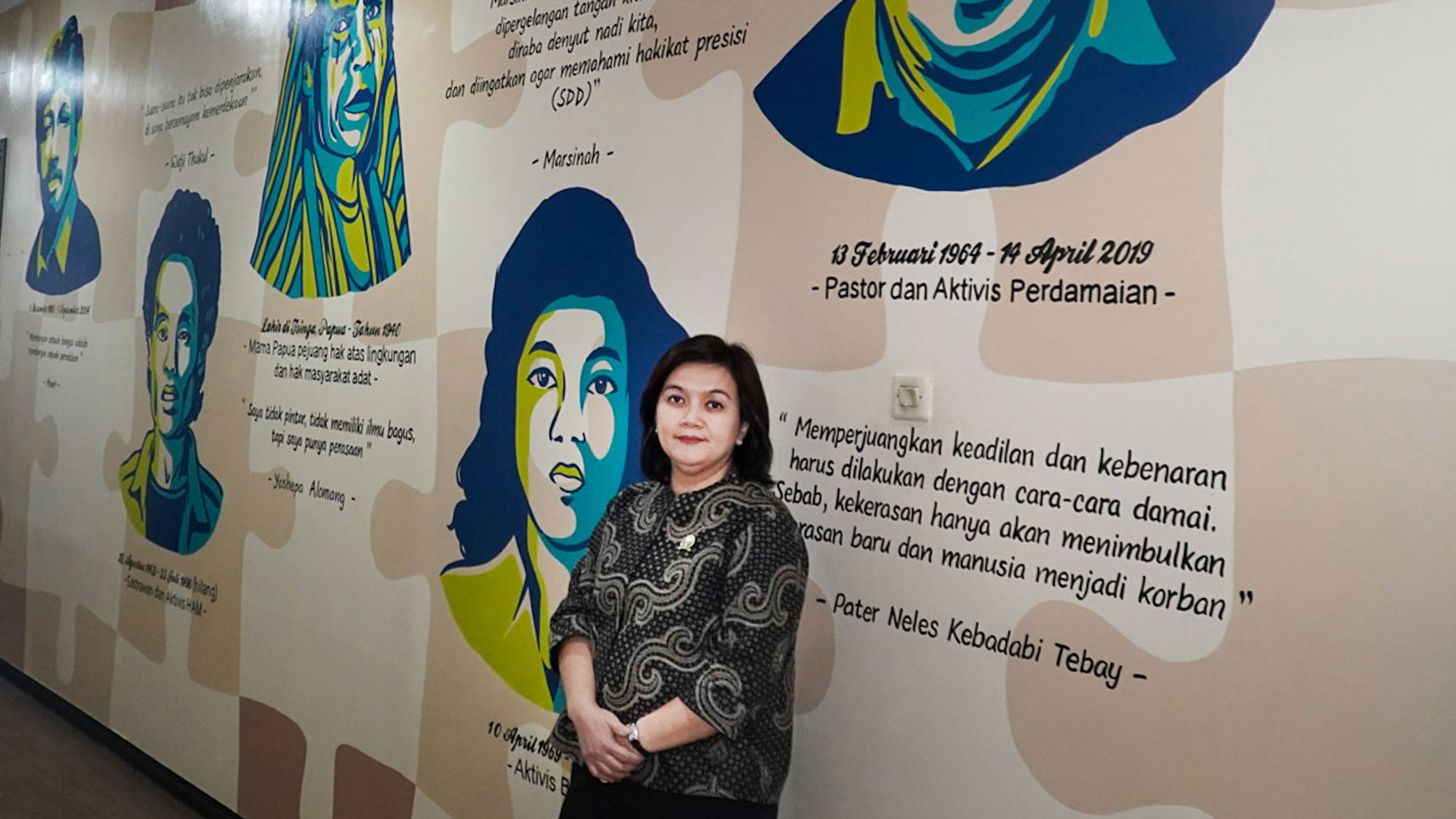
Atnike disclosed that Komnas HAM had submitted recommendations to the new government addressing key human rights issues. These included resolving the conflict in Papua, addressing historical human rights violations, and ensuring that the development of Indonesia’s new capital city, Nusantara, is consistent with human rights principles. “We urge the government to prioritize accountability for past gross human rights violations,” she said.
In an interview with Tempo Magazine reporters Sunudyantoro and Yosea Arga Pramudita at Komnas HAM’s office in Jakarta, Atnike discussed the institution’s stance in the face of the formation of a dedicated Ministry for Human Rights and potential revisions to Indonesia’s current human rights legislation.
Do you share public concerns about human rights enforcement under President Prabowo?
Enforcing human rights in Indonesia has always faced challenges, regardless of who holds executive or legislative power. Current leaders cannot be divorced from the past, as many gained access to power and resources during under the New Order government (1967 to 1998). Following the extraordinary political changes of 1998, there was hope for reform, especially under President Abdurrahman Wahid’s more open political approach.
Is there room for optimism under Prabowo’s presidency?
Human rights enforcement is inherently tied to the formalization of legal and political structures. Significant progress only occurs during periods of political upheaval before new power dynamics consolidate. Indonesia missed its window for substantial change after 1998. Nevertheless, institutions like Komnas HAM, under the legal authority it possesses, continue efforts to enforce human rights.
What do you mean by the formalization of legal and political structures?
After 1998, constitutional amendments integrated human rights protections, direct elections were introduced, and institutions like Komnas HAM gained greater authority. Human rights courts were also established. Once these mechanisms became institutionalized, bureaucratic processes began shaping enforcement. Political maneuvering alone cannot achieve sustainable human rights progress.
How do you view the new government’s stance on the 1998 events, given Minister Yusril Ihza Mahendra’s remarks?
His statement highlights the unresolved accountability for past human rights violations. The 1998 period encompassed economic and political crises, alongside incidents like forced disappearances, the Trisakti University students killed, and the Semanggi I and II massacres. Addressing these remains a state responsibility.
Given Prabowo’s track record, how difficult will it be to advance human rights?
As an independent statutory body, Komnas HAM’s role is to oversee government accountability for human rights. Challenges will persist under any administration, but we will remain critical and independent.
What are Komnas HAM’s key recommendations for the Prabowo government?
Our priorities include resolving the Papua conflict, addressing gross human rights violations through non-judicial mechanisms, and ensuring that the new capital city Nusantara’s development apply human rights principles. We’ve urged the government to mainstream human rights principles in areas like business, local governance, agrarian management, and environmental sustainability. Also, we advocate for strengthening police professionalism and the protection ndonesian citizens abroad.
Was legal accountability for past human rights violations part of your recommendations?
Yes, we included this in our recommendations to the transition team. Komnas HAM has investigated these cases extensively. Former President Joko Widodo acknowledged these as gross human rights violations and expressed regret. Unfortunately, efforts to restore justice for victims stalled. We hope the Prabowo government will resume and expand these efforts.
What continuation of efforts would you like to see?
This could involve the Ministry of Human Rights or the creation of a special agency tasked with revisiting past proposals, such as drafting legislation for a truth and reconciliation commission. We are open to collaborating and sharing ideas to move forward.
Truth and reconciliation efforts often face resistance, especially from implicated military officials. How do you propose overcoming this?
We hope that President Prabowo, as a former high-ranking military officer, will draw on his moral authority to influence his peers and seniors. Our focus remains on the victims. Non-judicial mechanisms should be prioritized to provide them with the recognition and restitution they deserve.
What’s your take on the establishment of the Ministry of Human Rights?
Splitting the Directorate General of Human Rights from the Ministry of Law and Human Rights suggests an effort to underscore the government’s commitment to human rights. However, Komnas HAM has existed for decades with a clear mandate. This new ministry appears to be a showcase initiative, but we hope it translates into substantive policies that integrate human rights perspectives across government.
How does Komnas HAM’s role differ from that of the Ministry of Human Rights?
Komnas HAM is an independent national human rights institution, operating with quasi-judicial powers recognized internationally. The ministry, on the other hand, is a governmental body directly under the president. Its creation signals a political agenda, rather than a functional overlap with Komnas HAM.
Could the ministry potentially replace Komnas HAM?
Legally, it’s possible to create regulations granting the ministry similar powers to Komnas HAM. However, in practice, Komnas HAM’s independence and international credibility cannot be replicated by a government ministry. The ministry cannot assume Komnas HAM’s enforcement and monitoring functions.
Given Prabowo’s history of human rights violations, could the new ministry be an attempt to rehabilitate his image?
President Prabowo’s past is intertwined with the New Order government, and it is clear he carries that legacy. If he uses his government to prioritize human rights as a core government priority, it could signify a meaningful shift and a chance to establish a new narrative.
How do you view the involvement of former 1998 democracy activists—once victims of abduction—in Prabowo’s government?
Politics in Indonesia is rarely black and white. Alliances shift based on pragmatic considerations, including access to power, positions, and influence. Those who once openly criticized President Prabowo but later joined his coalition reflect this dynamic.
What kind of political climate allowed the former democracy activists to join the government?
I’m not in a position to judge individuals’ choices. Ha ha. However, when political culture prioritizes pragmatism over principles, society faces potential risks. A relevant cautionary tale is Aesop’s Tale The Boy Who Cried Wolf.
What’s the moral of that story in this context?
If principles like human rights become mere political tools, society risks losing trust in their inherent value. When activists publicly champion values but act against them, it erodes faith in those values. Human rights must not become a disposable political commodity. Instead, they should remain a steadfast social ideal, immune to the ebb and flow of electoral propaganda.
What’s your stance on the reported push to revise the Human Rights Court Law to remove the concept of systematic human rights violations?
The issue with Law No. 26/2000 Concerning Human Rights Courts isn’t purely political—where political or command-level figures evade responsibility. The core issue lies in procedural contradictions between this statute and the national Criminal Procedure Code (KUHAP).
What kind of contradictions?
The Human Rights Court Law integrates both international human rights jurisprudence and domestic law, while the Code of Criminal Procedure adheres strictly to conventional criminal procedural rules. The latter demands rigid proof and witnesses under a positivistic framework. For severe human rights violations, especially historical ones, evidence and witnesses are often scarce or inaccessible. This discrepancy highlights the need for a specialized legal procedure tailored to human rights cases.
Could such revisions risk absolving generals implicated in rights violations?
The current Human Rights Court Law actually benefits Indonesia. It demonstrates the country’s ability to hold itself accountable for gross human rights violations. Without such domestic mechanisms, Indonesia could face international accountability. Weakening the law risks undermining this position.
So, is a revision necessary?
Revisions are needed, but only to reconcile contradictions between the existing laws. However, the priority should be enforcing the laws we already have. What about the stalled trial in the Paniai case in Papua? What about victims in earlier cases of abuse like Tanjung Priok, East Timor, and Abepura, where suspects were acquitted? Victims are still waiting for restitution, compensation, and rehabilitation. Revising laws means nothing if enforcement remains stagnant.
How should the government handle ongoing human rights issues in Papua?
The government has to exercise immense patience—patience to listen and address the grievances of all Papuans, whether indigenous or non-indigenous. Policies should reflect a deep understanding of the multifaceted problems in Papua, from conflict and violence to economic disparities and political tensions. The toll of violence in Papua claims lives on all sides—civilians and security personnel alike.
What are Komnas HAM’s recommendations for Papua?
Indonesia adopted a special autonomy framework for Papua in 2001, aiming to improve prosperity in the region. Papua, rich in natural resources, remains one of Indonesia’s least developed areas, especially for indigenous Papuans. Despite decades of special autonomy and development programs, the Human Development Index in Papua remains low. Worse still, violence has escalated over the past decade.
How can the cycle of violence in Papua be broken?
Every month, Komnas HAM receives reports of casualties and damage to public infrastructure due to ongoing conflicts. Breaking this cycle requires a multifaceted approach. The current capacity of Komnas HAM is far from sufficient to address the mounting casualties effectively. Solving Papua’s issues can’t rely on addressing isolated incidents.
We hope that President Prabowo’s government will demonstrate greater patience in crafting more strategic policies. This requires:
- Anthropological approaches to understand Papua’s social structures.
- Human-centered development policies that address the underlying grievances of marginalized communities.
- Political-security approaches that promote peace and stability while strengthening the conditions necessary for coexistence.
Do you agree that creating new provinces in Papua has exacerbated conflict?
The conflict persists despite the division. Many indigenous Papuans feel economically and politically marginalized, even though socio-political mechanisms were designed to include them. Initiatives like the Papua People’s Assembly, quotas for indigenous representatives in the Papua Provincial House of Representatives, and opportunities for indigenous Papuans to run for governor have been implemented. However, these measures have yet to fully address the deeper issues of inclusion and equity.
Some groups in Papua continue to demand independence. How should this be addressed?
Papua’s challenges cannot be viewed solely through the lens of nationalism. The issues are multi-faceted, encompassing:
- Economic disparities that leave many indigenous Papuans in poverty despite the region’s natural wealth.
- Historical grievances stemming from integration into Indonesia.
- Security concerns that fuel cycles of violence and distrust.
- Cultural and anthropological factors unique to Papua’s diverse communities, which differ significantly from other parts of Indonesia.
Government actors often overlook these cultural differences, which complicates policymaking and implementation. Recognizing and respecting these differences is essential to crafting effective solutions.
Atnike Nova Sigiro: A Brief Profile
- Birthplace and Date: Medan, North Sumatra, April 24, 1976
- Education:
- Bachelors in Social Welfare, University of Indonesia
- Masters in Social Policy and Development, The London School of Economics and Political Science
- Doctorate in Social Welfare, University of Indonesia
- Career:
- Chairperson, Komnas HAM (2022-2027)
- Executive Director, Jurnal Perempuan (2017-2021)
- Program Coordinator, Institute for Community Advocacy and Research (2000-2010)
- Assets: IDR 3.05 billion (US$203,000) (2023)
This post is based on https://www.tempo.co/wawancara/penegakan-ham-prabowo-subianto-1168695
In earlier news…
How Prabowo’s New Government is Burying Historical Serious Human Rights Abuses
From TV Tempo’s “Bocor Alus Politik” Podcast, November 16, 2024
TEMPO.CO – Indonesia’s newly-inaugurated President Prabowo Subianto has prepared a special speech for the commemoration of Indonesia’s national Human Rights Day on 10 December. However, his government is tending to work to resolve long-outstanding historical cases of serious human rights abuses through non-judicial channels.
Having tapped former 1998 pro-democracy activists who were themselves victims of kidnapping to become cabinet ministers in his new government, Prabowo and his supporters have also prepared a white paper that denies the involvement of the former Indonesian army special forces commander in historical human rights violations. Watch the full podcast. (https://youtu.be/TZoeTjf6j5g?feature=shared)
In related news:

 Stories From Indonesia
Leave a Reply