
Circumcision
A Short Story by Pramoedya Ananta Toer (1950)
Just like all the other village kids, I go to the prayer house at night to study the Quran. There is no joy in childhood greater than the joy we find there. We each pay two and a half cents per week, just enough to buy kerosene for the lamps. Study begins at five-thirty in the evening and goes until nine. This study is our only escape from the drudgery of nighttime homework.
What we call ‘study’ is actually just play. We whisper secrets, discuss the mysteries of the opposite sex, and make nuisances of ourselves. We distract those who are trying to pray the sunset Maghrib and evening Isha prayers while we wait for our turn to read. This is our world at the age of nine.
Like all my friends, I want to be a true Muslim, even though none of us have been circumcised.1 Sure, when it comes to religious matters, our only contributions are disturbing other worshipers, avoiding school lessons, and joining in Friday prayers at the mosque, even though we do not understand a word of what we are praying. And yes, even though we haven’t been circumcised, we are true Muslims.
Then, one of our friends is circumcised. They throw a big celebration. And that is when I start to wonder: Can I really be a Muslim if I am not circumcised? I keep that thought to myself, turning it quietly over in my mind. I must become a true Muslim. But is that possible if I am not circumcised? I do not share these thoughts with anyone else in the world.
It is common in our part of the city—in the small town of Blora—for boys to be circumcised between the ages of eight and thirteen. And usually this is marked by a great celebration. As for the girls, they are circumcised at fifteen days old, but there is no celebration whatsoever.
One night, my father comes home. I don’t know where he’s been. By then, all the lamps in the house have been extinguished, except for one in the center of the room. I can see that my father is in a good mood. While that is happening, I am listening to my mother’s tale about a haji2 who is obsessed with getting married. It’s a fascinating story, but my father’s arrival puts an end to that.
“Son, are you ready to be circumcised?” my father asks.
A smile plays on his lips, a smile that is trying to please.
The fear that strikes me when I hear the question is like nothing I’ve felt before. But I want to be a real Muslim. And I’ve always been afraid of my father, a fear I don’t fully understand. But this time, the smile wants to win over my heart and sweep away all my fears.
“Of course I’m ready, Father!” I reply.
My father’s smile widens into a warm, strong laugh. “What would you like after you’re circumcised? A new piece of material or a sarong?”
“A special piece of material, Father.”
Then he turns to my younger brother, Tato, who’s seven.
“And you, Tato—are you ready?”
“Of course, Father, of course!” Tato replies, his voice full of joy.
Father laughs, satisfied. In the dim light of the lamp, his white teeth gleam and his gums are a soft pink. Mother gets up from the mattress spread out on the floor.
“When are you going to have them circumcised?” she asks.
“As soon as possible,” Father replies.
Then Father stands up, walks away, and disappears into the night while Mother returns to her room.
Mother lies down again, but she doesn’t continue her story about the haji who is obsessed with getting married.
“Mamuk, and you too, Tato, thank God your father’s heart has been moved to have you circumcised.”
“Yes, Mother!” we reply.
“Your late grandmother and your ancestors, now blessed in heaven, will be very happy to know you are circumcised.”
“Yes, Mother!” we echo.
That night, I struggle to fall asleep. I imagine the pain I will feel from being cut. I think about the sarong and sandals that might be bought for the occasion, the new clothes, headscarf, cap, not having to go to school, all the guests, and the wonderful gifts I might receive. How wonderful it will be to have a new sarong and headscarf because, as well as wanting to be a true Muslim, I also want to be a true Javanese. And how wonderful it will be to receive a sarong, or even two or three. The other boys who haven’t been circumcised yet will surely envy me then.
I wake up in high spirits the next morning. Tato and I leave for school bright and early. My legs, which have always felt heavy on the walk to school, now feel light. All the students have heard the news. The boys who haven’t been circumcised yet look at us with new respect, especially the ones older than us. Every pair of eyes watches us with a regard we’ve never received before. Even the teachers seem to look at us favorably. And soon, very soon, we’ll truly become Muslims, Muslims who have been circumcised. And then, the most important thing of all, we’ll have the right to enter heaven, just like our kiai taught us. Once circumcised, we’ll live happily in paradise. We won’t need any of the fine possessions we long for now-the things we can never truly call our own.
At the prayer house, my friends greet the news with admiration. Even our kiai looks at us favorably, just as the teachers do at school. And I feel taller and more important than the other boys. The gates of heaven seem to swing open before me. I can even picture the beautiful maidens our kiai has promised – maidens so lovely that in my mind they look just like the girl from school who is the talk of all the boys.
“When I’m circumcised, I’ll be a true Muslim,” I tell the kiai. “And I’ll have the right to enter heaven.”
Our kiai chuckles with pleasure and adds, “You’ll receive forty-four maidens.”
“But I don’t want any maidens with six or eight breasts, like a dog’s,” I insist.
Our kiai laughs.
“I want a maiden who looks like Sriati, the pretty girl from school.”
Our kiai laughs again.
“And I’m going to fish in the river of milk all day long,” Tato chimes in.
The kiai laughs once more, his teeth – never brushed – looking dreadfully bad. Our older friends, who haven’t been circumcised yet listen to our conversation in silence. In their eyes, I can see a fear of being left out of heaven, of running out of maidens, of finishing up in hell instead.
From that evening on, we take our studies seriously. We throw ourselves into our school lessons with real determination. And on top of that, my brother and I begin fasting on Mondays and Thursdays until the end of the school year. As a result of all this effort, I graduate to the next grade.
Half a month before the end of the school year, my father plans to stage a play performed by the schoolchildren themselves. The circumcisions are scheduled for the next day. Father plans to make this an annual event, giving his poorer friends a chance to have their sons circumcised together. But there isn’t much enthusiasm from the people in our small town. Folks around here feel ashamed if their sons are circumcised by anyone else. So, for that first trial, only six boys are to be circumcised: Tato, myself, a ten-year-old nephew of my father, and an eighteen-year-old foster son of my father’s who has already had a child with our house helper. He refuses to be circumcised. He says he’ll only let his own father do it. The other two boys are from poor families living on the outskirts of town.
As far back as I can remember, my father’s plan to celebrate the end of the school year with a play and the circumcision of poor boys doesn’t go as he hoped.
At that time, I’m in the fourth grade at my father’s school, and my brother Tato is in the second grade. Both of us are promoted to the next grade at the end of the year. Five days before the end-of-year celebrations, we boys who are to be circumcised have to memorize the panembrama song.3 We will sing it on stage, introducing ourselves to the audience, letting them know that the next day we are to be circumcised, and asking for their blessings. Our teacher wrote a play about a lost goat, with all the roles played by the boys.
Finally, the day we’ve been eagerly awaiting arrives. The night before the circumcision, Tato and I receive gifts: silk sarongs from our grandmother, plastic sandals and new clothes from our mother, betel nut from the girls, and eight Dutch children’s books from our father. The gifts make us forget that we’re about to endure pain tomorrow.
That night, our school is packed with spectators. Food is served: boiled cassava and peanuts, fermented rice, sticky rice cakes, and other traditional foods. As the performance is about to start, the boys who are to be circumcised tomorrow line up on stage. I’m dressed in a sarong and headscarf. Tato and the other boys are bareheaded. As the curtain opens, the gamelan orchestra starts to play. We bow to the audience.
Oh, how proud I feel at that moment. I see all the spectators captivated by us as we sing, announcing that tomorrow we will be circumcised. The girls look at us with admiration, six more young men will soon join their ranks. When we finish singing, we bow again, and the audience responds with rapturous applause. Then the curtain closes, and we’re relieved of our heavy burden.
In our small town, entertainment is a rare treat. That’s why the The Lost Goat play draws a crowd from every corner of town. The four large classrooms of our school are packed to the rafters with people.
From time to time, as the gamelan orchestra pauses, other music takes over playing songs like Kembang Kacang, Rose Mary, cowboy tunes, Stambul Konstantinopel, and other kroncong melodies.
When the play ends, we boys who are to be circumcised receive many encouraging pats on the back – pats that fill us with courage. And that fills us with pride. That night, Tato continues singing in his bed until his voice grows softer and softer, and finally fades away as he drifts to sleep.
The day of a circumcision is one of the great days in our village, like births, weddings, deaths, and holy days. News about it spreads quickly throughout the town. From every corner, my mother receives gifts as contributions to the celebration, even though no formal invitations have been sent out. And just like on other significant days, we stay up late the night before and rise early.
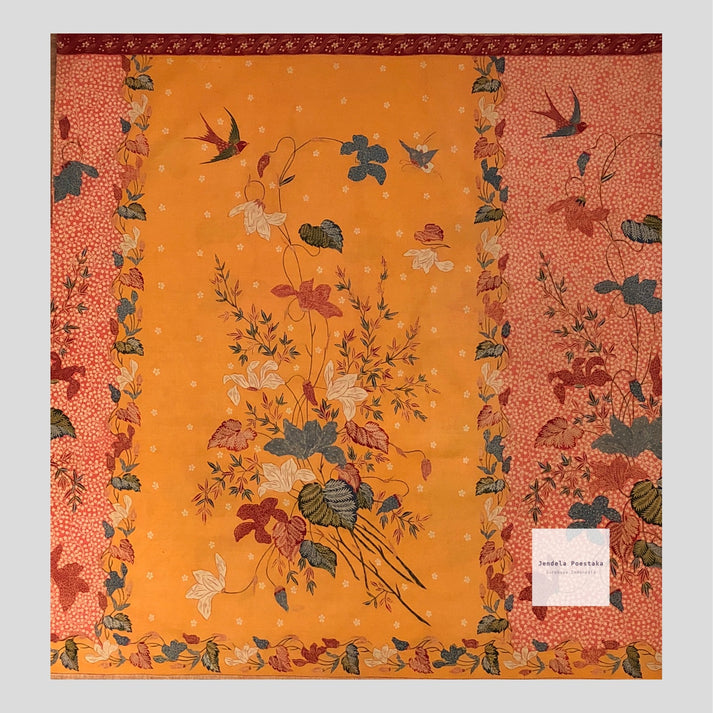
By half past four in the morning, our house is already bustling. The boys who are to be circumcised have washed and are dressed in new sarongs, with caps or headscarves. My younger sisters are dressed in brand-new clothes. Mother wears a new parang rusak patterned batik sarong and a lace-embroidered kebaya blouse4 with a kutubaru sash,5 a gift from her sister who teaches at the girls’ school in the neighboring coastal town of Rembang. She drapes a green rainbow shawl over her shoulders. Father wears his formal attire: a parang rusak patterned sarong and long-sleeved shirt. He is always barefoot, except when at home, where he wears wooden clogs or slippers.
As if stricken by an illness, our close neighbors also rise early, dress in new clothes, and join us on the walk to the school. Our school is five hundred meters from our house.
A canopy has been erected at the school for the circumcision ceremony. It is enclosed with lace mosquito netting. We boys to be circumcised sit in a row of chairs near the canopy. Gradually, the elders who will witness the ceremony start to gather in greater numbers. Children swarm around the hut too, while the girls kept a slight distance. Eventually, the circumciser arrives carrying a handkerchief bundle containing three razors.
An old man approaches us and says, “Don’t be afraid. It doesn’t hurt to be circumcised. It feels like nothing more than an ant’s bite. I even laughed when I was circumcised.”
Many other comforting voices echo similar sentiments. But no matter how sweet the words, we cannot shake off our anxiety and fear.
Then the time arrives for the circumcision. My father and mother, seated in large chairs among the guests, stand up and approach the hut, their faces radiating pride and contentment.
First, my father’s adopted son is taken into the hut, as he is the oldest among us. The other adopted son, who already has a child of his own, doesn’t show up for the ceremony that day. The children who have come to watch inch closer to the hut, till the elders have to shoo them away.
Fear gripped me like a claw at that moment. Still, my desire to become a true Muslim is stronger. But fear doesn’t vanish easily. Especially as the circumciser chants his prayers, my heart feels like it’s going to burst from my chest. The shouts have barely faded when my older stepbrother is led out of the hut. His walk is labored. His face is ashen, his lips white, and he appears completely drained. They seat him back in his chair, and placed a clay dish filled with ash between his legs to catch the blood still dripping from him.
One by one, the boys emerge from the hut, each as pale and unsteady as the last. Then my turn arrives. Two or three men hold my shoulders, seemingly fearing I might run off. They guide me into the circumcision hut. The circumciser waits for me with a cruel anticipation—at least, that’s how it seems to me. I am seated on a chair. My head is tilted back. My shoulders are gripped tightly, and a pair of hands presses my forehead to stop me from looking down. Beneath me, a clay plate filled with ash is prepared. Hands probe at my genitals, twisting the foreskin tightly, causing an intense burning sensation. Finally, the razor slices through the flesh. It is over. I have been circumcised. The hands that have been holding my forehead withdraw. I look down to see blood dripping from the tip of my penis.
“Don’t move yet,” one of them says.
“Yes, don’t move. Wait till the blood flow stops,” adds another.
I watch as the thick, dark blood—almost like black threads—drips slowly into the ash-filled dish.
Tato is the last, being the youngest among us. We are lined up in a row. Occasionally blood drips into the clay plates beneath us. Every eye is on us. Mother comes over and kisses my cheek. Her love is palpable, and it brings tears to my eyes. She also kisses Tato’s cheek. Father approaches and says, “Congratulations. Congratulations.”
The children start to disperse. Only the elders remain in the classroom where we have been circumcised. They too finally dissolve, one by one, after offering their farewells.
We walk home after the circumcision, treated like royalty for the day. Everyone seems happy to fulfill our every command. The families of the poor boys who have been circumcised with us arrive at our house, carrying chickens and rice as gifts.
“How do you feel now, Muk? Do you notice any change since being circumcised?”
“I feel very happy now, Mother,” I reply.
“And do you feel like a true Muslim?” asks Mother again.
Her question startles me. It becomes clear I do not feel any change, I do not finally feel like a true Muslim.
“I feel the same as I did yesterday, and the day before that. I don’t feel like a true Muslim yet,” I say.
“Perhaps your prayers are not finished?” she suggests.
“They are complete. Always complete, Mother.”
“Your grandfather went on the pilgrimage to Mecca. Perhaps if you made the pilgrimage, you would experience a change—become a true Muslim.”
“By ship, Mother?” asks Tato.
“Yes, by ship, to Arabia,” replies Mother.
“Then do we have to be rich first, Mother?” I ask.
“Yes,” says Mother.
With that, my hope of becoming a true Muslim vanishes. I realize the poverty of my parents. We have nothing that will allow us to make the pilgrimage. “Why doesn’t Father go on the pilgrimage, Mother?” I ask.
“Because your father is poor, Muk.”
Although we wish for wealth, we never really believe we can become wealthy. Once we recover, the desire to become a true Muslim never returns to my mind. Poverty stifles aspirations in our village. Gradually Tato and I become like the other children in our village—children whose dreams are crushed by poverty.
Jakarta, iii-1950.
Toer, Pramoedya Ananta. (1994). Sunat [Circumcision]. In Cerita dari Blora: Kumpulan Cerita Pendek [Stories From Blora: Collection of Short Stories]. Jakarta: Hasta Mitra. https://archive.org/details/ceritadariblora [Accessed 19 August 2024]. A version is also available at https://ruangsastra.com/32257/sunat-2 [Accessed 24 August 2024].
Footnotes:
- See https://www.bbc.co.uk/religion/religions/islam/islamethics/malecircumcision.shtml and https://en.wikipedia.org/wiki/Khitan_(circumcision). ↩︎
- One who has been on the pilgrimage to Mecca https://www.merriam-webster.com/dictionary/haji. ↩︎
- Traditional song to welcome guests and mark an important occasion https://youtu.be/kOH7_ls12tM?si=vg_zNBQR7yXQqAtH. Also of interest see https://www.researchgate.net/publication/352599832_Gendhing_King_and_Events_The_Creation_of_Gendhing_Panembrama_During_Pakubuwana_X. ↩︎
- A traditional women’s blouse https://en.wikipedia.org/wiki/Kebaya. ↩︎
- https://www.dewimagazine.com/news/komitmen-para-visioner-kreatif-dalam-mewujudkan-mimpi-anak-bangsa-lewat-kolaborasi-one-fine-sky-x-binhouse/, https://lifestyle.kompas.com/read/2025/07/25/183500720/kebaya-kutubaru-modifikasi-kebaya-kartini-yang-tak-lekang-oleh-zaman, https://www.atelier-nyonya.com/blogs/news/kebaya-kutu-baru, or https://www.tempo.co/gaya-hidup/aneka-jenis-kebaya-indonesia-mana-yang-paling-anda-suka–726617. ↩︎


 Stories From Indonesia
Leave a Reply