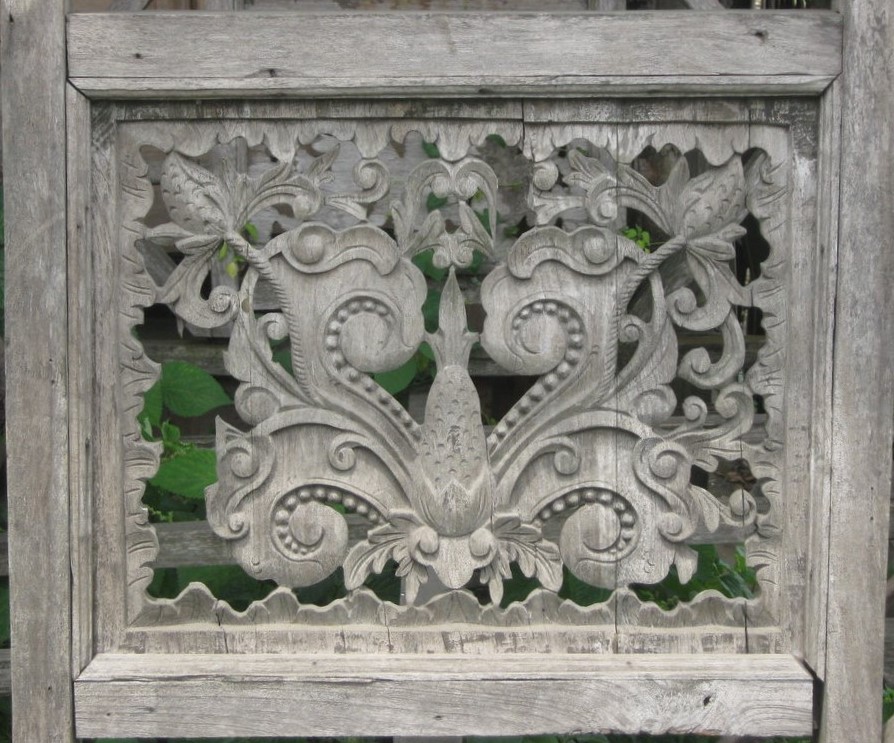
Two Creeping Geckos
By S Prasetyo Utomo1
Setyawati2 threw back the blankets and got up. She went over to the small table and drank down the last of the coffee from her cup. Every last bit. Head thrust right back, her mouth gaped wide open. The last wet, muddy granules of coffee were like cold lava flowing into her mouth. I like this least about her. She chewed the final granules of ground coffee, the dregs, which to the tongues of most ordinary humans taste bitter, with an energy and pleasure that could only be generated by her own mouth.
She stretched out her tongue and licked every last granule from the edge of the cup.
“You’re used to swallowing the bitter,” I teased.
She continued licking the last granules as she watched the geckos crawling along the wall.
Then Setyawati declared, “I’m very used to swallowing the bitter things in life – at home. It isn’t easy having a husband who isn’t as capable, who has no taste for beauty, but who’s into being in control. I’m tired of doing what he wants. Sometimes he thinks he’s the best, always right, knows everything. Ah, I get so mad!”
The two geckos on the wall approached each other nudging together, then scampered after one another. In the corner of the ceiling, right in the corner of the ceiling, the larger of the two geckos pounced on his quarry. Setyawati laughed aloud, shoulders heaving up and down. She turned on the light, illuminating the whole room at once, then blew out the candle. The scent of molten wax and burnt wick lingered.
Outside tree branches and casuarina leaves damp from the drizzly wind scratched against the window.
“My husband wants to show his power through his job,” said Setyawati opening the window and allowing the cold fog and drizzle to blow into the room.
****
“Come on!? Let’s go for a walk.”
“In the middle of the night?”
“Sure. I want to look at the fireflies, feel the mountain breeze at night, listen to the distant sound of the river.”
Without giving me an opportunity to resist Setyawati closed the previously open window. She took up her jacket and sank her two beautiful arms into it.
The pair of geckos were still snuggled against each other in the corner when Setyawati closed the door of the hotel room. We went down to the lobby and stood before the meeting room that was being used for the seminar. Filled with the sound of endless debate from morning till night, the room was now silent, only the proud microphones stood on the moderator’s table.
Gently and with conviction, Setyawati bid farewell to the hotel security guard and set off on foot. Despite his initial blank unseeing look, the security guards still managed a nod and a smile.
It was as though the road set Setyawati free from the evil thoughts of the geckos, from their laughter at mankind’s fumblings. I breathed in the misty night air, the scent of mountain soil, and the heavy scent of casuarina trees. In the darkness, I followed as Setyawati led through the quiet of village lanes, past irrigation dikes, rice paddies, meandering vegetable gardens, coming at last to a river, clear, cool, refreshing.
There were no fireflies. Only gatherings of people with guns in the village night watch huts. People greeted us as we passed, suspicious. But Setyawati’s gentleness protected us from the roughness of the armed villagers on night patrol. Passing a mosque we could see a number of the faithful still murmuring prayers, chanting the holy verse even at this late hour. Geckos crept along the walls of the mosque. To what other hidden mysteries did these geckos bear witness in their own tongue?
But it seemed that Setyawati didn’t notice the geckos on the mosque walls.
“Isn’t it strange,” whispered Setyawati. “People on guard suspiciously in the hut.”
Setyawati’s step was becoming uncertain, fearful. However, propelled by a desire to understand the situation and squeezing my arm tightly she went on. There was no moonlight. A dog barked in the far distance and the torch lights of the patrolling villagers’ cries crossed up and down the lanes in the paddy fields and over the vegetable gardens.
Suddenly one of the villagers called out from a rice field. People began to run towards him, far from the road in a vegetable field not far from the bund of a paddy field. Torch beams darted. Then the commotion grew to an uproar. As the commotion grew, Setyawati tugged at my arm and we moved towards the excited gathering.
Forcing her way into the tightly packed crowd of people shining torches at something, Setyawati screamed, “Ah! Two dead bodies lying in the mud – like two dead geckos!”
The bodies lay face down half covered in the mud. When they were turned over, wide slash wounds yawned across both their chests.
****
Placing her hands over her face, Setyawati couldn’t hide the horror. She held back tears. In the hotel room far from the bodies lying face down near the paddy field bund half covered by the mud, Setyawati restrained her terror with no more than a pair of hands. But even so, her hands weren’t strong enough to bear within themselves the upheaval in her soul.
Unconsciously, and I will be convinced forever it was unconscious, she nudged against me, gently pressing her head to my chest. Her arms were strong around my waist. She had forgotten the two geckos were still crawling along the wall. Were geckos, to Setyawati’s mind, incapable of comprehending the language of human sadness?
“I am so frightened that my husband or I will be slaughtered like the two people we saw in that field,” whispered Setyawati. “My husband has a great many enemies. A man once came to the house carrying a knife and threatened to kill us.”
I didn’t want to comfort her; I wanted to leave the trembling fear until her own courage returned. She was so tired and sleepy and her eyelids were closing when she dropped off, arms tight around my chest.
The two geckos had long since moved far apart, each scurrying after its own prey. But Setyawati was searching for a feeling of peace, seeking the sense of tranquility she had lost, by falling asleep, head nestled in my chest, like a newborn child slumbering soundly as it suckled it’s mother’s nipple.
“I think I had better head into town now,” she whispered, rousing, smiling and finding her inner quiet.
“It’s still dark, and what’s more there are interesting sessions all day.”
“I’m not interested anymore. Say goodbye to the others for me,” Setyawati declared in front of the door to the hotel room as she straightened her hair. Her eyes were warm. “The pair of geckos on the wall are laughing at me, aren’t they? And you think I’m like a little girl, don’t you?”
I walked Setyawati down to the lobby. She returned the key and climbed into her car which was covered in dew. In the remaining darkness and enveloped in the damp misty air, she left, leaving behind a roaring silence.
I entered my own room again and on slamming the door, two geckos dropped to the floor right at my feet, tails breaking off in the process. Leaving their tails flicking back and forth, they scurried back up onto the wall. I was no Prince Anglingdarma3 by the side of Setyawati, able to understand the language of the geckos, having to keep their secrets unto death in the midst of raging flames endured for the sake of his beloved queen.
Pandana Merdeka, October 1998
Source: Two Creeping Geckos (Dua Cicak Merayap) was published in the national daily newspaper Kompas in January 1999.
An Analysis
This Indonesian short story, “Two Creeping Geckos” by S. Prasetyo Utomo, intricately weaves together the mundane and the profound. Setyawati’s act of consuming the last bits of coffee, relishing the bitter taste, becomes a metaphor for her life’s bitterness, particularly in her challenging marriage. The geckos on the wall serve as silent witnesses to her struggles, their interactions mirroring the complexities of human relationships.
The narrative takes a dramatic turn when Setyawati and the narrator stumble upon two dead bodies, drawing a parallel between the deceased and the geckos. The gruesome discovery becomes a symbol of the potential dangers Setyawati faces due to her husband’s enemies. The fear and vulnerability are palpable as Setyawati seeks solace, momentarily finding it in the narrator’s embrace.
The symbolism of geckos persists, hinting at an elusive understanding of life’s mysteries. Setyawati’s final departure from the seminar, abandoning the intellectual pursuits, reflects her yearning for peace and normalcy amid chaos.
The story masterfully explores themes of power dynamics, fear, and the quest for inner peace, all set against the backdrop of a mysterious night. The geckos, like silent observers, carry the weight of unspoken truths, echoing the complexity of human emotions and relationships.
The mention of Prince Anglingdarma from the Hindu epic, The Mahabharata, serves as a symbolic touchstone, enriching the story with a broader cultural context. Prince Anglingdarma’s role in rescuing Setyawati in the epic draws parallels to Setyawati’s own struggles, albeit in a contemporary context. The reference may highlight the universal nature of challenges faced by individuals, transcending time and cultural boundaries. It suggests that Setyawati’s quest for peace and understanding, amidst the chaos of her personal and political life, resonates with timeless human struggles, echoing the archetypal journey depicted in ancient epics.
The geckos, witnessing Setyawati’s tribulations, become silent bearers of secrets, much like the mythical creatures in ancient tales. In Hindu mythology, animals often serve as messengers or symbols, and the geckos in this story seem to carry an unspoken wisdom about the mysteries of life and human emotions.
Additionally, the setting of Pandana Merdeka and the reference to the Hindu epic within an Indonesian context may subtly allude to the cultural diversity of Indonesia, where Hindu influences coexist with other cultural and religious elements. This blending of cultures reflects the rich tapestry of Indonesian society, adding a nuanced layer to the exploration of identity and the search for peace.
The juxtaposition of Setyawati’s modern struggles with references from ancient epics underscores the continuity of human experiences across different eras. It suggests that, despite the cultural and temporal gaps, certain themes of love, power, and personal growth remain constants in the human condition. The story, therefore, becomes not only a reflection of contemporary Indonesian society but also a bridge connecting it to broader cultural and human narratives.
Footnotes:
- Dr. S. Prasetyo Utomo (born January 7, 1961) is an Indonesian writer and academician affiliated with Universitas PGRI Semarang. He is renowned for his literary works, including essays, poetry, and short stories, published in various newspapers in Indonesia. Prasetyo Utomo is recognized as a prominent figure in the emergence of contextual literature discourse in the 1980s. Born in Yogyakarta on January 7, 1961. Since 1983, he has actively contributed essays, poetry, short stories, novels, and articles to several newspapers, including Horison, Kompas, Jawa Pos, Suara Pembaruan, Republika, Koran Tempo, Media Indonesia, Bisnis Indonesia, Nova, Seputar Indonesia, Suara Karya, Mutiara, Pelita, Jayakarta, Majalah Noor, among others. Three times, Prasetyo Utomo’s name has been featured in Kompas’ Selected Short Stories, in 2008, 2009, and 2010.
Bibliography:
“Perdebatan Sastra Kontekstual” (Contextual Literary Debate, essay anthology, 1985)
“Antologi Puisi Jawa Tengah” (Central Java Poetry Anthology, poetry anthology, 1994)
“Serayu” (poetry anthology, 1995)
“Ritus” (short story anthology, 1995)
“Lawang Sewoe” (poetry anthology, 1996)
“Sesudah Layar Turun” (poetry anthology, 1996)
“Jentera Terkasa” (poetry anthology, 1998)
“Horison Sastra Indonesia 2 Kitab Cerpen” (Indonesian Literary Horizon 2 Short Story Book, 2002)
“Cerita-cerita Pengantin” (Bridal Stories, short story anthology, 2004)
“Bidadari Sigar Rasa” (Angels of Sigar Rasa, short story anthology, 2005)
“Forum Sastra Indonesia Hari Ini: Jawa Tengah” (Indonesian Literary Forum Today: Central Java, 2010)
“Bidadari Meniti Pelangi” (Angels Walking on the Rainbow, novel, Kompas Book Publisher, 2005)
“Tangis Rembulan di Hutan Berkabut” (Tears of the Moon in the Misty Forest, novel, HO Publishing, 2009)
“Tarian Dua Wajah” (Dance of Two Faces, Novel, Alfabet, 2016)
“Cermin Jiwa” (Mirror of the Soul, Novel, Alfabet, 2017)
“Percumbuan Topeng” (Mask Encounter, Novel, Cipta Prima Nusantara, 2022)
Awards:
Cultural Award 2007 from the Ministry of Culture and Tourism for the short story “Cermin Jiwa,” published in Kompas on May 12, 2007
Literary Acarya Award 2015 from the Language Development and Development Agency
Selected Short Story Kompas 2008
Selected Short Story Kompas 2009
Selected Short Story Kompas 2010 ↩︎ - Setyawati and Anglingdarma are characters from the ancient Javanese legend called the Serat Angling Darma. See note 3. ↩︎
- In the Serat Angling Darma, Anglingdarma is a legendary figure believed to be the incarnation of Lord Vishnu. The narrative revolves around Anglingdarma’s life, starting from his birth to his adventures and challenges. The story begins with the birth of Anglingdarma to Pramesti, the daughter of Jayabaya. Jayabaya is the son of Gendrayana, the grandson of Yudayana, and the great-grandson of Parikesit, tracing his lineage back to characters from the Mahabharata.
Anglingdarma becomes the ruler of the kingdom of Malawapati and is known for his love of hunting. One day, he saves a girl named Setyawati from a tiger, escorting her back to her father’s hermitage, Resi Maniksutra. Anglingdarma not only helps Setyawati but also proposes to marry her.
However, Setyawati’s elder sister, Batikmadrim, has sworn that anyone wishing to marry her sister must defeat her in a contest. Anglingdarma emerges victorious, making Setyawati his queen and appointing Batikmadrim as the chief minister of Malawapati.
The plot thickens when Anglingdarma witnesses his teacher’s wife, Nagagini, having an affair with a male snake. In a fit of anger, he kills the snake and injures Nagagini. This incident triggers a chain of events, leading to misunderstandings and revenge plots.
Nagaraja, Nagagini’s husband, infiltrates Malawapati’s palace to seek revenge. However, he discovers the truth and apologizes to Anglingdarma. Nagaraja, desiring spiritual liberation (moksha), imparts his mystical knowledge, Aji Gineng, to Anglingdarma before his death.
Having gained this new knowledge, Anglingdarma develops the ability to understand the language of animals. This leads to a series of events, including an unfortunate incident where Setyawati feels offended by Anglingdarma’s laughter at a conversation between two lizards.
The story takes a tragic turn when Setyawati, feeling dishonored, chooses to perform Pati Obong (self-immolation) to restore her honor. Anglingdarma, bound by his promise to keep Aji Gineng a secret, refuses to reveal the truth, causing Setyawati’s resentment.
During the ritual of self-immolation, Anglingdarma overhears a conversation between two goats, realizing the emotional impact of his decision on the people. In a twist of fate, he decides not to join Setyawati in the flames. The narrative explores themes of love, honor, betrayal, and the consequences of keeping mystical knowledge secret. It weaves together elements of Javanese mythology, folklore, and moral teachings, making Serat Angling Darma a significant work in Javanese literature. See also https://historia.id/kuno/articles/siapa-sebenarnya-angling-dharma-Dr9AY/page/1; and https://historia.id/kuno/articles/angling-dharma-tokoh-nyata-atau-rekaan-vZz7V/page/1 ↩︎



 Stories From Indonesia
Leave a Reply