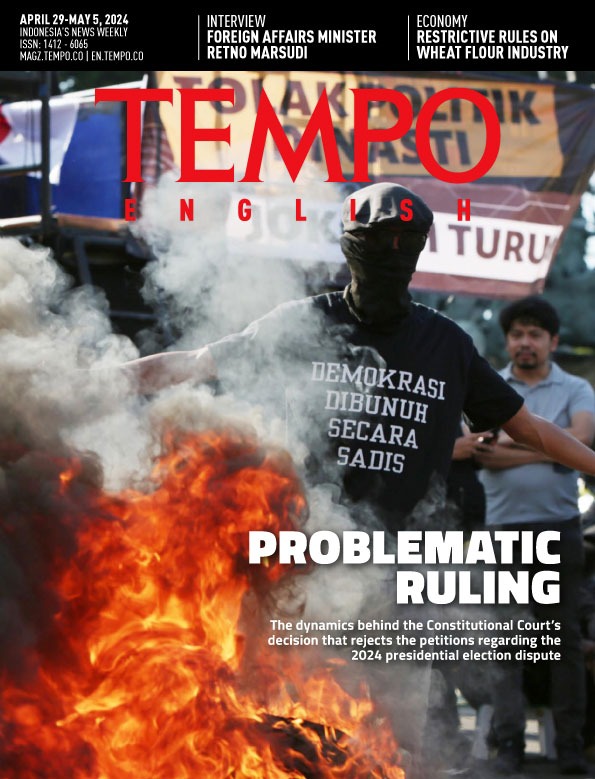
Press Release: Constitutional Court Increasingly Misguided
Center for Indonesian Law and Policy Studies (Pusat Studi Hukum dan Kebijakan Indonesia or PSHK)
On Monday, October 16, 2023, Indonesia’s Constitutional Court announced its decision regarding the examination of the requirements for becoming presidential and vice-presidential candidates in cases 29/PUU-XXI/2023, 51/PUU-XXI/2023, 55/PUU-XXI/2023, 90/PUU-XXI/2023, 91/PUU-XXI/2023, and 92/PUU-XXI/2023. In Decision Number 90/PUU-XXI/2023, the Constitutional Court granted the applicant’s request in part by interpreting the requirements for presidential and vice-presidential candidates to be, “…at least 40 (forty) years old or have/are currently holding positions elected through general elections, including regional head elections.”
The considerations and rulings provided make the Constitutional Court seem “increasingly misguided” on the following grounds:
The Constitutional Court has jeopardized its credibility and dignity as the guardian of the constitution due to its inconsistent behavior. This is because the constitutional justices who granted the applicant’s request drastically changed their stance.
The justices had previously firmly rejected the petitioner’s applications in Decision Numbers 29/PUU-XXI/2023, 51/PUU-XXI/2023, and 55/PUU-XXI/2023, arguing that the review was not a constitutional issue, but rather an open legal policy matter.
However, in Decision Number 90/PUU-XXI/2023, which essentially addressed the same issue, they partially granted the petitioner’s request, and introduced new norms to the requirements for presidential and vice-presidential candidates.
This situation raises questions about whether there were any indications of pressure, intimidation, or intervention that could potentially undermine the independence of the constitutional justices. Furthermore, the Constitutional Court has engaged in the practice of selectively applying jurisprudence to interpret open legal policy, which poses a danger to the institution, and the legitimacy of the Constitutional Court’s decisions.
Moreover, the Constitutional Court “complied” with the requests of the House of Representatives and the President to adjust the age requirements for presidential and vice-presidential candidates. The Constitutional Court relinquished its judicial power role which involves checks and balances, and instead became a political tool for the House of Representatives and the President to make instantaneous changes to laws without involving democratic participation.
It can be argued that the Constitutional Court has immersed itself in the political fray. This decision does not demonstrate the Constitutional Court’s commitment to promoting the rejuvenation of leadership in public administration through younger individuals, but rather highlights the Constitutional Court’s loyalty to those in power.
The Constitutional Court’s decision has the potential to lead to an unfair election in the 2024 simultaneous presidential and legislative elections, because it has resulted in an unequal contest, and was decided only three days before the statutory deadline for registration of presidential and vice-presidential candidates.
There are indications that the handing down of the Constitutional Court’s decision was rushed to meet the registration deadline for presidential and vice-presidential candidates. With such a short time frame, it has not allowed other young individuals, especially those currently or previously holding positions elected through general elections, including regional head positions, to adequately prepare for participation in the upcoming 2024 simultaneous elections.
Constitutional Court Decision Number 90/PUU-XXI/2023 actually places the Constitutional Court in the realm of policy formulation, which should be the domain of legislators. A strong political influence can be observed in the request for judicial review of the law concerned because it was conducted to adjust the qualifications for presidential and vice-presidential candidates to facilitate the candidacy of the current mayor of the city of Solo, Gibran Rakabuming Raka, who is the son of President Joko Widodo.
Consequently, the prerequisites for becoming presidential and vice-presidential candidates have been adjusted in a manner that bestows certain privileges on the individual, enabling participation in the 2024 simultaneous elections.
Referring to the dissenting opinion presented by Constitutional Justice Arief Hidayat, there were irregularities in the withdrawal of cases Number 90/PUU-XXI/2023 and Number 91/PUU-XXI/2023. These two cases were declared withdrawn by their attorney with a letter dated September 26, 2023, on Friday, September 29, 2023, at 14:32 local time.
However, on Saturday, September 30, 2023, at 20:36 local, the petitioner canceled the withdrawal of the cases. The peculiarity with the withdrawal of these cases lies in the discrepancy between the time of receipt, and the name of the officer who received the letter registering the case withdrawal, as stated by the attorney during the trial (Monday, October 3, 2023), and the time recorded on the Temporary Case File Receipt (Tanda Terima Berkas Perkara Sementara or TTBPS).
The attorney stated that the letter was received at 20:36 local time by Dani (Constitutional Court Internal Security (Pengamanan Dalam or PAMDALMK), while the TTBPS indicates 12:04 local time, and that it was received by Safrizal (PAMDALMK). There are also indications of the petitioner’s lack of seriousness in filing the a quo case,1 which warrants investigation by the Constitutional Court in order to maintain its dignity as the judicial authority.
The presence of Constitutional Court Chief Justice Anwar Usman, who participated in the decision of this case, is riddled with conflicts of interest. This is because case Number 90/PUU-XXI/2023 explicitly mentions efforts to promote Gibran Rakabuming Raka, who is Chief Justice Anwar Usman’s nephew, or has a familial connection to him, as a presidential or vice-presidential candidate. Due to his involvement in this case, Constitutional Court Chief Justice Anwar Usman has violated the Sapta Karsa Hutama Code of Ethics principle of impartiality (Constitutional Court Regulation Number 09/PMK/2006 concerning the Enforcement of the Declaration of the Code of Ethics and Behavior of Constitutional Justices).
According to this principle, a constitutional justice must recuse themselves from examining a case if they cannot act impartially, or are deemed unable to do so because their family members have a direct interest in the decision. Chief Constitutional Justice Anwar Usman should have declared his recusal from the examination of the a quo case. If the Constitutional Court does not recuse him, it will continue to be mired in conflicts of interest, and public trust in the Constitutional Court will further erode. This poses a danger to the future of democracy, the rule of law, and the independence of the judiciary.
Based on these points, PSHK urges:
1. Chief Justice Anwar Usman to resign from his positions as Chief Justice of the Constitutional Court and as a Constitutional Justice. His leadership has actually caused the Constitutional Court to appear as an institution that lacks independence and tends to support the Government and/or the House of Representatives. Chief Justice Anwar Usman has insisted on not recusing himself from the panel of justices when the matter was directly related to or had the potential to benefit his family members, creating a conflict of interest. This has also weakened public trust in Constitutional Court Decision Number 90/PUU-XXI/2023. If Chief Justice Anwar Usman continues to serve in these roles, trust in the Constitutional Court will continue to decline.
2. The establishment of a Constitutional Court Judicial Conduct Board (Majelis Kehormatan Mahkamah Konstitusi or MKMK) immediately. A Judicial Conduct Board must take action in relation to the ethical violations, procedural violations, and/or potential criminal acts mentioned in Constitutional Justice Arief Hidayat’s dissenting opinion in Constitutional Court Decision No. 90/PUU-XXI/2023. A Judicial Conduct Board plays a crucial role in establishing and revealing the actual facts to the public concerning how Constitutional Court Decision No. 90/PUU-XXI/2023 was prepared, and whether any violations occurred.
3. Constitutional justices to collaborate in the process of taking action concerning the ethical violations, procedural violations, and/or potential criminal acts expressed in Constitutional Justice Arief Hidayat’s dissenting opinion in Constitutional Court Decision No. 90/PUU-XXI/2023.
This article is based on: https://pshk.or.id/publikasi/siaran-pers/mk-makin-kesasar/
Footnotes:


 Stories From Indonesia
Leave a Reply