Inem
A Short Story by Pramoedya Ananta Toer (1950)
Inem is a friend of mine from among my girlfriends. She is eight years old, so she’s two years older than I am. She’s no different from my other friends. But if there’s anything that sets her apart, it’s this: they say she’s pretty for the other girls in our village. People are happy when they see her. She’s polite, not spoiled, skillful, and hard working. These things make her famous even among the surrounding villages. Inem is truly right to be my friend.
One time, when Inem was boiling water in the kitchen, she says to me, “Gus Muk, I’m going to be married.”
“Really?” I say.
“Really. The proposal came last week. Mother and father and my other relatives have accepted it.”
“How wonderful it is to be a bride!” I call out joyfully.
“How wonderful that is! They’re going to buy me beautiful clothes. I’m going to be dressed up in bridal clothes, with flowers, makeup, mascara and eye liner. How wonderful. How wonderful!”
And that was true. One afternoon Inem’s mother arrives to see my mother. At the time Inem had been sent to live with my parents. Every day, she helps cook in the kitchen and plays with my siblings and me.
Inem’s mother earns a living making batik for wages. If they’re not working in the rice fields, the women in our kampong work producing batik cloth. Some of them make batik cloth to be used as dresses, and others make smaller batik cloths to be used as head scarves. The poorer women make batik scarves because they can finish them faster and get paid sooner too. And little Inem’s mother earns a living making batik scarves. She receives the cloth and wax from her employer, the Green Shop. For every two scarves she finishes, she receives a wage of one and a half cents. On average, one can make eight to eleven headscarves a day.
Little Inem’s father cockfights. He spends his days just gambling on cockfighting. When he loses, the winner takes his rooster, and he has to pay one guilder – or at least seven-five cents. When he isn’t cockfighting, he plays cards with the neighbors, betting one cent each time. Sometimes Inem’s father is away for months at a time, wandering on foot from place to place. When he arrives home again, it means he has some money.
One time my mother told me that Inem’s father mostly works as a highway robber, out deep in the teak forests between our town Blora and the coastal town of Rembang. I was in first grade then and heard all sorts of stories about banditry, robbery, and murder. Those stories, along with the stories from my mother, made me afraid of Inem’s father.
Everyone actually knows that Inem’s father is a criminal. Yet, no one dares report him to the police. And no one can prove he is. Because of this, he’s never been arrested. In fact, nearly all of Miss Inem’s relatives are police officers. Some of them are even police inspectors first class. And Inem’s father was once a policeman. But he was fired for accepting bribes.
My mother also says that Inem’s father used to be a big criminal. To combat the crime wave, the Dutch Indies government made him a policeman – to eliminate his friends. And that, he never robbed again. However, people in our neighborhood are still very suspicious of him.
When Inem’s mother arrives to visit my mother, Inem is in the kitchen boiling water. I join in welcoming her mother. So, the guest, my mother, and I sit on the low red divan.
“Milady,” Inem’s mother says, “I’ve come to ask for Inem.”
“Why are you asking for Inem? Wouldn’t it be better if she stayed here? You’ve never had to spend anything on her, and she can learn to cook here.”
“But, milady, after the harvest is in, I plan to marry her off.”
“What?” exclaims mother surprised. “Marry her off?”
“Yes, milady. She’s a maiden now—she’s eight years old,” says Inem’s mother.
Now my mother laughs, and seeing mother laugh, our guest looks bewildered.
“Eight years old is still a child, isn’t it?” asks my mother then.
“We’re not from the noble classes, milady. I think she’s already a year past due. Missis Asih over there married her daughter off two years younger than mine.”
My mother tries to persuade her, but Inem’s mother offers more excuses. Finally, our guest speaks again. “I think it’s fortunate that someone is asking. If we don’t accept this proposal, maybe no one else will ask for Inem. How embarrassing it would be to have a daughter who is a spinster. And perhaps she could help lighten our daily burden.”
My mother doesn’t respond. Then she turns to me and says, “Fetch us the betel nut set and the brass spittoon.”
So I go to fetch the betel nut set and brass spittoon.
“And what does Inem’s father say?”
“Oh, Inem’s father agrees. Especially since Markaban comes from a wealthy family; he is their only child. He’s started trading livestock now – in Rembang, Cepu, Medang, Pati, Ngawen, and here in Blora, too.”
My mother seems pleased by this news – a joy I do not understand the reason for. Then she calls for Inem, who is boiling water in the kitchen. Inem arrives, and my mother asks: “Inem, do you want to be married?”
Inem lowers her head, deeply respectful towards my mother. I have never once heard her answer back. It’s true you often find people who can’t disagree with anything that’s said to them.
At the moment I watch Inem light up. She often looks this way. If you give her anything that makes her even a tiny bit happy, she will light up. But she isn’t used to saying thank you. In the interactions between simple families in our village, saying ‘thank you’ is still foreign. Only in the glow that beams from someone’s face does the expression find meaning.
“Yes, milady,” Inem whispers, almost inaudibly.
Then Inem’s mother and my mother begin to chew betel nut. My mother does not often enjoy chewing betel nut. She indulges only when we have female guests. From time to time, she spits into the brass spittoon.
“Missus Inem,” says my mother as Inem goes back to the kitchen, “we should not marry off small children.”
Inem’s mother looks surprised to hear what my mother says, but she doesn’t say a word. Her eyes do not seem to question it either.
“I was married at eighteen,” my mother adds.
Missus Inem’s surprise fades. She is no longer surprised, but still she does not speak.
“Missus Inem, we shouldn’t marry off small children,” my mother repeats.
And Missus Inem looks surprised again.
“Their children might be deformed.”
Missus Inem’s surprise disappears again.
“Yes, milady,” she finally replies coolly, “my mother was married at eight.”
My mother pays no mind and continues, “Not only will their body be deformed, but their health will be affected too.”
“Yes, milady, but our family is known for long lives. My mother is still alive, even though she’s over fifty-nine. And my grandmother is still alive. I would say she’s seventy-four and still strong. Strong enough to pound corn.”
My mother remains unmoved. She persists, “Especially if the husband is still a child.”
“Yes, milady, but Markaban is seventeen.”
“Seventeen! Mamuk’s father married me when he was thirty.”
Inem’s mother falls silent. She continues turning the tobacco wedged between her lips. Sometimes she shifts it to the right, and then to the left. And at times, she rolls it to clean her charcoal-colored teeth.
Now my mother has no more excuses to resist her guest’s wishes. “If it is your wish to marry her off, then I hope Inem finds someone good who can take care of her. Hopefully, she find her true match.”
Inem’s mother departs for home, still rolling the tobacco in her mouth.
“I do hope that no accidents befall that little child.”
“Why would an accident happen to her?” I ask.
“Nothing, Muk. It’s nothing.”
Then my mother changes the subject. “If the family’s situation improves, we won’t lose any more chickens.”
“Are our chickens being stolen, Mother?” I ask.
“No, Muk, it’s nothing,” my mother says slowly. “Such a small child. Only eight years old. Poor thing. But they need the money, and the only option is to marry off their child.”
Then mother goes out to the field at the back of our house to pick some long beans ready for cooked.
Fifteen days after her visit, Inem’s mother returns to take her child back. She seems pleased when Inem doesn’t protest being taken away. As Inem is about to leave our home, never to return as part of our family, she speaks to me at the kitchen door. “It’s alright, Gus Muk. I’m going home, Gus Muk,” she says softly.
She always speaks slowly. Speaking slowly is a custom in our small town to show deference. She leaves, joyful like a child about to receive new clothes.
From that moment, Inem no longer lives with us. I feel the loss of my close friend deeply. From then on, it isn’t Inem who takes me to the bathroom to wash my feet at night before bed. It’s my foster sister.
Sometimes I long to see Inem again. Often as I lie in bed, I think about the moment her mother led her away by the hand. And they both leave our house. Inem’s house is behind ours, separated by only a wooden fence.
She has been gone for a month. I often visit her house to play, and my mother gets angry whenever she finds out. She always says, “What can you possibly learn by visiting Inem’s house?”
And I always say nothing. Mother always has an argument whenever she scolds me. Each word she utters builds an impenetrable wall that can’t be breached by any excuse. Because of this, it is better for me to say nothing. And at the heart of her anger, she inevitably repeats the words she always says. “Why do you play with her? Aren’t there many other children you could ask to play with? It’s always her, the girl who is about to be married off.”
But still, I sneak off to her house. Sometimes it truly puzzles me why the prohibition exits and why it is important to break the rule. Breaking the rule gives me such a feeling of enjoyment. And for small children like me—oh, how many restrictions and taboos are piled on us! Yes, it feels like everything in the world is watching us, not letting us do anything we want. Like it or not, we children feel like the world is really just meant for grown-ups.
Then the wedding day arrives.
Five days before the wedding, Inem’s family is busy in the kitchen cooking a variety of sweat meats and dishes. This makes me want to visit her house even more.

The day before the wedding, Inem is adorned beautifully. Mother tells me to take five kilograms of rice and twenty-five cents as a contribution. That evening, we children gather around Inem and admire her. The baby hair on her forehead, her eyebrows, and bangs have been shaved off, shaped neatly, and darkened with kohl makeup. Her small bun is held in place with a hairpin decorated with paper flowers on spring stems which we call sunduk mentul. Her outfit is made of satin silk, an expensive fabric from Solo. Everything is rented from a Chinese vendor in the Chinese quarter near the town square. Even the rings and bracelets, made of gold, are just rentals.
The house is decorated with banyan tree and young coconut leaves. Tricolored flags flutter across the walls in circles of palm leaves. Even the electricity poles are decorated with tricolored ribbons.
My mother arrives and helps with the preparations. But not for long. This is something my mother doesn’t often do, unless it’s for one of the closest neighbors. She arrives back at home again in less than an hour. At that moment, a delivery arrives from Inem’s future husband: a sack of sweat meats, a goat, a sack of rice, a packet of salt, a sack of husked coconuts, and half a bag of white sugar.
At this time, the harvest has just been completed. Rice is cheap, and if rice is cheap, every other food is cheap, too. That’s why many celebrations are held after the marrying season. This is why Inem’s family can’t find a shadow puppet performance. The puppeteers have accepted requests from other families and kampongs. Shadow puppet performances are the most popular entertainment in our area. In our town, there are three types of shadow performance – the traditional wayang purwa performances, which show stories of the Mahabarata and Ramayana epic legends, along with related tales. Then there are wayang krucil performances, using wooden puppets shaped like people, telling stories from Arabia, Persia, India, China, and the time of the Majapahit kingdom. There are also wooden wayang golek performances, but people don’t enjoy them as much.
Since there aren’t any puppeteers available, Inem’s family considers hiring dancers. At first, there’s an argument. Missus Inem’s family comes from the ranks of religious teachers. But Mister Inem refuses to be overruled. So, dancers are brought in, along with their gamelan ensemble. Traditional tayuban dancing is performed.
Usually, tayuban dancing in our area attracts those who want to join in, along with small children who wan to watch – small children whose understanding of the birds and the bees doesn’t go beyond kissing yet. Older children don’t want to watch because they’re embarrassed. And as for the women, absolutely not. In our area, tayuban dancing – used to heat up the sexual appetite – always includes liquor: rice spirits, beer, whiskey, genever, or gin.
Tayuban dancing goes on for two days and nights. We small children really enjoy watching the men and women dance and kiss and sometimes clink glasses and down hard liquor as they dance and shout.
And even though my mother forbids me from going to watch, I sneak out.
“Why did you go over to the place where those wicked people are? Look at your religion teacher; even though he’s Mister Inem’s brother-in-law, he hasn’t gone to watch. You can see that for yourself.”
Our religion teacher lives behind our house too, on the right of Inem’s house. In the future, Teacher’s absence will become a topic of conversation that always heats up. It also brings up two topics that just linger on the tip of the tongue: Teacher is indeed a pious person. And Mister Inem is a real jerk.
Mother sharpens her anger at me with words I cannot understand: “You know what? They are people who don’t know how to respect women,” she says sharply.
And when the groom arrives to be united with the bride, Inem, sitting on the dais, is escorted by someone. The groom has already arrived at the pavilion. Inem bows and kneels to her future husband, and then washes his feet with scented flower water from a brass basin. Then the couple are sashed together and led to the dais. At that moment the attendees exclaim in unison, “One child becomes two. One child becomes two. One child becomes two.”
The women watching seem overjoyed, as if they themselves are about to become the recipients of joy.
That’s when I see Inem crying so hard her makeup is ruined, and tears streak her beautiful face. At home, I ask my mother, “Why was the bride crying, ma?”
“If the bride cries, it’s because she remembers her long-departed ancestors. Their spirits attend the ceremony too. And they rejoice that their descendants have married safely,” mother replies.
Her words don’t occur to me at the time, but later I understand why she is crying. Inem needs to go to the toilet, but doesn’t dare say so.
The ceremony fades into cold emptiness. No more guests arrive bearing gifts. The house returns to its former state. And when the quarrels erupt, Inem’s father has already left Blora. Missus Inem and Inem herself continue making batik – day and night – after the wedding. And should anyone visit their house at three in the morning, they can often be found still at their batik making, enveloped in the swirls of candle smoke coming from the kitchen. Quarrels are also often heard in the house.
Once, while I’m sleeping in bed with mother, loud shouting wakes me: “No! No!”
It is still night-time. The cries repeat, accompanied by pounding on the door and banging sounds. I know it’s Inem’s voice. I recognize it.
“Ma, why is Inem shouting?” I ask mother.
“They’re fighting. Hopefully no harm comes to the little child,” she says, but she doesn’t explain any further.
“Why would harm come to Inem?” I press.
Mother does not want to give me an answer. And then when the commotion subsides, we fall asleep again. Shouts like those are certain to happen almost every night. Shouting. More and more shouting; every time I hear it, I ask mother. But she will not answer properly. Sometimes she just sighs, and says, “Poor child, so young.”
And one day Inem arrives at our house. She immediately looks for my mother. Her face is pale, almost bloodless. Before saying anything, she expresses her plea with tears, polite tears.
“Why are you crying, Inem? Are you fighting again?” asks mother.
“Madam,” Inem says, “I hope,” she says through sobs, “that you’ll accept me here again like before.”
“But aren’t you married, Inem?”
Inem cries again. Through her tears she says, “I can’t bear it, milady.”
“Why, Inem? Are you unhappy with your husband?” mother asks.
“Madam, have mercy on me. Every night, he just wants to wrestle, madam.”
“Couldn’t you say, ‘Please, don’t do that’?”
“Inem is scared, madam. He’s so big. And when he wrestles hard, I can’t breathe. Won’t you accept me again?” she pleaded sorrowfully.
“If you didn’t have a husband, Inem, I would accept you, of course. But you do have a husband,” mother says.
Hearing mother’s reply, Inem starts crying again. “Milady, I don’t want to have a husband.”
“Even if you don’t want one, you do have one still, Inem. Maybe in the future your husband will become better, and maybe you can both live happily together. Didn’t you want to get married?” mother says.
“Yes, milady… but…”
“Even so, Inem, a woman must be devoted to her husband. If you’re not devoted to your husband, you’ll be cursed by your ancestors,” mother says.
Inem cries even harder, unable to speak.
“Now, Inem, promise me. You will always provide food for your husband. If you’re idle, you have to pray to God for his protection. You must promise to wash his clothes and massage him when he’s worn out after making a living. You have to massage him if he catches a chill.”
Inem still does not respond. Only her tears keep falling.
“Now, go back to your husband. If you leave your husband like this, things won’t turn out well for you, either now or in the future,” mother adds.
“Yes, milady,” she says obediently.
Inem stands and trudges home slowly.
“Poor thing. So young,” mother says.
“Ma, does father ever wrestle you?” I ask.
Mother looks into my eyes carefully. Then her scrutiny fades, and she smiles.
“No,” she says, “your father is the best person in the whole world, Muk.”
Then mother goes to the kitchen to find a hoe and works in the field with me.
A year passes without much of note. Then once again Inem arrives. A year has made her look much bigger. Clearly, she has grown into adulthood, even though she is still only nine. As usual she goes straight to my mother and sits on the floor, her head bowed, and says, “Milady, I no longer have a husband now.”
“What?”
“I am not married anymore.”
“So, you’re a widow now?” mother asks.
“Yes, milady.”
“Why did you divorce him?”
She doesn’t answer.
“Weren’t you devoted to him?”
“I’ve always been devoted to him, milady.”
“Did you massage him when he came home tired from work?” inquires mother, probing.
“Yes, milady, I followed all the instructions.”
“Why did you divorce, then?”
“Milady, he often beat me.”
“Beat you? A child this young being beaten?”
“I was devoted, milady. And when he beat me, and I was in pain, is that devotion, milady” she asks, wanting clarification.
Mother falls silent for a moment. Her eyes study Inem.
“Beaten,” whispers mother, softly.
“Yes, milady – beaten. Just like my mother and father used to.”
“Perhaps you were not devoted enough to him. A husband wouldn’t dare beat his wife if she were really devoted.”
Inem does not respond. She changes the direction of the conversation, “Will you take me back?”
Mother hesitates, then responds firmly, “Inem, you are a widow now. There are many important men here. Wouldn’t it be improper for others to see you?”
“Is that because of me, milady?”
“No, Inem, it’s because it wouldn’t be proper.”
“Wouldn’t be proper, milady? Because it wouldn’t be proper I can’t be here?”
“Yes, that’s the way it is, Inem.”
The widow doesn’t say a word. She stays seated on the floor, seemingly without any intention of leaving her position. My mother approaches her. Pats her shoulders in consolation. “Now, Inem, it’s better you help your parents earn a living. It’s such a shame, but I cannot take you back again.”
Two teardrops cling to the corners of the small woman’s eyes. She rises, dragging her feet dejectedly as she leaves our house headed towards her parents’ home. After that, she rarely appears outside her own house.
And then, the nine-year-old widow – being a burden to her parents – can be beaten by anyone who wants to, her mother, her younger brother, her uncle, her neighbor, or her aunt.
Even so, Inem never comes back to our house again.
Toer, Pramoedya Ananta. (1994). Inem. In Cerita dari Blora: Kumpulan Cerita
Pendek [Stories From Blora: Collection of Short Stories] (pp. 39-52). Jakarta: Hasta Mitra. https://archive.org/details/ceritadariblora. Retrieved from https://ruangsastra.com/32072/inem/. First publish in Cerita Dari Blora, Balai Pustaka, Jakarta, 1952.
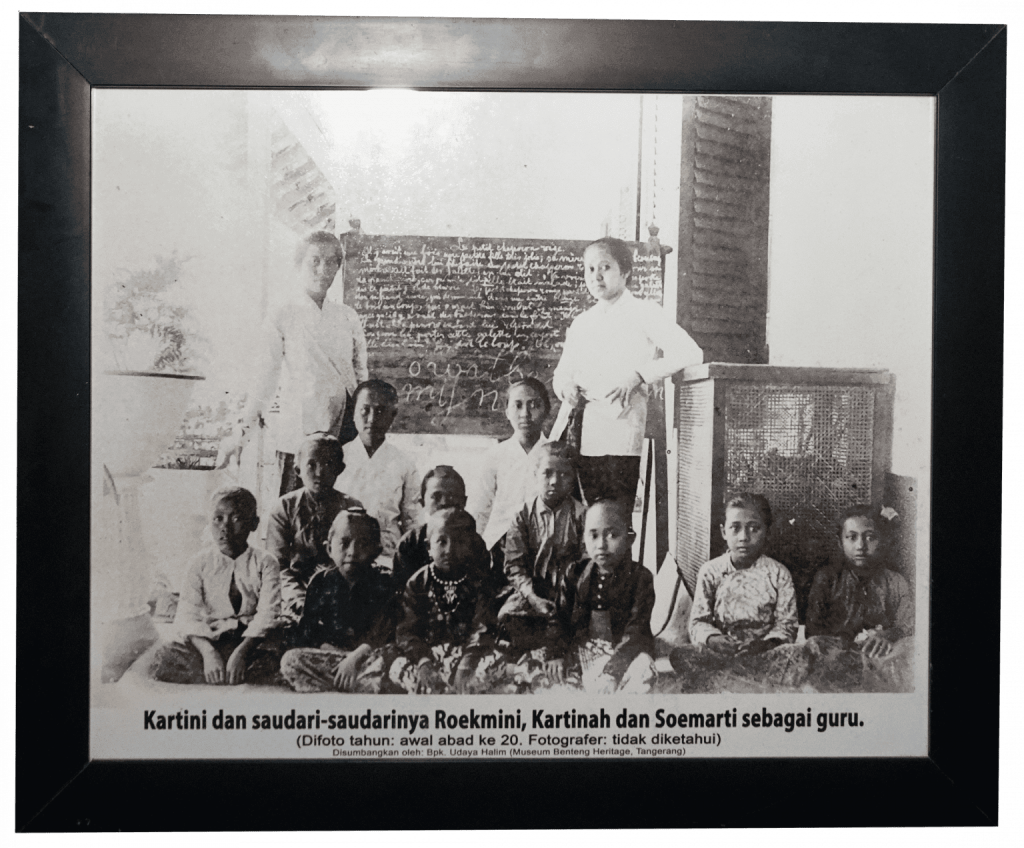
Featured image credit: Undated early twentieth century photograph of colonial era human rights campaigner and educator RA Kartini and her two sisters teaching. Source: RA Kartini Museum, Rembang, Central Java / Foto tanpa tanggal dari awal abad ke-20 yang menampilkan aktivis hak asasi manusia dan pendidik era kolonial RA Kartini dan kedua saudara perempuannya sedang mengajar. Fotografer tidak diketahui. Sumber: Museum RA Kartini, Rembang, Jawa Tengah https://museumkartinirembang.id/foto-r-a-kartini-dan-saudarinya-mengajar/.





 Stories From Indonesia
Leave a Reply