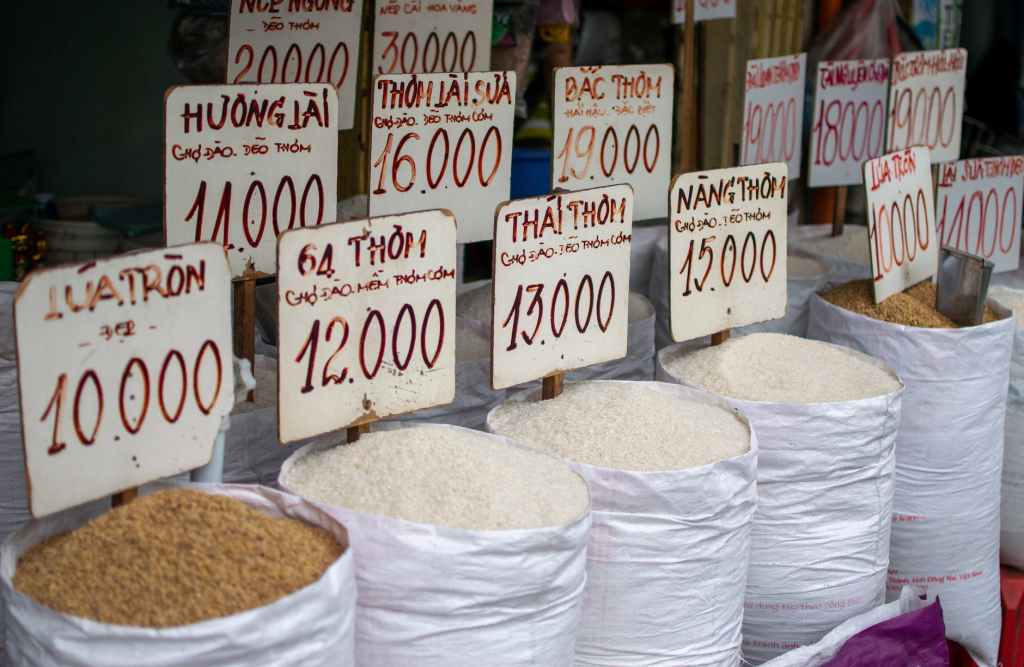
Rising Rice Prices Not as Steep as Other Countries, Claims Indonesia’s President Joko Widodo
By Dian Erika Nugraheny and Ihsanuddin for Kompas.com, January 3, 2024
JAKARTA, KOMPAS.com – President Joko Widodo said the increase in the price of rice in Indonesia was not as bad as in other countries around the world. What is happening now is the world is experiencing a rice price shock, he said.
“There is climate change, there is a super El Nino, and now 22 countries stopped exporting their rice, so there has been a shock in the price of rice and food prices around the world,” said President Widodo in the city of Purworejo in Central Java province on Tuesday (2/1/2024), as reported by a YouTube broadcast from Presidential Secretariat.
“Everyone, every country is experiencing this, but in our country the increase is not as bad as in other countries,” he said. Read more at https://nasional.kompas.com/read/2024/01/03/06105991/jokowi-klaim-kenaikan-harga-beras-indonesia-tak-sedrastis-negara-lain
In earlier news…
Long-Term Planning Essential for Rice Imports
Press Release by the Indonesian National Ombudsman, November 17, 2023
JAKARTA – Mr. Yeka Hendra Fatika, a member of Indonesia’s Ombudsman office, stressed the need for a long-term strategy in forming rice importation policies. He pointed out that these policies have often been crafted without clear indicators.
“The importation of rice demands careful, long-term planning. For instance, considering data from 2000 to 2023, the average annual rice import has been one million tons. To ensure stability, the government could engage in a dialogue with Thailand, committing to purchase five million tons of rice over five years, thereby securing the Government Rice Reserve (CBP). Any surplus could be considered for export,” said Mr. Yeka during a media briefing titled “Public Services in Rice Policy Ahead of the 2024 Election Year,” held at the Indonesian Ombudsman Office in South Jakarta on Friday, November 17, 2023.
Emphasizing the declining trend in domestic rice production, Mr. Yeka highlighted the importance of maintaining ample Government Rice Reserve stocks for national food security. He underscored that the government’s credibility is intrinsically linked to the sufficiency of the Government Rice Reserve.
In 2021, the Ombudsman proposed 12 indicators to guide decision-making in rice importation. Mr. Yeka emphasized that clear indicators would help ensure that rice import policies are grounded in practical conditions rather than political interests.
“I hope that following this discussion, the National Food Agency (Bapanas) will address the issues raised today. The rice problem has been a recurring issue,” added Mr. Yeka.
Concerning food assistance aimed at stabilizing rice prices, Mr. Yeka urged the government to provide aid in a timely way without resorting to postponement (rapel) systems, which can cause uncertainty in communities.
Addressing the persistent rise in rice prices, the Ombudsman had previously urged the National Food Agency to reconsider the effectiveness of the maximum retail price (MRP) policy for rice. However, while suggesting the implementation of the MRP policy for grain at the rice mill level to regulate prices, the Indonesian Ombudsman advocated for regular evaluations to assess the efficacy of removing the MRP policy for rice.
Attributing the continuous increase in rice prices to insufficient rice supply, Mr. Yeka proposed that the National Food Agency introduce an MRP policy for grain at the rice mill level to manage prices at the farmer level.
Mr. Yeka highlighted the closure of several rice mills as an indicator of decreased domestic rice supply, impacting business operators. He called for the government’s stronger involvement in guiding rice mills, beyond merely issuing permits.
Echoing this sentiment, Professor Dwi Andreas Santosa from Bogor Agricultural University’s Agriculture Faculty noted that from 2014 to 2023, domestic rice production had annually decreased by an average of 1%. He highlighted the 2023 production decline of 0.65 million tons, coupled with imports amounting to 3.3 million tons, resulting in an excess stock of 2.65 million tons contributing to the 2024 initial stock of 6.71 million tons.
“There’s an urgent need for quarterly national rice stock data. These figures are pivotal in determining import need and quantity. With transparent data, the government can reassure the public about the genuine need for imports,” explained Prof. Andreas. Additionally, he advocated for the state logistics agency Perum Bulog to support farmers by absorbing rice or unmilled rice.
Meanwhile, Ms. Febby Novita, Perum Bulog’s Business Director, highlighted challenges in absorbing unmilled rice from farmers. She related that the last rice import occurred in 2018, and the current Government Rice Reserve stands at 1.4 million tons, reflecting their focus on maximizing domestic availability.
At the same event, Mr. Budi Waryanto, Director of Food Availability at the National Food Agency, responded to the Ombudsman’s input regarding the evaluation of the rice MRP, indicating deliberations were ongoing. He identified the evolving challenge in food availability as the shifting patterns in planting cycles happening earlier.
This article is based on: https://ombudsman.go.id/news/r/ombudsman-importasi-beras-harus-ada-perencanaan-jangka-panjang and https://money.kompas.com/read/2023/11/17/213000626/bulog–penyaluran-beras-sphp-telah-mencapai-938.475-ton; https://regional.kompas.com/read/2023/11/25/135132678/cerita-pj-gubernur-kalbar-semobil-dengan-jokowi-ditanya-inflasi-dan-curhat
In related news:
- https://majalah.tempo.co/read/sinyal-pasar/171095/inflasi-era-jokowi
- https://bisnis.tempo.co/read/1841779/prabowo-yakin-indonesia-ekspor-beras-empat-tahun-lagi-pengamat-bombastis
- Price of Rice in Cirebon Reaches IDR 450,000 Per Sack, Residents Scream (kompas.com)
- https://nasional.kompas.com/read/2024/02/15/13210591/minta-menteri-atasi-kelangkaan-beras-jokowi-pasar-minta-berapa-pun-beri
- https://money.kompas.com/read/2023/12/05/070845126/copot-buwas-dari-dirut-bulog-erick-thohir-rotasi-biasa
- https://andalpost.com/kampanye-hari-keenam-anies-baswedan-janji-berantas-mafia-pangan-dan-miskinkan-koruptor/
- https://money.kompas.com/read/2023/11/27/094700926/-update-harga-bahan-pokok-27-november-beras-masih-mahal-cabai-dan-telur-ayam
- https://andalpost.com/pemerintah-batalkan-rencana-impor-beras-dari-china-harga-jadi-faktor-utama/



 Stories From Indonesia
Leave a Reply