The Color Purple
By Ratna Indraswari Ibrahim
It is an oppressively humid afternoon, and everyone is drenched in sweat. All the members of Hendrawan’s extended family are sound asleep, exhausted from the previous night’s festivities. The wedding eve widhodharen ceremonies kept everyone up late, celebrating with the bride and groom. Today, at two-thirty in the afternoon, the wedding contract is set to be officially signed.
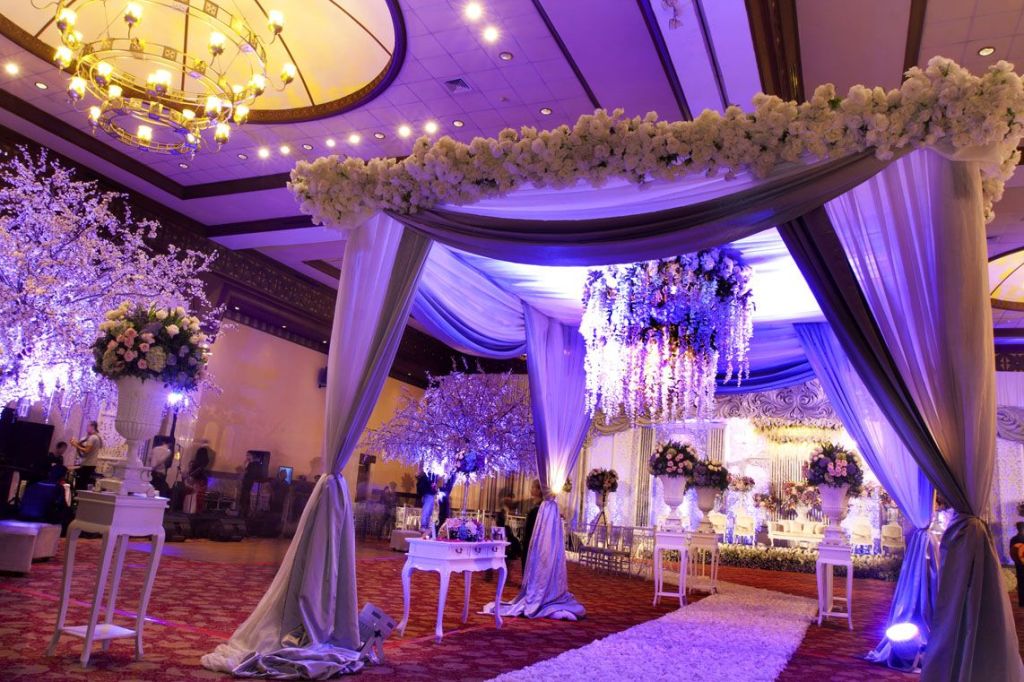
Then, the newlyweds are to proceed to the highly regarded reception center, draped in various shades of purple, the most sought after venue for weddings in the city of Malang.
They are to follow the entire traditional wedding ceremony of the Malang region, and the bride, who does in fact have a fondness for the color purple, is set to wed Indra her college companion from the Faculty of Engineering at Brawijaya University.
The match is considered most felicitous, as Indra and Luke share a harmonious social standing. Born to a Jakarta businessman, Indra was, nonetheless, subjected to a fairy tale scenario akin to Cinderella. Realizing that his son had yet to find a girlfriend, Indra’s father arranged a birthday celebration and invited several young ladies as potential matches for his son.
Among the prospective daughters-in-law, it is Luke who garnered the most favor from Indra’s family.
The townsfolk wholeheartedly endorse the couple, finding them a charming match. Their age is suitable for embarking on a blissful journey as a young couple, and none of their closest friends discern any future discord in their relationship. According to their inner circle, Luke and Indra are an affectionate pair who adore children. In her spare time, Luke takes on the role of a playgroup teacher, often witnessed joyfully engaging with her students alongside her beloved.
Arguments are rare, for Indra and Luke share such similar inclinations for how they prefer to spend their leisure hours. Even in times of disagreement, they seem incapable of causing harm to one another. Prior to her wedding, Luke confides in her friends, “I am not marrying a prince; I am marrying Indra with all his strengths and weaknesses. By the time I turn twenty-one, I wish to embrace motherhood. That I am confident is the right age for me. I do not want my career to consume me to the point of neglecting my children. They represent my future, as well as the future of our nation. I am grateful that the doctor has assured me of my ability to bear children. In truth I have longed to be a mother since the age of eighteen.
Indra is the only person who has genuinely embraced my aspirations. Many young couples fear that having children too early will deprive them of enjoying life together further down the road. But that is not my concern. Since turning eighteen I have prepared myself to avoid becoming overly engrossed in the frivolities of youth. I often purchase books on child-rearing, and even though classical music is not my cup of tea, when I stumbled upon a Mozart symphony, I acquired it. I read an article that claimed classical music stimulates a child’s intellect. It is worth noting that I do not wish to raise my children the way Mama raised me.”
During my childhood both Papa and Mama are consumed by their business affairs. Even though the maid frequently pinches me I never dare to inform my parents. Revealing the torment to Mama will come to nothing; she never believes me. In their presence the maid presents herself as sweet and amiable. Mama believes that her burden as a mother can be alleviated especially as my sister is spared the maid’s pinches. Mama always perceives me as mischievous, unlike my docile baby sister.
To this day I remain uncertain why an enduring resentment towards the maid resides in my heart, permeating every corner of this house. This afternoon she arrived with her grandson. I find no affinity with the child and that perturbs me considering everyone assumes I adore children. Alas I cannot muster affection for this little boy. In his eyes I discern the very eyes of the maid who once inflicted pain upon me. The boy understands my sentiments and promptly requests to depart from my room. I readily oblige swiftly ushering both of them out.
I should to be able to reconcile these emotions. Yet today I find myself somewhat despondent. This week I have been plagued by incessant headaches and unsettling nightmares. One would think I should be elated at the prospect of marrying the future father of my children. Instead a disorienting dizziness grips me once again. I drift off into slumber only to find myself ensnared in a dream where the little boy pounds a drum incessantly beside my ear. I awaken with my stomach churning and an urge to retch. Nonetheless I must appear composed and resplendent today.
Indeed prior to becoming Indra’s bride I have addressed this matter with him on numerous occasions. If we are to have children we must entrust them to someone we can rely on for their care. Thus marriage is an immensely solemn commitment for me. I refuse to replicate the mistakes of my mother who revels in her own world to such an extent. Of course I dare not utter the words, “My mother is selfish.” My life with my two younger brothers was fulfilling beyond measure.
I still recall a time when I was seven years old. I beseech Mama for a pair of roller skates. At the time skates were a rarity in the city of Malang, yet she effortlessly procured a pair for me. I can still picture the wide-eyed astonishment of my elementary school peers who hailed from families of greater means as I glide past them on my skates.
Mama often proclaims, “She is a contented woman.” Papa never raises his hand to strike, unlike his younger sister’s husband, nor is he miserly like his older sister’s husband. However, according to Mama there are no blameless women among her relatives. A man’s faults only reveal themselves after he assumes the role of a husband. Thus marrying a good husband is akin to winning the lottery. Although I sense that I have glimpsed Indra’s imperfections, I believe I can endure them. No person in this world is flawless and I too am far from being a perfect woman.
Yet Mama’s warnings about women who end up with ill-suited husbands haunt me at times. Lately, my closest friend Rita has been lamenting her husband’s frequent bouts of violence. I fear she may be trapped in an unending cycle. Witnessing the bruises inflicted by her husband fills me with dread. Naturally if Indra were to treat me as Rita is treated I would take decisive action. However Mama insists, “Marriage complicates matters.” Rita may have longed to sever ties with her husband but she cannot! I declare, “If I were in Rita’s shoes I would have divorced my husband long ago.”
Mama shrugs dismissing my assertions seemingly unconvinced of my capacity for assertiveness.
This wedding celebration has become the talk of the town in Malang, for the prospective in-laws are successful entrepreneurs determined to adhere to many of Malang’s long-forgotten traditional customs. It is a captivating spectacle. Mr Hendrawan has even purchased a horse-drawn carriage for the couple’s second procession from their home to the reception center. The splendid purple carriage can often be spotted in Mr Hendrawan’s yard captivating the locals of Malang.
Purple will dominate the wedding attire at the reception with the wedding hall adorned in purple, from the bridal seat to the carpets and ornate flower arrangements. Mr Hendrawan has ordered dozens of purple moon orchids as decorations for the reception center. It is their color of choice favored by Mr Hendrawan’s whole family.
Certain rooms in Mr Hendrawan’s house, particularly the one designated for the wedding ceremony, have been painted purple. The bridal chamber is adorned with purple bed covers and decorations. Only during the marriage ceremony itself will the bride and groom wear white brocade attire but their shared shawl shall remain purple. Some claim even their nightgowns are of the same color.
No one in the city of Malang has witnessed such elaborate and costly preparations before, far beyond the means of the majority of its inhabitants.
Then there comes Mbok Pah, wishing only to offer herbal remedies to the bride. Still she is the first to realize that Luke is nowhere to be found. While the others are still deep in slumber, Mbok Pah bustles searching every corner of the house. Finally, with nervous trepidation she wakes Luke’s mother.
“I can’t find Miss Luke, ma’am.”
Luke’s mother, roused from her slumber, springs to attention. “Search until she is found. The ceremony is soon to commence.”
After an extensive search by Mbok Pah, the entire extended family awakens, stammering, “Luke is truly not here!”
Now every relative and friend begins to search throughout the city of Malang but the bride is nowhere to be found.
Panic spreads grips all as the groom and his extended family arrive to join their son in matrimony. The Hendrawan family is left helpless, with tears streaming down one person’s face others are unable to resist the torrent of tears.
At the behest of the groom’s extended family Luke’s uncle reports his niece’s disappearance to the police.
The police meticulously record every detail about Luke and repeatedly inquire, “Is this an arranged marriage?”
“No, they have been dating. Please help us because the reception at the wedding center is only a few hours away and if the bride and groom are not located, every local and national newspaper will carry the story tomorrow. Indra is the son of a successful businessman from Jakarta. This will bring shame upon our entire extended family,” Luke’s uncle asserts emphatically.
The police can only shake their heads for this is indeed an unprecedented case. Nevertheless the officer has close ties with the prosperous businessman, so they dispatch men to search for Luke.
By the time of the wedding reception, Luke remains missing still. The guests whisper amongst themselves, muttering concern about the bride’s disappearance. In fact just an hour prior to Luke’s unexpected disappearance, according to Indra, they were still exchanging text messages. Luke mentioned feeling excessively flushed and suffering from a headache, requesting more powder for her bridal makeup, something she despises. Indra informs the police, “We both agreed wholeheartedly to marry right away and start a family while we are still young.”
They have mutually vowed never to emulate Luke’s aunt who remains unmarried even at the age of nearly 35. Indra often listens as Luke relates about her aunt. “My aunt has a successful career but has never married! I don’t want to be like her. My aunt can’t even figure out how to find baby formula, or take a child to kindergarten or to the doctor.”
However two months before Luke’s wedding, her aunt had proudly announced, “I have just given birth to a child.” Luke’s aunt never divulges the identity of the father. Luke finds this extraordinary and recounts the story to Indra over and over. Nevertheless both Luke and Indra firmly agree to marry legally and embark on starting a family.
Thus it is inconceivable for Luke to vanish without a valid reason. Indra fears that dark forces connected to his father or Mr Hendrawan’s business rivals may be meddling in their wedding preparations. He implores the police and all of Hendrawan’s relatives to search for Luke, to spare her from embarrassment and uncover the truth behind this calamity. Could it be linked to his father’s or Luke’s father’s business rivals?
In front of the police Indra reiterates, “Sir, jealousy always simmers among businessmen and perhaps it lies at the heart of this problem. I am willing to pay any amount to find Luke today! I’m not certain she left the house without a satisfactory reason. What I admire most about her is her rational demeanor and strong will. If it weren’t for her I might not have had the courage to wed.”
Alas Luke is nowhere to be found in the city.
Then after three days Luke appears again at home and recounts her tale saying, “At the time I was overcome by stifling heat and a young child led me outside of the house. Assuming she was one of the children from our extended family, I determined to take care of her. To amuse the child we climbed into one of the pedicabs parked at the front of the house. I anticipated returning by two o’clock, well before the wedding. It was a delightful experience. The child and I had a splendid time. We arrived at a children’s play park, indulged in ice creams, and played on the swings. Then as it neared four o’clock I realized I was late and that the child had wandered off. Panic set in as I frantically searched for the child.”
“I never intended to cause embarrassment. I was simply searching for the child who had assured me she would return momentarily. I feared her parents would worry if I could not find her. It is undoubtedly my fault! Even though I know I should have returned home for the wedding to marry Indra. Yes, the child shouldn’t have wandered off, so we could return home together, and I could become Indra’s bride, bringing joy to my entire extended family.”
“However I couldn’t locate the child and I wept. I worried for her well-being. If she wasn’t found that night, I would have committed a grave sin. Surely her parents would be searching for her anxiously. I should have reported her disappearance to both the family and the police. But fear gripped me and I clung to the hope that the child would reappear at any moment, and then we would have happier days together.”
Luke’s account is met with disbelief. Both sets of parents feel humiliated, and Luke’s boyfriend declares that his family is also deeply embarrassed, leading him to terminate the relationship.
Luke reiterates, time and again, “If the wedding doesn’t proceed it is my fault. In that moment, the child and I filled with bliss, and my worry intensified when she suddenly vanished. Indra, please carefully consider the issue before making a final decision, once you have calmed down. We still love each other.”
For days the townsfolk discuss the failed marriage. Some believe that the Hendrawan family failed to make adequate offerings as they prepared the wedding in accordance with Malang’s traditional customs, provoking the ire of the ethereal inhabitants. They assert that the Hendrawan family should have first conducted a purification ceremony at the wedding venue. The residents of the city believe that to adhere to the complete traditional wedding customs of Malang, proper offerings should be made, and a succession of rituals should be performed, from the widhodharen wedding eve ceremonies to a range of gatherings, until the completion of the wedding.
Meanwhile some friends of Luke and Indra are taken aback, wondering why the couple have abruptly called off the wedding despite their deep love for each other and their unwavering commitment to marrying even before completing their studies.
For days we discuss this matter yet in the end we remain uncertain of Luke’s true state. Some claim they even have no idea of her whereabouts.
As we pass by Luke’s house we are met with the sight of the fence and buggy, adorned in purple, a reminder of what could have been.
Malang, 2004.
Source: Kompas Daily, 11 April 2004, Retrieved from https://cerpenkompas.wordpress.com/2004/04/11/warna-ungu/https://ruangsastra.com/29376/tamu/ and https://ruangsastra.com/29247/warna-ungu/ (Accessed 9 July 2023)
For some background on the author see https://ensiklopedia.kemdikbud.go.id/sastra/artikel/Ratna_Indraswari_Ibrahim and https://www.dandc.eu/en/article/story-ratna-indraswari-ibrahim-prolific-writer-feminist-and-activist-bound-wheelchair


 Stories From Indonesia
Leave a Reply