The Color Purple
By Ratna Indraswari Ibrahim
It is a very sweaty afternoon. All of Hendrawan’s extended family are asleep. The previous night till late they are all with the bride and groom for the widhodharen wedding eve ceremonies. Later today at two thirty the bride and groom will be married. Following that they are to travel to the reception center dominated by the color purple, the most prestigious wedding reception venue in the city of Malang. They are to marry using the entire traditional wedding ceremony from Malang. The bride, who really does like the color purple, is to marry Indra, her college friend from the Faculty of Engineering at Brawijaya University. The match is regarded as most agreeable. Indra and Luke have a completely compatible social status. Indra is the child of a businessman from Jakarta. However, that said, Indra’s father, as in the fairy tale Cinderella, seeing that Indra hadn’t had a girlfriend yet, arranged a birthday party for his son and invited a number of girls as prospective matches for Indra.
For Indra’s family it was Luke who became the most favored potential daughter-in-law.
The townsfolk think they make a lovely couple! Their age is appropriate for becoming a happy young couple. None of Luke’s or Indra’s close friends see any future blemishes in their relationship. According to their close friends Luke and Indra are a couple who love children. Luke fills her spare time as a playgroup teacher. So they often see the couple playing happily with Luke’s students.
They seldom argue. There is too much in common between Indra and Luke about how they like spending their spare time. Should there be a fight it looks as though they aren’t going to hurt each other. In fact before her wedding Luke tells her friends, “I’m not marrying a prince. I am marrying Indra with all of his strengths and weaknesses. When I am twenty-one I want to be a mother to my children. I guess that is the right age for me. I don’t want to be so busy with my career that I forget I have children. Children for me are my future as well as the future of the nation. I’m grateful the doctor says I am healthy enough to have children. I have actually been hoping to have children since I was eighteen. Indra is the only one who has taken my ideals seriously. Many young couples fear that if they have children too soon they won’t have another opportunity to enjoy life together. But I don’t! From the age of eighteen I have prepared myself to not get too caught up in the world of young people. I often buy books about bringing up children. And even though I don’t like classical music, when I came across a Mozart symphony I bought it! Because I read in an article that classical music can stimulate a child’s intelligence. It should be underlined that I do not want to bring up my children as Mama brought me up.
When I was little Papa and Mama were so busy with their business. And even though the maid would often pinch me I didn’t dare tell my parents. If I had told them about the torture Mama would not have believed me. In front of my parents the maid could be so sweet. My mother felt the burden of her children could be reduced, especially as my maid did not pinch my sister. Mama always thought I was so naughty, not like my baby sister.
To this day I don’t know why hatred for my maid is constantly in my heart and in every corner of this house. This afternoon she arrived with her grandson. I do not like that child. I am worried because everyone says I adore children. Apparently I can not like this little boy. In his eyes I see the eyes of the maid who used to hurt me. The boy knows how I feel. He asked to leave my room straight away. I agreed quickly and pushed both of them out of the room.
I should be able to sort things out. I am a little depressed today. I have been having a lot of headaches and some nightmares this week. I should be overjoyed to be marrying the future father of the children. In fact I have been feeling dizzy again. I fell asleep. I dreamed of the little boy beating on a drum right next to my ear. I woke up and wanted to be sick. But today I have to look fit and beautiful.
Indeed before becoming Indra’s bride I have spoken to him about this many times. If we are to have children we should have someone we can trust to take care of them. So marriage for me is a very serious step. I am not going to repeat the mistakes of my mother who enjoys her own world so much. Of course I dare not say, “My mother is selfish.” My life with my two younger brothers was very fulfilling.
I still remember. I was seven. I ask for skates and at the time skates are often not available in Malang city. Mama easily obtains the skates. I still remember how my elementary school friends (whose parents were wealthier I thought) are wide eyed as I glide passed on the skates.
Mama often says, “She is a happy woman.” Papa never hits, not like his younger sister’s husband, or stingy like his older sister’s husband. Still, according to Mama, there is no one to be blamed among her female relatives. The faults of a man only become known after he becomes a husband. So marrying a good husband is like winning the lottery. I feel like I have seen Indra’s flaws. I feel like I can still tolerate his flaws. I believe no one in this world is perfect because I myself am not a perfect woman. But sometimes Mama’s talk about women who wind up with the wrong husband haunts me. My best friend Rita has been complaining lately about her husband who often hits her. I’m afraid she cannot get out of the vicious cycle. I was so scared to see the bruises from her husband’s beatings. Of course I will act decisively if Indra treats me like Rita. But Mama says, “When we are married things are not that simple.” Rita might have wanted to get out of her marriage for a long time but she can’t! I say, “If I were Rita I would have divorced my husband a long time ago.”
Mama shrugs as if she’s not convinced I can be that assertive.
In fact this wedding celebration has been talked about by the townsfolk of Malang because the prospective in-laws are successful business people who are planning to follow much of Malang’s traditional customs, customs not used by the people of Malang for a long time. This is an interesting spectacle. Mr Hendrawan has already bought a horse buggy for the bride and groom’s second procession, from the house to the reception center. The local folk of Malang often see the splendid purple buggy in Mr Hendrawan’s yard.
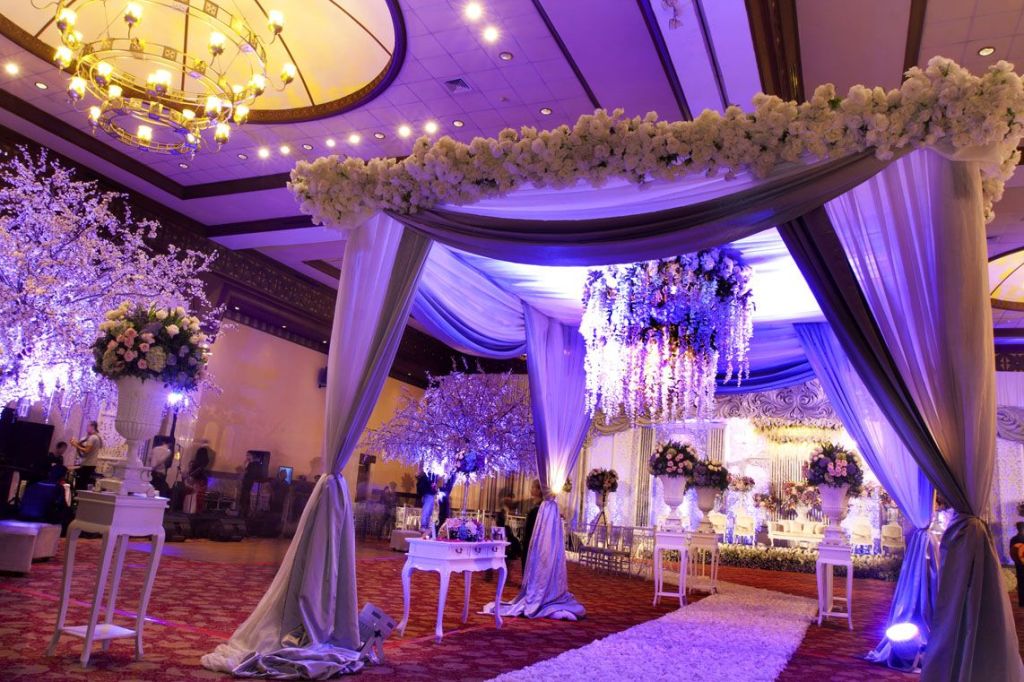
Purple wedding outfits are to be worn at the wedding reception and the wedding reception hall is bedecked all in purple, starting with the bridal seat, the carpets, and the ornate flower arrangements. (Mr Hendrawan orders dozens of purple moon orchids as decorations for the reception center). They choose purple. The favorite color of Mr Hendrawan’s family.
Some rooms in Mr Hendrawan’s house, notably the room to be used for the wedding ceremony, have been painted purple. The bridal bed cover and all of the decorations are purple in the bridal room. Only for the marriage ceremony itself are the bride and groom to wear white brocade, but the shared shawl for both to share is to remain purple. Someone says their two nightgowns are also purple.
Not one person in Malang has seen preparations so complex and costly, preparations that would be difficult for the majority of the residents of Malang to use.
Then there is Mbok Pah. Wanting no more than to offer herbal medicines to the bride, Mbok Pah is the first to sense she can not find Luke. While the others are still deep asleep, Mbok Pah searches all over the house. Finally she nervously wakes Luke’s mother.
“I can’t find Miss Luke, Ma’am.”
Sleepy-eyed Luke’s mother wakes up suddenly. “Look for her until she is found. The ceremony starts soon.”
Finally after Mbok Pah has been searching for some time, the entire extended family is awaken and stammers, “Luke really isn’t here!”
Now every relative and friend searches for Luke all over Malang city. But the bride is no where to be found.
The panic grows wider and wider as the groom and his entire extended family arrives to marry their son. The extended Hendrawan family can barely do anything as one person starts crying and others join in.
At the insistence of the in-law’s extended family, Luke’s uncle reports the disappearance of his niece to the police.
The police record all of Luke’s details, and ask repeatedly, “Is the wedding an arranged marriage?”
“No, they have been dating. Help us because the reception at the wedding center is only a few hours away and if the bride and groom are not found, every local and national newspaper will be carrying the story tomorrow. Indra is the son of a successful businessman in Jakarta. This will embarrass our entire extended family,” says Luke’s uncle emphatically.
The police can only shake their heads. This is the first case of its kind they have come across. But the policeman is very close to the very successful businessman and they send out men to search for Luke.
Luke is not found by the time of the wedding reception. The invitees whisper to each other and some are concerned about the disappearance of the bride. As a matter of fact according to Indra an hour before Luke’s disappearance they were still texting each other. Luke just said she was sweating so much and had a headache, so her bridal makeup needed more powder put on, one thing Luke doesn’t like. Before the marriage plans were confirmed by their parents, Indra tells the police, “We both really did agree to get married soon so we could start a family while we were still young.”
They have both agree they will never imitate Luke’s aunt who still lives alone at the age of almost 35. According to Indra Luke often talks about her aunt. “My aunt has a good career but she never married! I don’t want to be like her. My aunt can not even understand how to find baby formula, or take her to the kindergarten or to the doctor.”
However, two months before Luke’s wedding, her aunt proudly declares, “I have just given birth to a child.” Aunt never mentions who the father of the baby is. Luke sees this as extraordinary and this she often tells Indra about it. But Luke and Indra still agree they would legally marry and then start a family.
So it couldn’t be possible for Luke to leave without a good reason. Indra is afraid that dark forces from his father’s or Mr Hendrawan’s business competitors are interfering with their wedding. Then he urges the police and all of Hendrawan’s relatives to look for Luke so she won’t embarrass herself and to look for the true cause of this disaster. Does this have anything to do with his or Luke’s father’s business competitors?
In front of the police Indra says repeatedly, “Sir, there is always jealousy among business people and perhaps this jealousy is the root of the problem. So I will pay any amount to find Luke today! I am not sure Luke left the house, for no apparent reason. What I am proud of is her rational attitude and strong will. If I had not gone out with her I might not have had the courage to get married yet.”
Luke is indeed no where to be found in the city.
After three days, Luke returns home, and she relates, “At the time I was feeling stiflingly hot and a small child led me outside from the house. I thought I would look after the child, thinking she was one of the children from our extended family. To entertain her we climbed up into one of the pedicabs parked at the front of the house. I expected I would be back at two o’clock before the wedding. It was a wonderful sensation. The small child and I had a wonderful time. We arrived at a children’s play park, had ice creams, and played together on the swings. Then after it was almost four o’clock I realized I was now late to get home, and the child had wandered off somewhere, so I panicked and went looking for her.”
“So I did not mean to embarrass anyone. I went looking for the child who only said she would be a moment. I thought her parents would miss her if I didn’t find her. It is definitely my fault! Even though I know I should have come home for the wedding to marry Indra. Yes, the child shouldn’t have wandered off from me so she and I could come home and I become Indra’s bride, with the joy that could be felt by my whole extended family.”
“Still the child couldn’t be found and I cried. I was worried about the child. If she couldn’t be found that night I would have sinned terribly. For sure her parents would have been frantically searching for her. I should have reported the child’s disappearance to the family and to the police. But I was scared and hoped the child would appear again at any moment and together we would have happier days.”
No one believes what Luke says. Both sets of parents feel humiliated. And Luke’s boyfriend states that his family feels humiliated, and he can not continue the relationship.
Luke says again and again, “If the wedding doesn’t go ahead it is my fault. At the time, the little child and I were so happy and I was so worried because all of a sudden she wasn’t next to me. Really, Indra, you should think through the problem carefully first, when you have calmed down, before breaking off our relationship. We still love each other.”
For days the people of our town talk about the failed marriage. There are some who think the Hendrawan family did not make sufficient offerings as they prepared the wedding in accordance with Malang’s traditional customs, which made the incorporeal residents angry. The Hendrawan family should have first held a ceremony to purify the wedding center. The residents of our city believe that to use the complete traditional wedding customs of Malang they should have first made offerings, performed ritual after ritual from the wedding eve widhodharen ceremonies, gatherings, through till the wedding is complete.
Meanwhile some of Luke’s and Indra’s friends are surprised, wonder why the couple have suddenly called it off, even though they love each other, and are so committed to getting married even when they haven’t finished their studies.
For days we talk about this and in the end we do not know how Luke really is. Some say they have no idea where she is.
Then whenever we go passed Luke’s house we can see the fence and the buggy both decked out in purple.
Malang, 2004
Kompas Daily, 11 April 2004, Retrieved from https://cerpenkompas.wordpress.com/2004/04/11/warna-ungu/https://ruangsastra.com/29376/tamu/ and https://ruangsastra.com/29247/warna-ungu/ (Accessed 9 July 2023)
For a little bit of background on Ratna see https://ensiklopedia.kemdikbud.go.id/sastra/artikel/Ratna_Indraswari_Ibrahim and https://www.dandc.eu/en/article/story-ratna-indraswari-ibrahim-prolific-writer-feminist-and-activist-bound-wheelchair

 Stories From Indonesia
Leave a Reply