
The Dual Function Agenda Behind Changes to Defense Force Law
By Hendrik Yaputra for Tempo.co, May 11, 2023
JAKARTA – Chair of the Initiative Center—a non-governmental organization focusing on democracy issues—Mr. Al Araf views the plan to increase active-duty officers’ opportunities to hold civilian positions through a revision of the Indonesian National Armed Forces (TNI) Law as questionable. The agenda is seen as opening the door for the return of the dual function of the (formally named) Republic of Indonesia Armed Forces (ABRI) that existed during the three-decade rule of the New Order government (1965 to 1998).
Mr. Al Araf pointed out that the substance of ABRI’s dual function involved military involvement in practical civilian politics, aside from handling national defense affairs. Military involvement in practical politics took the form of ABRI officers occupying civilian positions, whether in ministries or state institutions, the House of Representatives, or regional heads. “This, of course, would mark a regression in the course of the 1998 reform movement and the process of democratization in Indonesia, which has positioned the military as a tool for national defense,” he said on Wednesday, May 10, 2023.
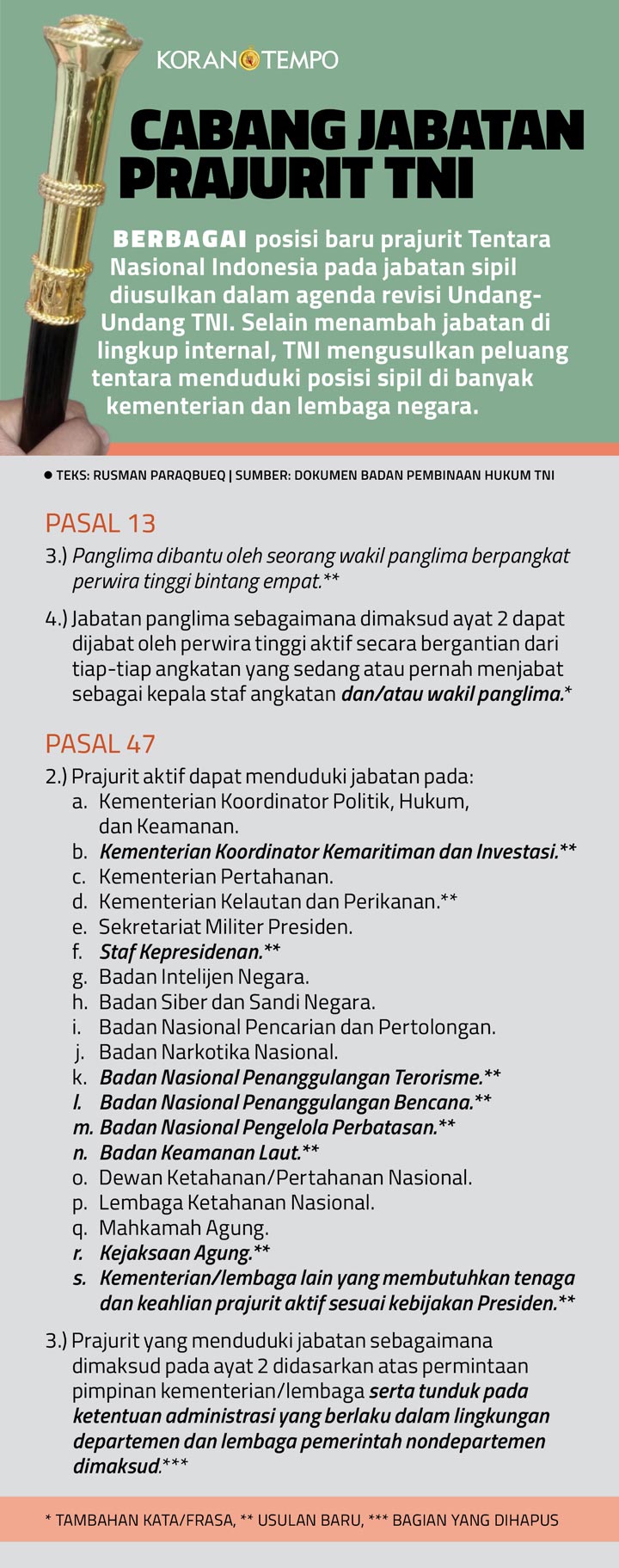
The Indonesian National Armed Forces (TNI) is currently drafting a revision of Law Number 34/2004 Concerning the Indonesian National Armed Forces. According to a draft of the document from the TNI Legal Development Agency of April 2023, it is proposed to expand the range of civilian positions in ministries and state institutions that can be filled by TNI officers from 10 to 19 ministries and agencies.
The expansion of positions available to soldiers is reflected in the proposed revision of Article 47 paragraph 2 of the law. For example, soldiers could hold positions in the National Counterterrorism Agency (BNPT) and the Attorney General’s Office. Moreover, it is proposed that the TNI would be able to hold positions in any ministry or state institution, as long as this aligned with the president’s policy.
Mr. Husein Ahmad, a researcher at the civil society organization Imparsial (Impartial), argued that placing the military outside of its function as an instrument for national defense would weaken the professionalism of the TNI. In a democratic state, he said, the primary function and duty of the military is national defense. The army, he added, is not designed to hold civilian positions. “Professionalism is built by placing the military in its original function as an instrument of national defense, not placing it in other civilian functions and positions that are not within its area of competency,” said Mr. Husein.
Mr. Ikhsan Yosarie, a researcher at the SETARA Institute for Human Rights and the Security Sector, agrees with Mr. Husein. Mr. Ikhsan believes there is currently no urgency to place active-duty soldiers in government ministries and state institutions. Typically, he said, the TNI fills civilian positions during emergencies.
According to him, the proposed points for revising the TNI Law are efforts to revive the dual function of the New Order era ABRI, which breaches People’s Consultative Assembly Resolution No. VI/2000 mandating a separation between the armed forces and the police. However, the TNI should only play a role as an instrument of national defense. “Occupying civilian positions deviates from the proper role and function of the TNI and is a cause of the stagnation in the country’s democratic foundations,” said Mr. Ikhsan.
He argued that active-duty soldiers occupying civilian positions would have difficulty making democratic decisions. This is because military culture applies a command system to its members. Additionally, ministries or state institutions typically prioritize accountability and transparency, which are not compatible with military culture. “Placing active-duty soldiers in civilian positions should happen consistently with the requirements of national defense,” he said.
Military observer Mr. Khairul Fahmi questioned the new proposals in Article 7 paragraph 2 letter b number 19 and Article 47 paragraph 2 letter s. Article 7 paragraph 2 letter b number 19 allows the TNI to carry out additional tasks determined by the president to support national development. Then Article 47 paragraph 2 letter s allows the military to serve in ministries or other institutions according to the president’s policy.
Mr. Khairul considers these two points highly dangerous because it is not known whether the ministries and other institutions referred to relate to the TNI’s area of competence or not. If the ministries and other institutions referred to are not related to the TNI’s areas of competence, it has the potential to bring the military back into politics. “That goes against the mandate of the 1998 national democratic reforms,” said Mr. Khairul.
As for the Executive Director of Imparsial, Mr. Ghufron Mabruri, he believes that expanding the space for soldiers to hold civilian positions is a measure in the direction of legally entrenching erroneous policies. Because, until now, many active-duty TNI soldiers have held civilian positions such as in the National Disaster Management Agency, the Ministry of Energy and Mineral Resources, and State-Owned Enterprises. “Clearly, these placements violate the law,” said Mr. Ghufron.
Old Plan
Over the past four years, the discourse on the placement of active-duty TNI soldiers in civilian positions has sparked controversy. In the 2019 annual TNI Leadership Meeting, then commander of the TNI, Air Chief Marshal Hadi Tjanjanto (2017 to 2021), proposed changes to the structure of the TNI and revisions to the TNI Law. He wanted positions in ministries and institutions at first- and second-tier senior executive level to be occupied by active-duty TNI with a minimum rank of colonel.
This plan was motivated by the over-abundance of high and mid-ranking officers who lacked promotions positions within the TNI. Air Chief Marshal Hadi hoped that expanding civilian positions which were available to be filled by active-duty TNI members would reduce the number of officers without positions, from 500 to 150-200.
At the time the idea sparked criticism from academics and pro-democracy and human rights activists. They believed the plan betrayed the 1998 democratic reform agenda that prioritizes civilian supremacy. They feared that placing active-duty soldiers in civilian positions would serve as a gateway to the return of the military’s New Order era dual function.
After fading into obscurity, the controversy surrounding the plan to place active-duty TNI soldiers in civilian positions resurfaced in public discussion in August last year. This time, it was Minister of Maritime Affairs and Investment Gen. (Hon.) (Retd) Luhut Binsar Pandjaitan (2016 to present) who addressed the issue. The former Commander, Army Doctrine, Education, and Training Command (1997 to 1999) stated that the plan to amend provisions in the TNI Law had been under discussion since he was Minister of Political, Legal, and Security Affairs (2015 to 2016).
According to Luhut, if active-duty TNI officers could be placed in ministries and government institutions, there would no longer be high-ranking TNI officers filling unnecessary positions, thus making the organization more efficient. Senior TNI officers would also not need to vie for positions because they could pursue careers outside the military itself. “Actually, the TNI can play a more direct role, and TNI officers don’t all have to become Army Chiefs of Staff, but they can work in government ministries,” Luhut said during the National Gathering of Retired Army Officers on August 5, 2022.
Stirring controversy once again, this discussion was eventually addressed by President Joko Widodo. “I see that the need for it is not urgent yet,” Jokowi said when answering questions from journalists during his visit to Sukoharjo district in Central Java, on August 11, 2022.
In an academic manuscript completed in 2019, the Ministry of Legal Affairs and Human Right’s National Legal Development Agency (BPHN) also outlined the numerous ministries and institutions requesting the placement of TNI officers. For example, the Ministry of Energy and Mineral Resources (ESDM), in July 2019, requested a change in the Liaison Officer Staff for Maritime Affairs (Susmar) in the Directorate General of Oil and Gas for the 2019-2021 period. There were also requests from the Maritime Security Agency (Bakamla), PT PAL (Persero), the Ministry of Maritime Affairs and Fisheries (KKP), the Coordinating Ministry for Human Development and Culture (PMK), and the Pancasila State Ideology Development Board (BPIP).
Also read: Op-Ed: The Armed Forces, Capital, and Politics By Danang Widoyoko
The number of TNI soldiers placed in 10 ministries and government institutions, has reached 1,481 personnel, with the highest number in the Ministry of Defense. Even before the TNI Law revision proposal, 121 active-duty personnel were placed in institutions outside the 10 ministries regulated by the TNI Law, namely the Maritime Security Agency (Bakamla), the National Counterterrorism Agency (BNPT), and the National Disaster Management Agency (BNPB), the Coordinating Ministry for Maritime Affairs and Investment, the Ministry of Transportation, the Coordinating Ministry for Human Development and Cultural Affairs, the Ministry of Marine Affairs and Fisheries, the Ministry of Ministry of Energy and Mineral Resources, and the Pancasila State Ideology Development Board.
The issue has also come under the scrutiny from the Indonesian Ombudsman office. The agency responsible for supervision of government administration found many active-duty soldiers holding dual positions, serving in both the TNI and ministries or institutions while also serving as commissioners of publicly owned enterprises (SOE). The Ombudsman found 27 TNI officers working as commissioners of SOEs in 2020. The Ombudsman deemed the placement of active-duty officers as commissioners of SOEs to be a violation of Article 47 paragraph 1 of the TNI Law.
Last year the Indonesian Ombudsman again became aware of allegations of maladministration in the appointment of Major General (Retd.) Achmad Marzuki as the acting Governor of Aceh in 2022, which also drew scrutiny from the Ombudsman. Four days before Jokowi appointed him, Maj. Gen. Achmad had resigned from active duty in the military.
HQ TNI Dismisses Concerns
Head of the TNI Information Center, Rear Admiral Julius Widjojono, confirmed that the proposed changes to Article 47 paragraph 2 of the TNI Law were to accommodate various practices that had been ongoing in several ministries and institutions. “Because, when the TNI Law was enacted, these bodies did not yet exist,” said Julius.
Julius also argued that currently many active-duty officers have an understanding of national interests and possess the expertise needed by ministries or government institutions. He also argued that the spectrum of (national security) threats is no longer just military, but also non-military, such as assisting in the handling of the Covid-19 pandemic. “This is not considered to be a dual function as during the New Order era, but rather an advanced civil-military relationship,” he said.
Julius explained that the draft revision of the TNI Law is still an internal concept drafted by the TNI Legal Development Agency. The draft has been presented to TNI Commander Admiral Yudo Margono at TNI Headquarters at the end of April. “It hasn’t been accepted by the Commander yet, (but) it’s just a presentation,” said Julius. “So it hasn’t been sent to the Ministry of Defense yet.”
On the other hand, the Academic Draft of the TNI Bill prepared by the National Legal Development Agency (BPHN) of the Ministry of Legal Affairs and Human Rights outlines several reasons for the need to change the TNI Law, which so far has limited the placement of active-duty military personnel in civilian positions to only 10 ministries and government institutions. This limitation is considered inconsistent with several changes in regulations regarding nomenclature and institutions, such as the law regulating government ministries, and the presidential regulation regulating non-ministerial-level government agencies.
This post is based on https://koran.tempo.co/read/berita-utama/481975/agenda-dwifungsi-di-balik-revisi-uu-tni.
Footnotes:
dwifungsi – Page 95, “In that 1998-2004 reformasi period, the army had given up the most resented aspects of the Dwifungsi (Dual Function) doctrine formulated by General Nasution in 1958—a “middle way” in which the military did not take charge of government but was not simply a professional fighting force. This had been encouraged by the US Army’s doctrine of “civic action” for the soldiery in weak states and then enormously distorted beyond reasonable balance under Suharto. Figures are hard to come by, but in the late 1980s about 16,000 commissioned and noncommissioned officers were in kekaryaan (civilian assignment) positions. At times these military personnel were more than half the senior executives in the civilian bureaucracy and three quarters of the provincial governors and district bupati. Others sat in the national, provincial, and district legislatures.” Hamish McDonald, Demokrasi: Indonesia in the 21st Century, Palgrave MacMillan, 2015 https://archive.org/details/demokrasiindones0000mcdo
In related news:
- https://www.tempo.co/politik/-hasil-revisi-uu-tni-tentara-aktif-akan-lebih-banyak-menduduki-lembaga-sipil-1220723
- https://play.headliner.app/podcast/c83a34f5e5204465b0697e78d4cf3857/episode/cm7vq4a9q000101wb6qkq9x62
- https://koran.tempo.co/read/nasional/487712/bahaya-tni-dan-polri-masuk-sipil
- https://nasional.kompas.com/read/2024/03/23/14380571/panglima-tni-ganti-posisi-kepala-bais-dari-letjen-rudianto-ke-mayjen-yudi
- https://majalah.tempo.co/read/nasional/171114/dwifungsi-tni-jokowi
- https://www.kompas.id/baca/polhuk/2022/01/21/naper-al-araf-dari-pertanahan-ke-pertahanan
- https://www.theguardian.com/us-news/2025/jun/16/trump-conflict-of-interest

 Stories From Indonesia
Leave a Reply