
One Hundred Thousand for Rubbish Art: A Review of Menanam Padi di Langit [Planting Rice in the Sky] by Puthut EA
Blog post by Wahyudin, January 20171
– 9 –
[…] consider the description of Bambang Bujono (Tempo, 11 January 1975): “In neither the invitation to painters to participate in the 1974 Grand Indonesian Painting Exhibition2, nor the guidelines for the exhibition panel of judges can you find a section normally found in art exhibition judging guidelines stating that the decision of the judges is final.
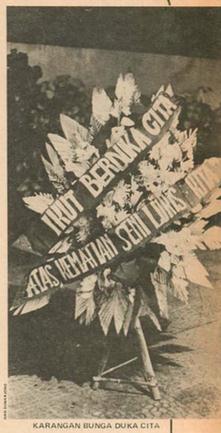
Maybe this was the reason a dispute arose that took the form of the “1974 Black December Declaration3” along with the delivery of a condolence funeral wreath from the community to the Jakarta Arts Council for the “Death of Indonesian Painting”.
This happened on the last night of 1974 which was the closing night of the 1974 Art Festival at the Jakarta Arts Center (Taman Ismail Marzuki or TIM). The condolence wreath wasn’t effective anyway, because the security guards at TIM were the ones who “accepted” the wreath, and they then stored it away in the locked dance studio at TIM.”
Compare this to the description of Miklouho-Maklai (1998: 36-37). “On 31 December 1974, during the Grand Indonesian Painting Exhibition, held biennially at TIM, an incident occurred that marked the start of the New Art Movement4. There was a protest against the judges who had awarded prizes to certain paintings in the form of a condolence funeral wreath emblazoned with the words, “With condolences for the death of our painting”.
The condolence wreath was delivered on the last day of the exhibition when the prizes were awarded to the winners of the competition that traditionally accompanied the Biennial. This was intended to publicize the students’ anger at the judges who, in their view, valued only what they referred to as “decorative and consumerist” painting. The protesters called themselves the “Black December” movement, and it was also supported by students from the Indonesian Academy of Visual Arts (ASRI).”
Look at this photograph:

[…] The first paragraph on page 69 says, “Apart from the wreath, the protesters also wrote a manifesto which a lot of names signed, especially from Bandung, Jakarta, and of course the five people from Yogya.”
The question is who were the “five people from Yogya”? It’s very surprising that even with his overactive imagination the writer of this book is unable to answer this question.
A short explanation on page 67 of the book makes it possible to speculate about the “five people from Yogya”. But the page only names four people, Bonyong, Harsono, Hardi and Nanik Mirna. So who is the person not mentioned? Because the answer is not provided in the book we have to consider the historical facts about the Group of Five Young Yogya Painters.
As I mentioned earlier, according to Harsono (2013), the Group of Five Young Yogya Painters which formed in Yogyakarta in 1973 under the “guidance” of Fadjar Sidik (painter, STSRI “ASRI” lecturer and member of the judging panel for the “Good Paintings” exhibition) was composed of five students from STSRI “ASRI” Yogyakarta, namely Bonyong Munni Ardhi, FX Harsono, Hardi, Nanik Mirna and Siti Adiyati. (Also see Hendro Wiyanto, “FX Harsono dan Perkembangan Karyanya (1972-2009) [FX Harson and the Development of His Work (1972-2009)]” in Re: Petisi/Posisi FX Harsono [Re: Petition/Position of FX Harsono], (2010: 41-187)5; Dermawan T (2013) and Miklouho-Maklai (1998: 33-34)).
They were invited to participate at the 1974 Grand Indonesian Painting Exhibition or Jakarta Biennial I. Apart from them, five other STSRI “ASRI” students were listed in the catalog who were also invited, namely Nyoman Gunarsa, Ris Purwana, Suatmaji, Sudarisman and Subroto SM.
Given these historical facts I hope no reader is tempted to speculate and answer that what was meant by the writer of this book by the “five people from Yogya” is Bonyong, Harsono, Hardi, Nanik Mirna and Siti Adiyati, because such speculation would take one down the road of historical liars and the anti-“Jas merah” [Red Jacket] brigade.
How could it be otherwise, because you need to know that, although they were invited to participate in the 1974 Grand Indonesian Painting Exhibition, there were only four members of the Group of Five Young Yogya Painters who signed the “Black December” manifesto, namely, Bonyong, Hardi, Harsono, and Adiyati. (See Harsono (2013); Dermawan T. (2013); Wiyanto (2010: 70) and Miklouho-Maklai (1998: 36-38)). The one person who did not sign the Declaration, of course you can guess, was Nanik Mirna.
This is why Nanik did not receive the academic sanction of being “suspended without time limit” from STSRI “ASRI” as was the case with Bonyong, Hardi, Harsono, Adiyati, and Ris Purwana. (See “Skors di ASRI”, Tempo, 15 February 19756; Dermawan T. (tt.: 135); Dermawan T. (2013); Miklouho-Maklai (1998: 38) and Dermawan T. (1979: 2)).”
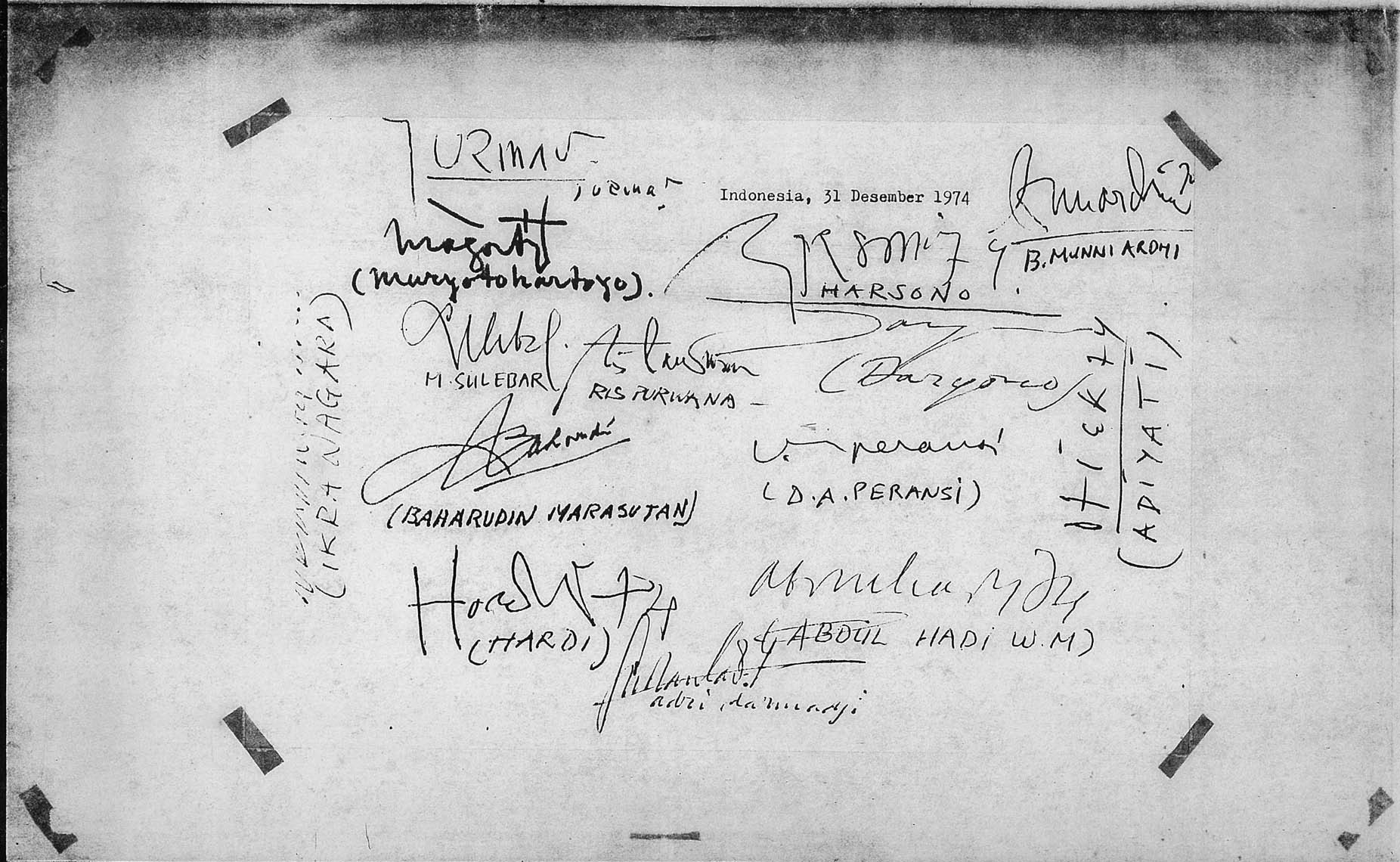

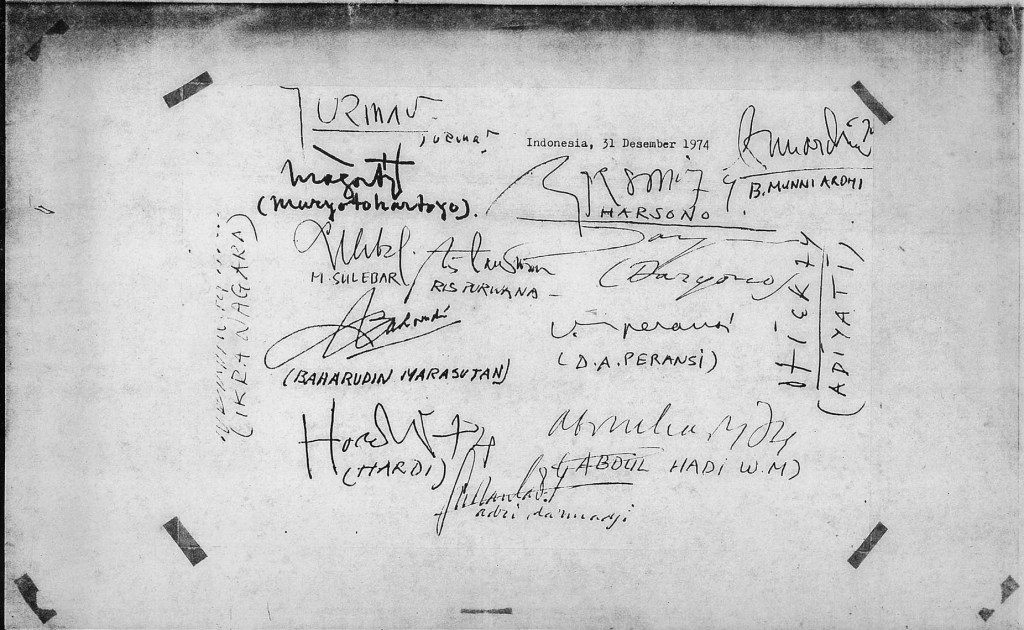
Black December 1974 Declaration
Recalling that over the past few years artistic and cultural activities have been carried on without a clear cultural strategy, we have come to the conclusion that art and culture entrepreneurs do not display a shred of evidence of the slightest understanding of the most fundamental problems of our culture. This is an indication that for some time the development of art and culture has been destroyed by a spiritual erosion.
For this reason we feel the need in this black December of 1974 to declare our opinion regarding the symptoms obvious in the works of Indonesian painting today.
1. That although the diversity of Indonesian painting constitutes an undeniable fact, nevertheless this diversity does not in itself represent a positive development.
2. That for development that ensures the continuation of our culture, painters have a high calling to provide spiritual direction which is based on humanitarian values and which is oriented around the reality of social life and which is oriented towards the realities of social, cultural, political and economic life.
3. That creativity is the essential nature of painters who employ whatever means to achieve new perspectives for Indonesian painting.
4. That therefore the identity of Indonesian painting in itself has a clear position.
5. That what has hindered the development of Indonesian painting to date is worn out concepts that continue to be professed by the establishment, art and culture entrepreneurs, and established artists.
In the interest of saving our painting, now is the right time for us to award an honor on that establishment, the honor of being a retired veteran of the culture.
Indonesia, 31 December 1974
Signed by:
Muryotohartoyo, Juzwar, Harsono, B. Munni Ardhi, M. Sulebar, Ris Purwana, Daryono, Adiyati, D. A. Peransi, Baharudin Marasutan, Ikranegara, Adri Darmadji, Hardi, Abdul Hadi W





Featured image credit: Garuda by Kanva Abas from Fase Perkembangan Sejarah Senirupa Indonesia Bagian 2.
Footnotes:
- Source: Seratus Ribu untuk Sampah Seni Rupa. ↩︎
- The Grand Indonesian Painting Exhibition 1974 at the Digital Archive of Indonesian Contemporary Art. The exhibition catalog. ↩︎
- Images of the Declaration come from Desember Hitam, GSRB Dan Kontemporer; http://archive.ivaa-online.org/khazanahs/detail/2203 ↩︎
- Gerakan Seni Rupa Baru Exhibition 1987 at the Digital Archive of Indonesian Contemporary Art; http://archive.ivaa-online.org/files/uploads/texts/20120400%20The%20Problematic%20Rupture%20of%20GSRB.pdf ↩︎
- Rath, Amanda Katherine. Re: petisi/posisi : F.X. Harsono / Amanda Katherine Rath … [et al.] Langgeng Art Foundation Magelang 2010 ↩︎
- http://archive.ivaa-online.org/khazanahs/detail/3299 ↩︎
Also of interest:


 Stories From Indonesia
Leave a Reply