Surrounded
A Short Story by Mochtar Lubis (1950)
They embrace the ground tightly, hugging the earth as they listen to the sound of another mortar shell flying towards them. The sound—a shrill “whizzz!”—splits the air, then slams into the ground, exploding “kaboom!” As it splits the earth and rips through the air, they are sprayed with dirt and sand, small rocks and grass, brush and branches, and the leaves of bushes, strewn by the shrapnel and now falling like rain.
Then they slowly raise their heads and look around. Their eyes search for who is injured, and then joy lights up in their weary eyes as they see that no one is hurt. Gradually, their bodies and tensed nerves can unwind and relax again because they know they will be safe for another fifteen minutes. The mortars are only being fired once every fifteen minutes. It’s been like this for an hour.
Two men are leaning against the dirt wall of the shallow ditch that was dug out with bayonets and helmets. The shirt of the man without a helmet is dark red below his right shoulder blade, from the blood oozing from the hole where a bullet has penetrated. Blood is still flowing slowly from the pulsing wound, dripping through the blood that has thickened on the material of his shirt. His face is pale and bruised, and on the ground close by lies a Colt pistol, near his right hand, bound to his wrist by a leather strap. The other person lies propped up beside him, moaning. He isn’t hurt, but his dysentery has returned to attack him, and the backside of his trousers is stained red. Even though he was instructed not to join the patrol, he insisted on coming, and in the people’s militia, discipline isn’t tough enough to manage anyone.
The man shot in the right shoulder opens his eyes for a brief moment and glances at the companion leaning up next to him.
“Does it hurt bad?” he asks. His companion just answers with the voice of someone in pain. He closes his eyes again and then a moment later opens them again. He looks at the other three people. He can see the three of them if he turns his head slightly right and left. They’re all taking cover in a shallow ditch for protection, under the bushes growing at the top of a hill, aiming their rifles, taking shots. The sound of their rifles crack and break the quiet at the top of the hill. They are surrounded.
If he looks directly ahead, then through some trees, through the branches and leaves of the scrub growing at the top of the hill, he can see a river flowing just a few hundred meters away. The river water is flowing around the boulders, glistening against the shafts of afternoon sunlight. Not far from the riverbank on the far side, three buffalo are grazing in a field that hasn’t been worked for a long time. The field is overgrown with tall grass and small bushes. About one or two kilometers from where the buffalo are grazing, he can see some people walking along the ridge in the middle of the rice paddies that leads to a village hidden among a cluster of trees: coconut trees, kapok trees, and other trees, like an island in the middle of the flat rice paddies.
“This morning we were still in that village,” he thinks.
And far across the river, where the flat land meets the hills and mountains, he can see smoke billowing into the sky, slowly moving forward.
“The train,” he thinks, and his memories come flooding back.
“Six months ago, we were still riding the train. A brave company of militia fighters — the Wild Cats. Joking in the passenger cars, one of them pats his chest and declares he was able to seize the American-made Garand rifle he’s holding in a fight with the enemy at Bekasi. Another stands up and shows off a Luger automatic pistol. ‘I took this in Bandung,’ he announces. And so it goes on: pants, shirts, shoes, helmets, berets, bayonets, Sten guns. All able to be captured in battle.”
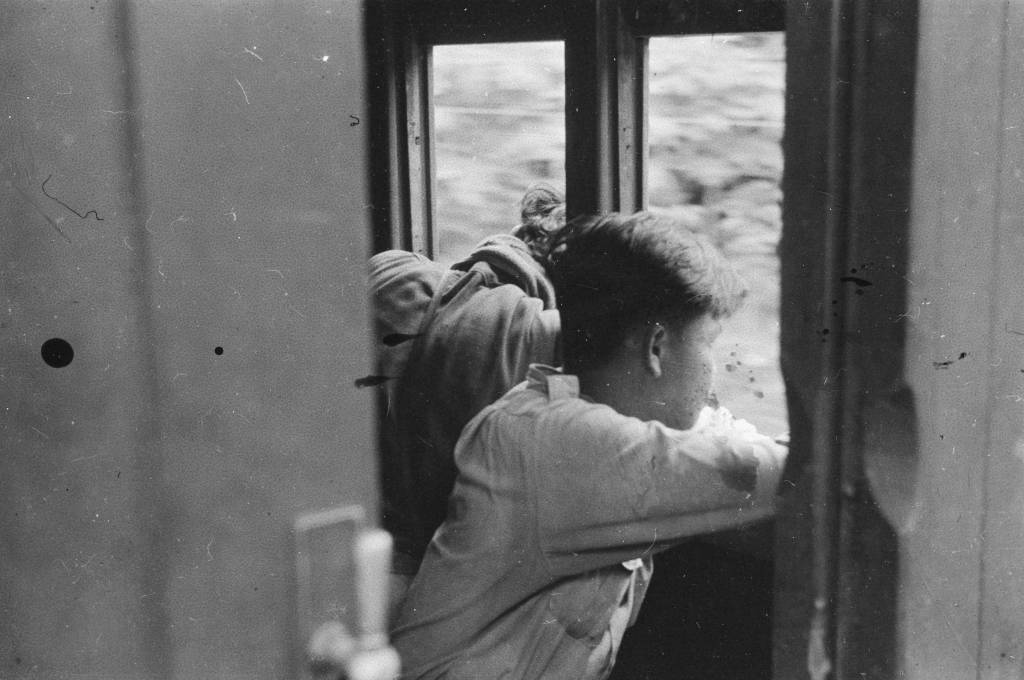
And his memories drift further back. “Ah, so many of us are already dead. Three people died in the attack near Semarang, hit by mortar shells. It was so bad that when they wanted to bury them, you couldn’t tell any more whose hands belonged to who, or the pieces of legs, the bodies, or the pieces of heads scattered around on the ground. Finally, they are collected and buried together, and over the grave, over the pieces of blood-soaked body parts, they plant a sign with all their names. Two people died in a duel. Yes, a duel. And gradually, one by one, they disappear from the Wild Cats militia. Someone dies in a hospital in Surakarta, of pneumonia. Another in Jogjakarta. A few in Magelang, Malang, Cirebon, and Karawang, on the banks of the Bekasi River. From bullets, Purwakarta, Tasikmalaya, Garut. A long list of blood-drenched names. Bullets, the cries of war, the passion of sacrifice, blazing lusts, animal urges, and diseases—they die because there is no one to treat them, because there is no medicine to treat them with.”
Suddenly he bows his head deeply to his chest; the man suffering from dysentery forgets to groan as they both hug the earth and the other three throw themselves down onto the floor of the ditch they’re sheltering in. Another mortar shell comes flying towards them. With a shrill “whizzz!” it splits the air, its sharp sound hitting the ground and exploding with a cracking “thud!” It tears up the earth and rips through the air, showering them with earth, pieces of rock, branches, and leaves from the bushes around them.
“That one landed closer than the last one did,” he thinks.
He glances from the corner of his eye at the man next to him, then he searches for the others. Suddenly, he turns his head sharply as if he’s remembering something, and he looks at the man leaning on the ground beside him. The man has stopped moaning. His head is drooping on his shoulder. He pulls up the man’s hair and turns his head, and at that moment he knows. He is dead. One side of his head has been torn apart by a mortar fragment. The iron fragment of the mortar shell is fixed in the ground behind the man’s head. When he tries to pull it out, he quickly jerks his hand away. It’s still hot. The sight is not a new one for him. He’s seen this many times. He releases the man’s hair, and the head that’s been torn off on one side rolls back onto the man’s shoulder.
He closes his eyes for a moment. He wants to scream, but sound refuses to come out of his throat. He licks his tongue against his dry, dirt-covered lips, but that too does not help. He swallows to get rid of the stony taste clogging his throat, but that also does not help. He leans his head against the wall of his earth shelter and he closes his eyes.
He does not know how long his eyes are closed. He does not know that he’s fainted, been unconscious, and that the fingers of his memory have leafed back through the pages of the book of his past…
There is a young girl, only sixteen years old, who is always standing and waving at the train, at each train that passes in front of the house of her father, who is the station master. The station master’s house stands near the railway, with a bamboo fence, and as each train passes, the girl runs out, waving at the train. Every time they pass on the train, the girl is never not standing, leaning against the fence, waving. Finally, the girl’s face is etched into his mind, clear as a portrait. Time passes, and the girl’s waving is for him alone, not for the whole train. The girl’s laughter is for him alone. And for a long time, he has the feeling they have promised to meet like that each time he passes on the train. A few times, he gets off the train. He gathers the courage to go to the station master’s house to speak to the girl. But he never does. “She doesn’t know who I am,” he thinks.
Then he is jolted back to consciousness. He slowly opens his eyes. All he can see is a tiny red ant crawling on his chest. That is all he can see because his head is hanging on his chest, and he no longer has the strength to lift his head; only he does not know this. And then he passes out again. But he is not aware of this either.
…the train’s whistle screeches its request for the signal to open. A moment later, the train stops at the little station, and he steps down. This time I will go to her, he thinks. He walks quickly to the station master’s house. He sees the station master’s daughter still standing there, leaning against the fence, waving to the train that is stopped at the station. But as the girl sees him approaching, she turns to look at him, and a smile comes over her lips.
He is standing shyly in front of the girl.
“It’s taken you such a long time to arrive,” the girl says to him gently.
He raises his head, happy.
“You’ve been waiting for me?” he asks, full of expectation.
“Why, yes. Why else would I be running out every time the train goes past? I am always hoping you will go by.”
He steps toward the girl, and she takes his hand. He embraces her, bowing his head slightly and bringing his lips slowly toward hers. With a sense of wonder, love, and respect. Then the shrill whistle of the locomotive cuts through the air, deafening his ears, and the rumble of the train’s wheels clashing against their iron rails draws nearer and nearer. Through the commotion, the girl’s voice asks, “The train is leaving. Don’t you have to go?” And he whispers, “No, I’m going to stay here with you.” A feeling of intimate happiness fills his heart. Through the sound of a deep, strong beating, his lips touch the girl’s; a feeling of joy descends, enveloping his heart and glowing all over his body from the inside and outside, as if the sun is shattering and scattering about the two of them, embracing, supporting, and taking them high into the realm of freedom and happiness…
The hissing scream of a flying mortar tears through the air, falling right in the ditch where he is sheltering. It explodes in dazzling white flames like the sun exploding, enveloping, drowning, encircling. Then there is silence. Silence, darkness, dimness, and disappearing. Disappearing. Drifting away. To somewhere.
Not long after, a group of men in green shirts wearing helmets like American Marine helmets stands at the top of the hill and looks down at the five corpses lying among the shredded bushes. Two are beyond recognition, crushed in the ditch. Among the pieces of body parts, there is a piece of a hand severed at the elbow, half sunk in the ground. From the wrist, a leather strap is tied to a Colt pistol.
Then the group moves back down the hill and disappears into the darkness. The sky glows red where the sun has slipped below the horizon. The flashes of sunlight on the surface of the water flowing in the river have disappeared. The buffalo that were grazing in the rice fields on the far bank have made their way home to their stalls. From behind the hills and mountains to the west, nightfall is rapidly descending.
Source: Surrounded (Terkepung) is a story from the short story collection of Lubis, Mochtar. Si Djamal : dan tjerita2 lain / oleh Mochtar Lubis, Gapura, Djakarta, 1950, h. 70.
Featured image credit: Excerpt showing an Indian 3-inch mortar team setting up their weapon, from Ambonese Roadblock, Release of Dutch Internees and Exhumation of Bodies, 35mm film, IWM JFU 443, https://www.iwm.org.uk/collections/item/object/1060030361.
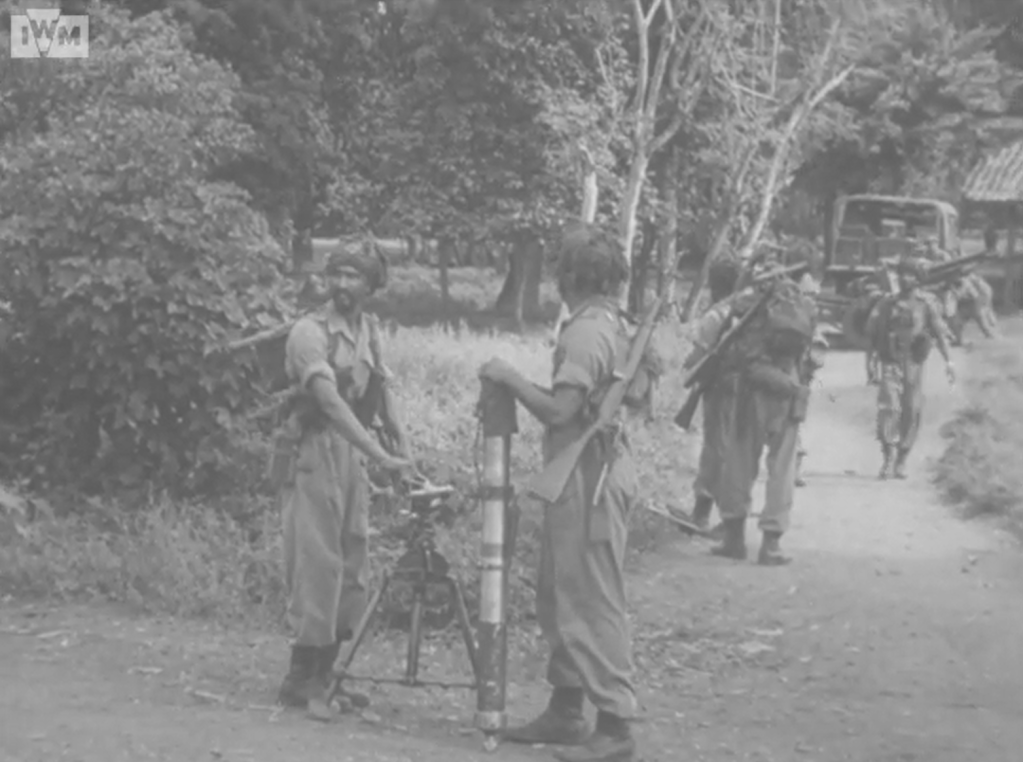
Sumber: https://www.iwm.org.uk/collections/item/object/1060030361



 Stories From Indonesia
Leave a Reply